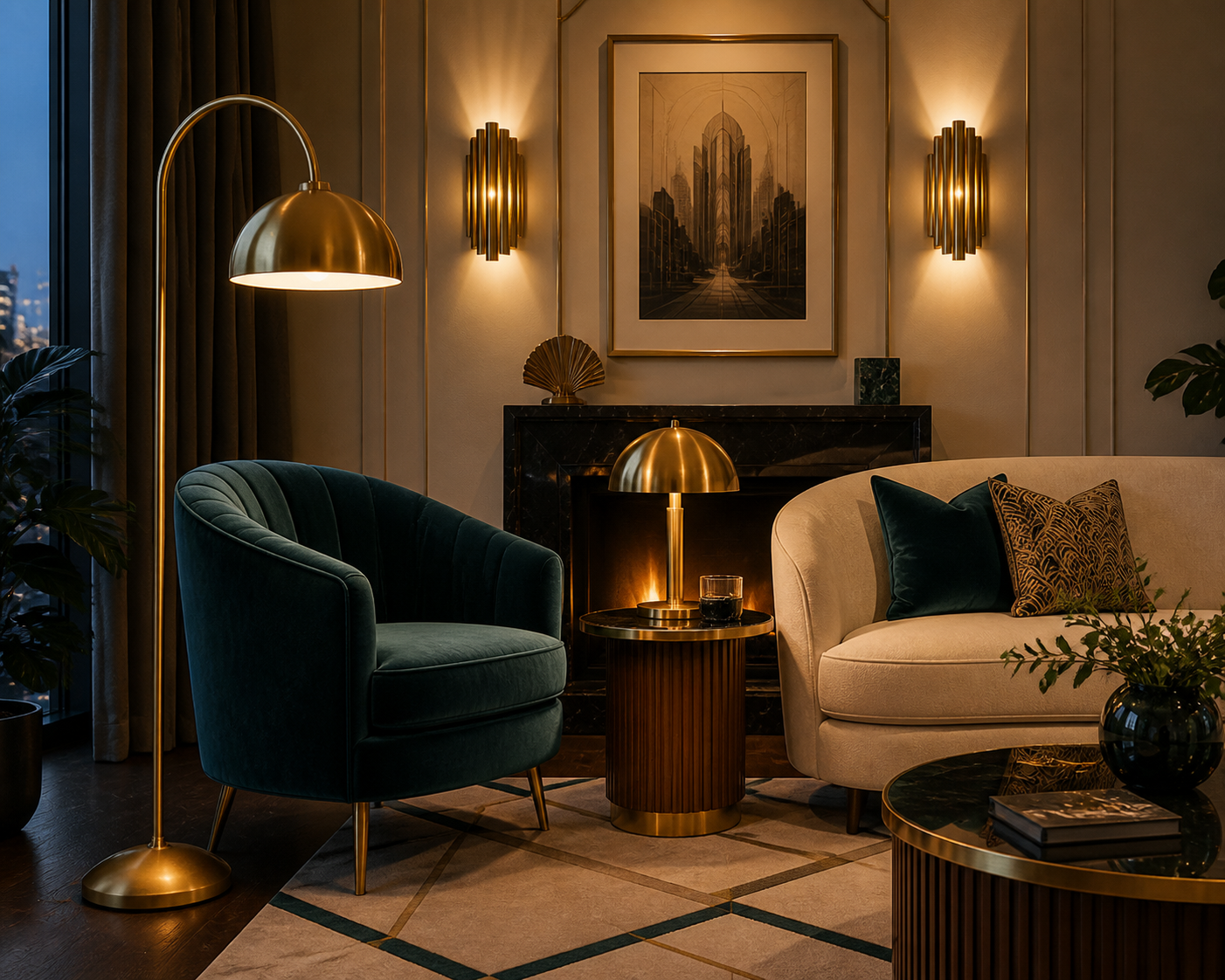

Lighting is the unifying material in this living room. Two fluted wall sconces flank the artwork above a dark fireplace, an arched floor lamp reaches over the green chair, and a compact dome lamp sits on the central side table. Their brass-toned surfaces distribute warm highlights at three heights, binding furniture and architecture into one evening composition.
The room does not depend on matching every fixture. Each type performs a different spatial role and carries a distinct silhouette. Repeated metal tone, controlled symmetry around the fireplace, and curved furniture create coherence. This is a more convincing Art Deco strategy than applying the same geometric motif to every object.
Twin Sconces Frame the Fireplace Axis
Vertical fluted sconces sit at equal distances from the central artwork and send light both upward and downward. Their placement widens the perceived fireplace wall, while the repeated ribs provide fine detail against broad pale panels. The dark fire opening remains the visual base beneath their warm pools.
Because the sconces are symmetrical, the artwork can stay narrow and centered. The arrangement gives the rear elevation formality without filling the mantel with objects. Light itself becomes part of the frame around the picture and fireplace.
The Arched Floor Lamp Reaches into the Seating Group
A tall curved stem rises beside the green chair and brings a dome shade inward over its front edge. The base remains outside the primary rug field, while the light reaches the occupied area. This solves illumination without placing another small table beside the chair or suspending a fixture over the whole room.
The arc echoes the chair's rounded back and the cream sofa's curved end. Its polished-looking shade catches more reflected light than the upholstery, giving the left side enough brightness to balance the glowing fireplace at center.
A Small Table Lamp Creates an Intimate Middle Layer
The central lamp stands on a round ribbed side table between chair and sofa. Its low dome directs attention to the shared reach zone and bridges the height difference between fireplace sconces and floor-level furniture. A glass and small object remain beside it without crowding the tabletop.
Repeating a dome shape at floor and table heights could become literal, but their scales are markedly different. The floor lamp defines a broad arc; the smaller lamp creates a compact pool. Function, not simple repetition, distinguishes them.
Curved Seating Keeps the Lighting Composition Fluid
A deep green chair and cream curved sofa face inward across the small round table. Their contrasting values create two distinct masses, while green cushions repeat the chair color on the sofa. The arrangement keeps the fireplace visible between them and leaves the lamps attached to actual seats rather than floating at room edges.
A second round table appears partly in the foreground, extending the ribbed dark-and-brass language. Its position crops into the scene but does not interrupt the chair-to-sofa relationship. The pattern of circles softens the fireplace's rectangular geometry.
The Rug Converts Metal Highlights into a Floor Pattern
Dark green and warm narrow lines cross the pale rug in a geometric arrangement. Those accents repeat the chair, cushions, and brass-toned lighting at floor level. The rug therefore connects the room vertically instead of serving as an unrelated decorative layer.
Evening Contrast Gives Every Source a Clear Job
Blue light appears through the tall left window, while curtains and wall panels remain dark enough for warm fixture pools to register. The fireplace adds a low central glow. This contrast reveals how the room might operate after daylight fades, when a flat ceiling wash would remove much of its depth.
The practical principle is to place light where the composition changes: sconces at the architectural axis, a floor lamp beside the independent chair, and a low lamp at the shared table. Repeat one metal family, but vary height and silhouette. The result feels collected and functional rather than purchased as a set.
Thin metal inlays rise through the pale wall panels and extend the warm highlights beyond the fixtures themselves. These narrow vertical accents connect the sconces to the ceiling line, while their spacing remains wide enough that the central artwork still controls the axis. Dark curtains at the window provide a quiet edge to that luminous wall composition.