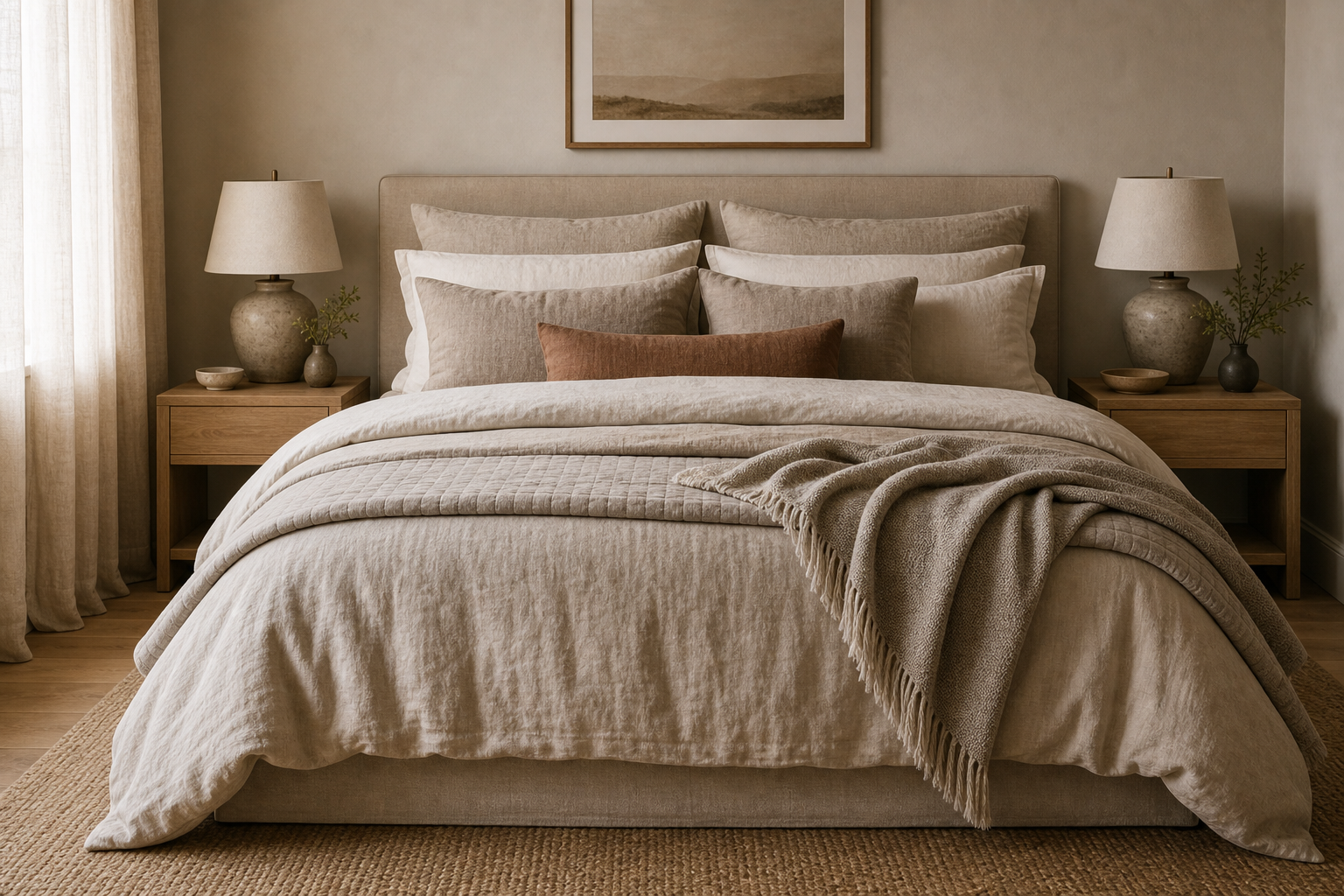

The bed carries nearly all of this room's visual texture, yet the layering remains controlled. A pale upholstered headboard supports two rows of large neutral pillows, smaller taupe cushions, and one long muted-rust lumbar pillow. Below, a light duvet folds over a quilted coverlet, while a coarse fringed throw crosses the lower-right corner rather than covering the entire bed.
Warm-neutral design often becomes flat when every textile matches exactly. Here, ivory, oatmeal, greige, taupe, and soft brown shift subtly from layer to layer. The differences are reinforced by smooth, crinkled, quilted, and loosely woven surfaces, allowing the composition to gain depth without relying on high-contrast pattern.
The Pillow Stack Builds Height in Clear Steps
Two large pale sleeping pillows sit closest to the headboard and rise above a second, slightly lighter row. Smaller taupe cushions overlap them at the center. Each layer decreases in height and width as it moves forward, so the upholstered border remains visible around the stack.
The arrangement is full but not wall-to-wall. Narrow gaps remain at both ends, connecting the headboard to the nightstands and preventing pillows from appearing wedged into the bed width. Exact fabric fibers are uncertain; the useful observation is the stepped proportion and tonal separation.
One Rust Lumbar Pillow Gives the Palette Direction
A long muted-rust cushion occupies the front center and provides the composition's only concentrated warm color. Its narrow horizontal shape echoes the headboard and mattress width without repeating the square cushions behind. Because the accent appears once, it reads as intentional rather than thematic.
The rust tone relates to the timber nightstands, lamp bases, floor, and landscape artwork. That connection lets a small textile organize colors already present around the bed. Adding the same accent to every layer would reduce the subtlety that makes the neutral arrangement convincing.
Duvet and Coverlet Form Separate Horizontal Bands
The main pale duvet creates a generous soft roll near the pillow line and falls loosely toward the floor. Beneath it, a quilted coverlet forms a flatter band with visible square stitching. Their differing thicknesses make the lower bed readable as layers rather than one oversized cover.
The coverlet projects at the sides while the duvet turns back across the top, exposing both textures. This is a practical styling move visible in the scene: fold the upper layer far enough to reveal the one beneath, but retain enough overlap that the bed still feels cohesive.
The Throw Introduces an Asymmetrical Finish
A heavy taupe throw lies diagonally across the lower-right corner with a fringed edge falling toward the floor. Its irregular folds interrupt the otherwise centered bed and introduce the deepest textile tone. The left side remains mostly uncovered, keeping the quilted band visible.
This off-center placement gives the bed a lived-in quality without disturbing the careful pillow arrangement. The throw is substantial enough to hold its shape but does not climb into the lumbar cushion. It occupies a distinct lower layer rather than becoming another central stripe.
Paired Nightstands Extend the Bed's Symmetry
Matching timber-toned nightstands flank the upholstered bed with open lower shelves and one broad drawer each. Large ceramic lamp bases and pale shades rise to similar heights on both sides. Small bowls and branch vessels vary the surfaces without changing their balanced mass.
The nightstands are separated from the mattress by narrow gaps, which preserve the upholstered bed outline. Curtains at the left and darker wall at the right create different side conditions, so the repeated furniture gives the center necessary stability.
Soft Daylight Reveals Tonal Differences
Full-height pale curtains filter window light across the left side of the bed, making folds and quilt stitching more apparent than color contrast alone would. The right lamp and shaded wall produce a deeper gradient on the opposite side. Together they show how neutral layers depend on directional light to remain dimensional.
To recreate the look, begin with two broad bedding layers of different construction, stack pillows in decreasing heights, and reserve one muted accent for the front. Add a throw asymmetrically so lower textures remain visible. The bed feels generous because every layer has a distinct edge, scale, and tonal role.
The woven rug extends beyond the bed on both sides, giving the generous bedding a stable floor boundary. Its warm coarse texture relates to the throw without repeating the same weave.