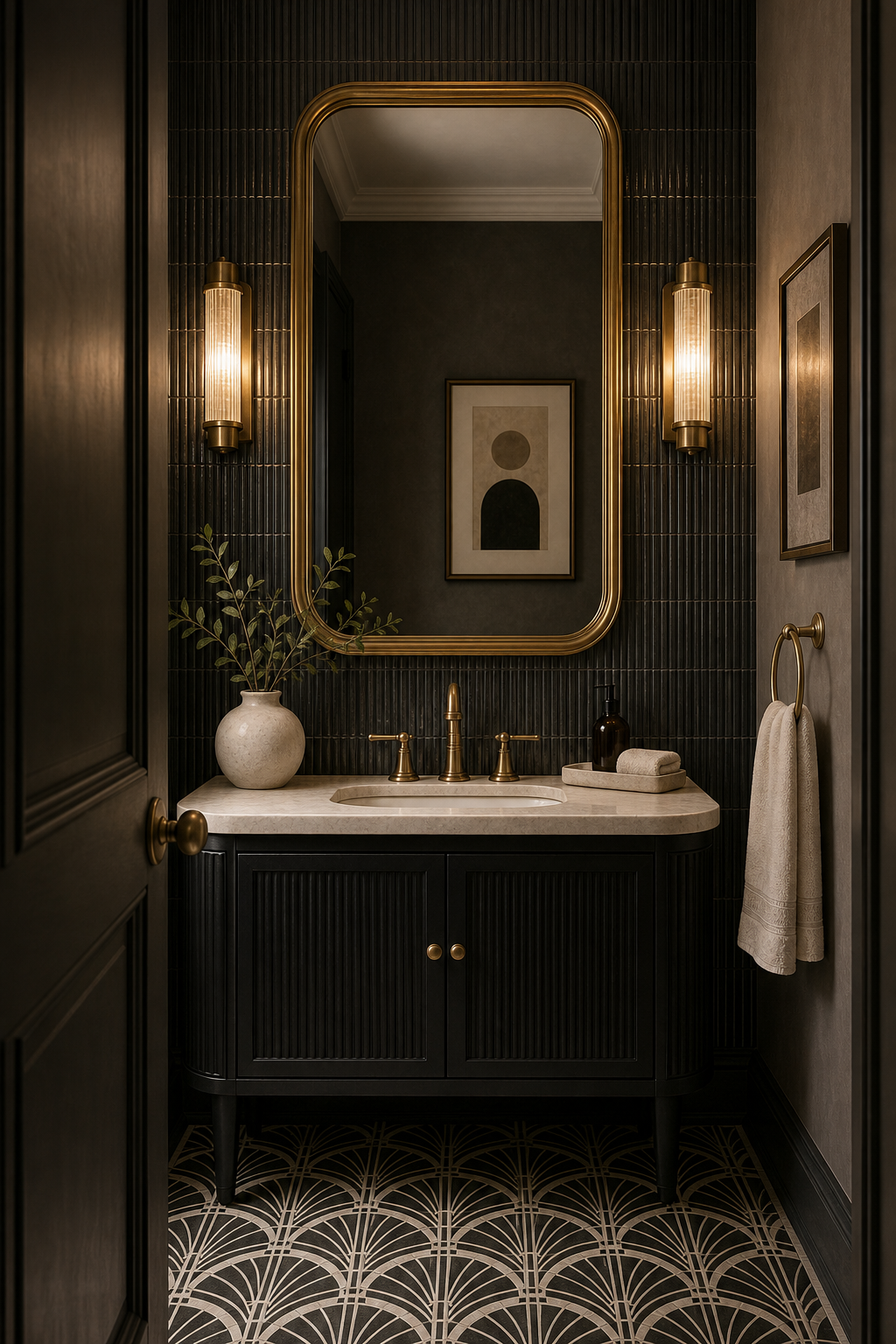

The tall brass-framed mirror gives this compact powder room its glow and vertical emphasis. Its softly rounded top rises from the vanity backsplash toward the ceiling, standing out against a dark fluted wall. Two slender brass-toned sconces flank the frame, so reflection and light operate as one composition rather than separate fittings competing within a narrow space.
Below, a dark vanity blends into the wall and allows the pale basin top to form a crisp horizontal break. The geometric floor supplies pattern at the lowest level, where it can animate the room without interrupting the mirror silhouette. Brass is repeated in controlled lines, while black and off-white carry the larger surfaces.
The Mirror Uses Height to Enlarge the Wall
The frame is narrow and extends well above the sconce midpoints, drawing the eye upward through the small room. Its rounded upper corners soften the vertical rectangle and reflect the doorway behind, adding perceived depth. The mirror is neither a wide vanity panel nor a decorative miniature; its proportions suit one basin and one user while making the wall appear taller.
Paired Sconces Build an Even Frame
Each wall light uses a slim brass-toned body and elongated glowing shade. They sit at matching heights with clear gaps from the mirror edge, creating a symmetrical bracket around the reflection. The image conveys warm light but cannot establish bulb temperature or output. Their most visible success is geometric: narrow vertical lights echo the mirror without becoming parallel lines of equal size.
Fluted Wall Texture Holds the Dark Palette
Fine vertical grooves cover the wall behind the vanity and continue beyond both sconces. Highlights catch the ridges, preventing the near-black surface from becoming flat. This texture also relates to the vertical mirror and light fittings at a smaller scale. The precise wall material is uncertain, so its depth and rhythm are more reliable design observations than a specific product claim.
The Vanity Recedes Beneath a Pale Basin
A compact dark cabinet sits below a pale rectangular basin or top, with a slim warm-toned pull visible across the front. Dark doors merge with the wall, while the lighter upper plane marks the usable washing surface. A plant, soap container, and small pale vessel stay close to the outer edges, leaving the central basin area clear.
Geometric Flooring Carries the Deco Pattern
A repeating fan-like or scalloped motif spreads across the floor in dark and pale tones. Its curved geometry echoes the mirror top but remains much finer in scale. Concentrating pattern underfoot allows the narrow wall composition to stay legible. A large patterned wallpaper behind the mirror would compete with the fluting and weaken the clean brass outline.
Brass Appears as Edge, Not Mass
Warm metal is limited to the mirror frame, sconces, faucet, and cabinet detail. None occupies a broad solid area. This controlled use prevents the room from feeling theatrical while still delivering the unmistakable Art Deco contrast of gold-toned lines against black. The quiet luxury bathroom mirror study takes a softer approach; this powder room relies on sharper contrast and vertical repetition.
Small Scale Rewards a Single Strong Elevation
Only the washstand wall is shown, and it contains enough architecture, light, reflection, and pattern to complete the room's identity. No storage tower, shower, bath, or additional fixture should be imagined beyond the frame. For a similarly compact powder room, concentrate budget and precision on the one elevation seen from the doorway. Alignment between basin, mirror, and sconces will have more impact than adding several disconnected decorative features.
The dark vanity and wall are close in value, yet a narrow shadow beneath the basin top keeps them from merging completely. The pale top projects beyond the cabinet sides and gives soap and the small vessel a defined landing plane. Brass fittings then cross this black-and-white division in fine lines, connecting mirror and basin without creating a broad metallic surface. The composition is successful because every contrast changes at a precise edge rather than dissolving into decorative shimmer.
The mirror reflection is tightly edited, showing a pale doorway and small framed work rather than another busy vanity wall. This borrowed depth makes the powder room feel connected to the adjoining space while the brass frame maintains a firm visual boundary.