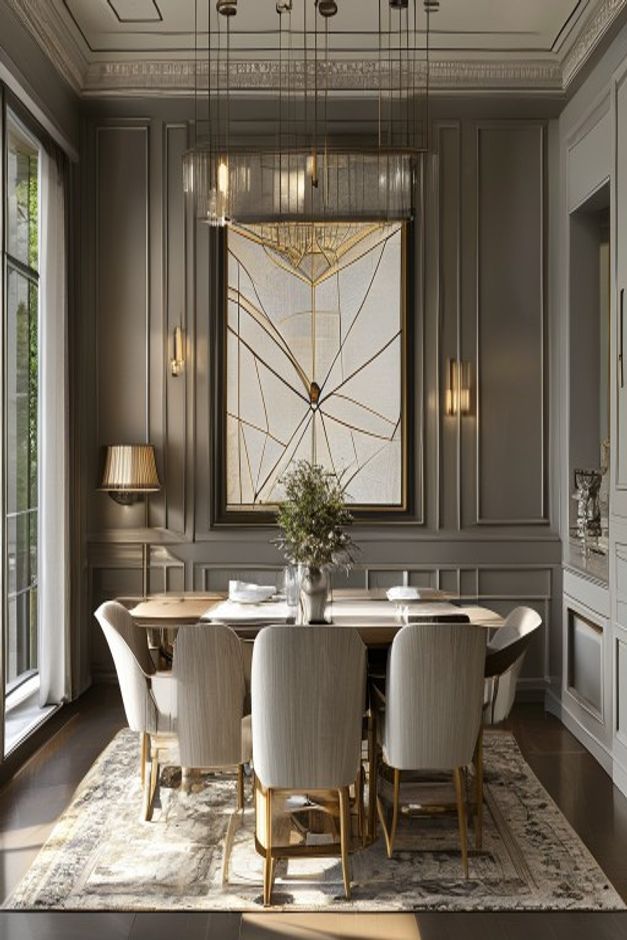
The wall treatment, not the table, defines this dining room. A large geometric composition occupies nearly the full central bay, combining dark fields, pale panels, and slender brass-toned lines. Its scale makes the dining group feel intentionally placed in front of an architectural backdrop rather than set against an unfinished wall.
The rest of the room responds with discipline. Six pale upholstered chairs form a low horizontal band, a cluster of hanging lights marks the table center, and dark side panels frame the artwork. Even the narrow side window is absorbed into the larger rhythm instead of becoming a competing focal point.
One Graphic Wall Sets the Room's Proportions
The artwork or decorative panel is substantially wider than the table and rises well above chair height. That generous relationship is what gives it architectural force. A smaller framed piece would leave too much inactive wall around the dining group and weaken the sense of ceremony.
Its internal lines change direction, creating a sequence of rectangles and diagonals rather than one predictable grid. The composition remains controlled because the palette is limited. Dark brown or black areas anchor the edges, pale areas bring relief, and metallic-looking lines provide crisp separation.
The graphic panel's strongest diagonals converge above the table rather than drifting toward a corner. That internal direction brings attention back to the dining group and makes the wall active without appearing random. Narrow metallic-looking lines remain accents; broad dark and pale fields carry the composition's weight.
Dark Paneling Gives the Artwork a Deliberate Frame
Deep wall panels surround the central graphic and continue toward the corners. Their vertical joints establish a quieter rhythm behind the more animated geometry. This is a useful contrast: one layer supplies order, while the other introduces movement.
The lower wall stays visually continuous behind the chair backs. There is no unrelated console or collection interrupting the main elevation. By refusing a second display layer, the design lets the wall art remain the clear reason for the room's Art Deco identity.
Upholstered Chairs Form a Soft Counterweight
Six light chairs surround the rectangular table with closely aligned backs. Their curved top corners and padded surfaces soften the hard-edged wall pattern. Because the upholstery is pale, the seating reads as one calm band rather than six isolated silhouettes.
Dark legs connect the chairs to the wall panels and floor, while the lighter seats relate to the graphic's pale fields. That color exchange keeps the foreground from feeling detached. It also allows the substantial table to sit quietly between two stronger horizontal layers: the chairs and the artwork.
The Pendant Cluster Marks the Table Without Hiding the Wall
Several small pendant forms descend over the center of the table at different points. Their narrow drops create sparkle and vertical emphasis without forming an opaque fixture across the artwork. The spacing preserves sightlines to the graphic from the opposite side of the room.
A published quiet luxury dining room lighting study uses a restrained stacked fixture. This Art Deco room takes the opposite approach: multiple slender drops echo the wall's linework while still keeping the background readable.
Side Light Prevents the Dark Envelope From Feeling Flat
A tall window at the side brings natural light across the chairs and catches the raised edges within the wall composition. The result is a dark room with visible depth, not a uniformly shadowed box. Small wall lights add further highlights along the paneling.
Sconces occupy the darker side panels at a lower intensity than the pendant cluster. Their small pools of light reveal the panel joints and keep the outer wall from disappearing. This secondary illumination broadens the room visually while leaving the central artwork and table as the primary sequence.
The Rug Defines a Precise Dining Zone
A pale rectangular rug extends beneath the table and all chair positions. Its quiet surface establishes a clear floor boundary while reflecting light back toward the upholstered seats. The margin around the chairs appears broad enough for the group to read as complete even when viewed at an angle.
The most transferable decision is to choose one wall feature large enough to govern the entire composition, then make every supporting element answer it. Here, seating softens the geometry, lighting repeats its vertical lines, and the rug supplies a pale base. Adding another bold pattern would dissolve that clarity.