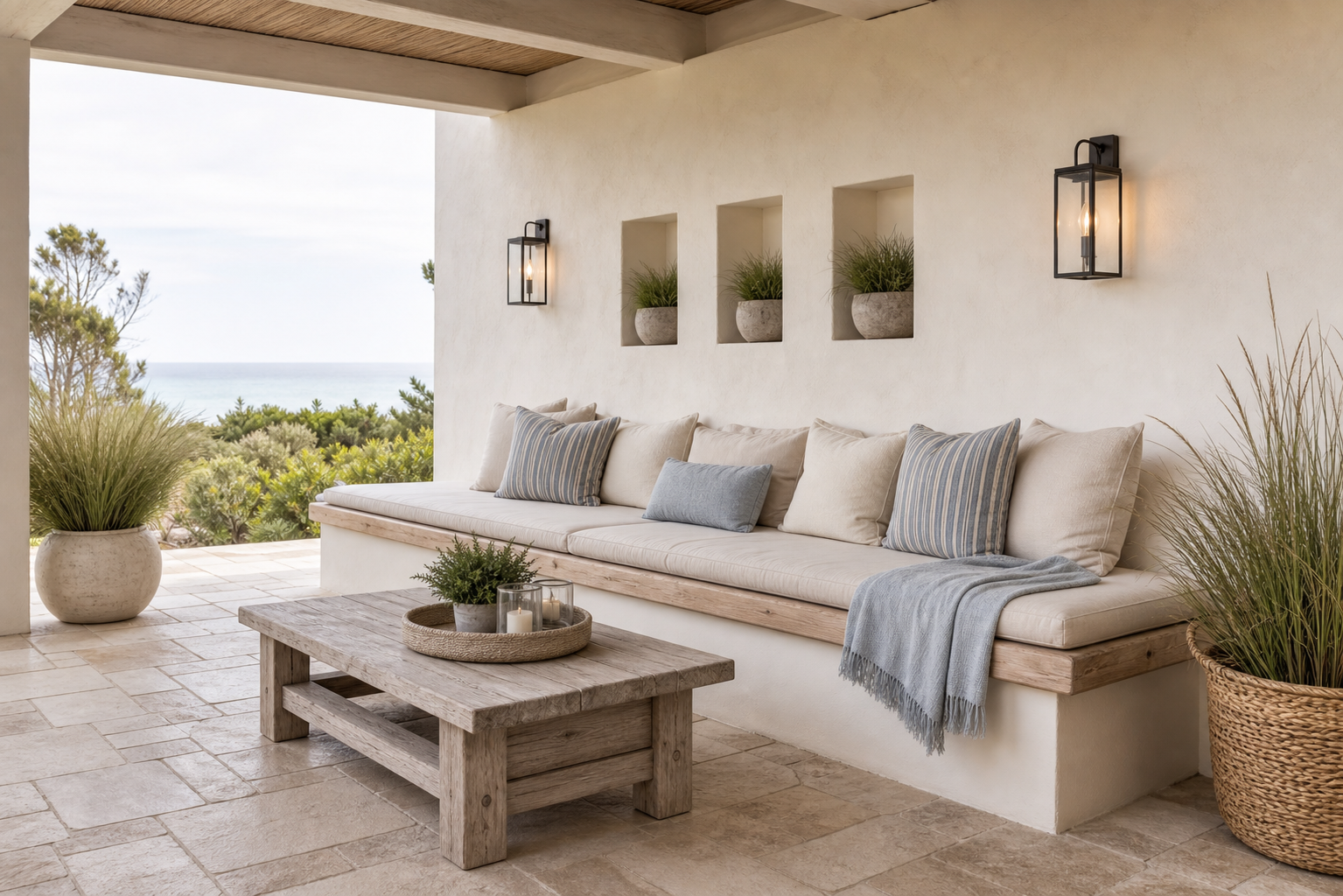

The built-in bench turns the long plaster wall into seating while leaving the patio center open to the coastal view. A pale masonry base supports a continuous timber-toned seat and fitted cushion, with loose striped pillows distributed across the span. Because no sofa arms interrupt the line, more of the narrow terrace remains usable for movement and a low table.
Three recessed niches and two black lantern sconces animate the wall above without projecting into seated headroom. Pale paving continues toward the open edge and sea beyond, while baskets and grasses gather at the perimeter. Architecture holds the seating; movable pieces remain low and light enough to preserve the horizon.
The Bench Converts Wall Length into Seating
The bench is the longest continuous form in the space, and that length makes the patio feel intentionally planned. Because it is built into the wall, the seating reads as architecture rather than movable furniture. That is what gives the terrace its calm, resort-like order.
The bench begins after the entry opening and stops before the planted corner, preserving clear end conditions rather than filling every centimeter of wall.
A row of freestanding chairs would occupy more floor area and interrupt the view toward the open side of the patio. Here, the bench keeps the main walking path open while still providing a long seating zone. The low table can sit forward without making the terrace feel crowded.
The masonry base meets the paved floor without visible legs or gaps, allowing the bench to read as part of the terrace enclosure. A slim timber-toned cap separates cushion from plaster and protects the seat edge visually. No storage doors are visible in the base. Its value is spatial economy: the wall carries the furniture load and releases the central patio for a table, approach, and the view beyond.
Pale Plaster Connects Furniture and Architecture
The warm white plaster gives the bench and wall one continuous surface, which makes the seating feel relaxed and permanent. Its subtle texture also suits the outdoor setting. It catches daylight softly and pairs naturally with stone pavers and weathered wood.
Recessed Niches Add Depth Without Projection
The recessed niches break up the long wall above the bench and give the potted grasses a protected place to sit. Their repetition matters. The niches create rhythm without adding framed art or objects that would feel too interior for this patio.
Each niche contains a compact plant and is set above the back cushion line. Their repeated square proportions bring order to the broad plain wall.
Lantern Sconces Mark the Seating Span
The black lantern sconces give the plaster wall a crisp edge and make the bench usable after sunset. Their vertical shape contrasts with the long horizontal seat, so the wall feels balanced instead of stretched.
The Low Table Protects the Horizon
The table sits low enough to keep the bench and sea view dominant. Its weathered wood surface repeats the pale coastal palette in a more tactile way. The tray, candle and small plant are restrained, which leaves enough room for the table to remain practical during outdoor use.
The low timber table uses a thick rectangular top and open shelf, with a tray and small plant contained near the center. Its height stays below the bench cushion, preserving conversation and the sea horizon. Weathered-looking grain relates to the seat cap and woven baskets, but the exact wood species and outdoor treatment are not visible. The table feels appropriate because its mass is low and its footprint fits entirely within the open floor zone.
Textiles Bring Comfort Without Visual Bulk
The cushions are pale and simple, while the striped pillows bring a measured blue-gray accent. That small amount of pattern is useful. It gives the bench a coastal note without turning the wall into a busy decorative display.
The same priority given to clear seating circulation appears in this coastal outdoor patio guide, though the built-in here releases even more floor area along the wall.
Three striped cushions alternate with plain pale ones, giving the long bench a measured cadence rather than a continuous band of pattern. The blue-gray throw is confined to the right end, where it relates to the open water view without covering the seat's timber edge.