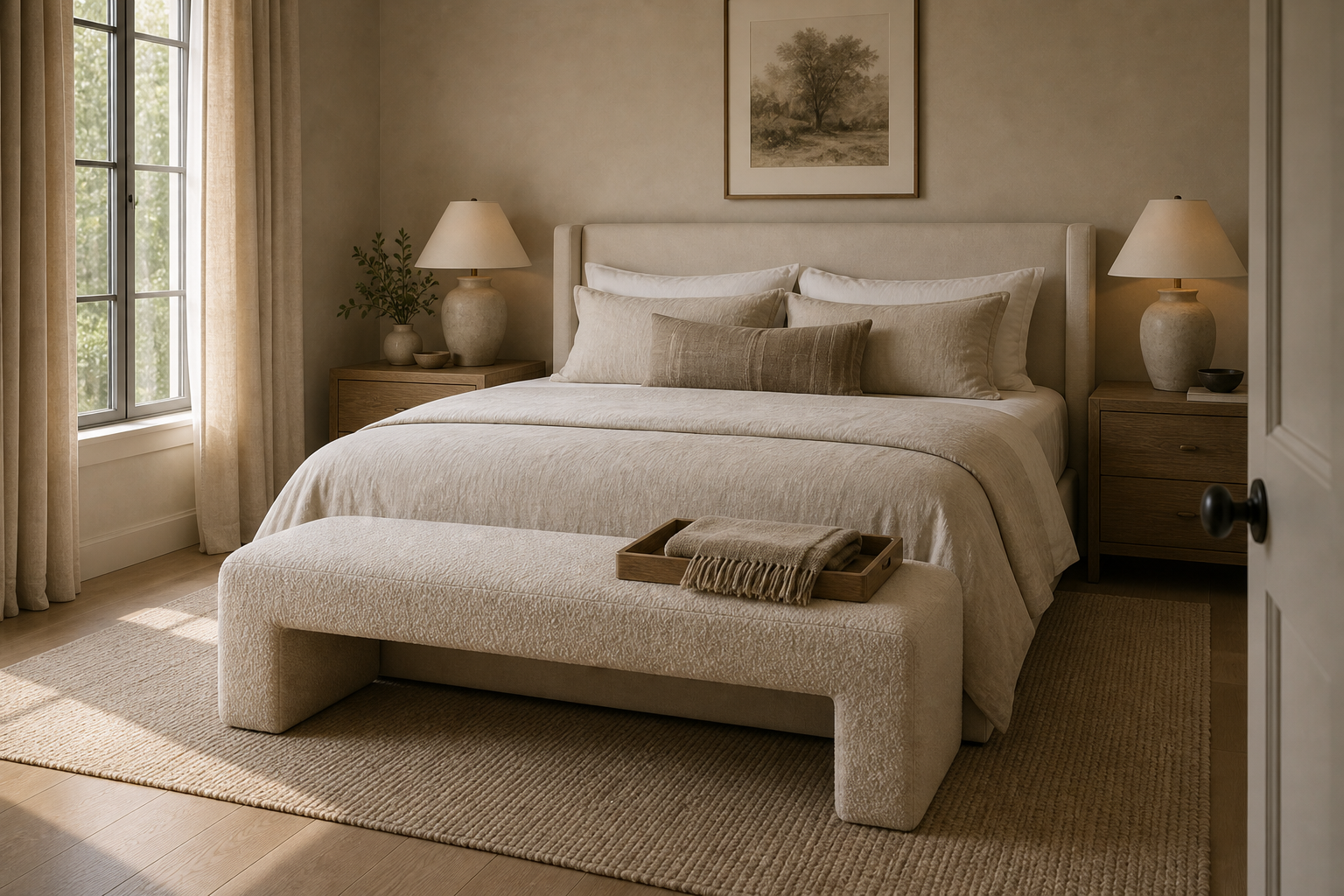

The bench is not an accessory placed after the bedroom was finished; it completes the bed's footprint. Its low, softly rounded body sits wholly within the pale rug and stops short of the mattress width, leaving distinct circulation at both sides. Tonal bedding, paired lamps, timber-toned nightstands, and filtered window light support that foreground element without introducing a second focal point.
The Bench Finishes the Bed's Long Axis
The nubby pale fabric bench sits across the foot of the bed and gives the composition a clear finish. Without it, the bed would stop abruptly before the rug has a chance to feel anchored. Its length is important. The bench is wide enough to relate to the bed but not so wide that it crowds the walking path near the doorway.
The bench aligns close to the center of the bed and leaves the corners of the rug visible. It therefore reads as part of one nested composition: broad rug, narrower bed, and a bench that repeats the bed's direction without duplicating its exact width.
The bench has a nubby upholstered surface that catches daylight and adds tactile depth. In a warm neutral bedroom, that kind of texture matters more than strong color. Because the bedding is smoother and looser, the bench introduces a firmer, more tailored texture at the foot of the bed.
Nubby Fabric Adds Contrast Without New Color
The bench sits fully on the pale woven rug, which visually ties it to the bed rather than letting it float separately on the floor. The rug also extends beyond the bench, giving the foot of the bed enough softness and making the walking area feel intentional.
Texture replaces contrast at the foot of the bed. The nubby pale fabric catches stronger shadow than the smoother bedding, while the timber-toned tray supplies one firm edge. The earlier channel-tufted bed-wall analysis demonstrates a more architectural version of the same low horizon.
The Rug Collects Bed and Bench Together
The low timber-toned tray and folded throw add function without turning the bench into a display surface. They show how the bench can be useful while still staying calm. The timber-toned tray also repeats the nightstand tone, connecting the foot of the bed to the furniture behind it.
Paired Nightstands Stabilize the Background
Matching nightstands and ceramic lamps give the bed wall a balanced frame. That symmetry allows the bench to sit as the lower foreground element without making the room feel lopsided. The lamp scale is modest, which keeps the eye from jumping away from the bench and bed relationship.
Daylight from the left window reveals the bench texture and the weave of the rug. The pale curtains soften that light before it reaches the bed. That softness is why the room feels warm rather than flat; the neutral palette depends on light moving across fabric.
Daylight arrives from the left and falls across the bench face, rug, and folded throw. Because the curtains diffuse the window edge, the neutral materials remain distinct without needing exact fabric labels or an invented lighting specification.
Keeping the Bench Useful Rather Than Decorative
Choose a bench that sits lower than the mattress and is slightly narrower than the bed. That proportion will make it feel useful without overpowering the sleeping area. Use a textured upholstery such as nubby pale fabric, woven fabric or washed linen, then keep the styling limited to a tray, folded throw or one small object.
Testing End Clearance Before Choosing the Width
I would avoid a bench with tall arms in this room. The current low profile keeps the foot of the bed open and easy to move around. I would also avoid stacking extra pillows on the bench. The bed already carries the pillow layers, and the bench works best when it remains functional.
The visible path between bench and doorway is what makes the arrangement credible. A taller, wider, or armed piece would turn that route into a negotiation. Start with movement around the foot of the bed, then select a bench that occupies only the remaining visual zone.
The bench's rounded corners soften the long rectangular bed and reduce the sense of a barrier at the doorway approach. Its folded throw sits to one side rather than covering the whole top, preserving enough open upholstery for actual use. At the rear, lamp shades remain below the artwork and headboard line, producing a quiet vertical stack. The bedroom feels complete because foreground, sleeping zone, and wall are each given a distinct depth, not because additional furniture fills every open area.