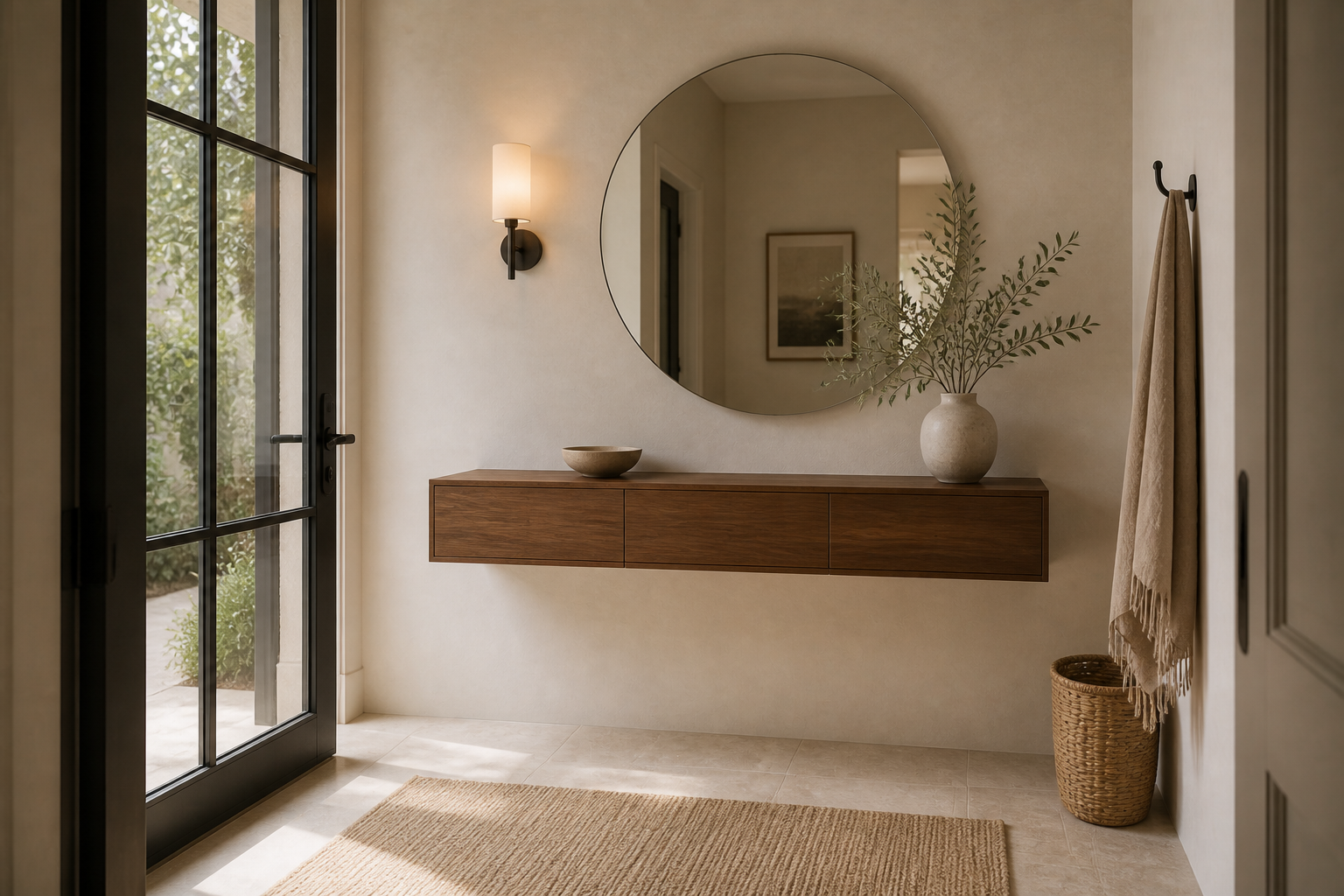

The console provides an arrival surface without behaving like a piece of floor furniture. A slim timber-toned volume projects from the softly textured wall and leaves the pale floor entirely visible below. A large round mirror, one wall sconce, a dark-framed glass door, woven basket, and restrained vessel arrangement complete the elevation. Its contemporary quality comes from protecting circulation while still giving the entry a useful center.
The Console Creates Function Without Floor Legs
The timber-toned console is the strongest functional element because it is mounted to the wall and leaves open space beneath it. That floating detail makes the entry feel lighter than a freestanding table would. Its slim rectangular shape also gives the softly textured wall a clear horizontal line without crowding the walkway.
The console is shallow and stops well before the adjacent doorway, preserving a clean route through the foreground. Its wall mounting allows the floor boundary to continue uninterrupted, which visually enlarges the small arrival zone.
The empty space below the console is not wasted; it is what keeps the entry comfortable. The floor remains visually continuous from the glass door to the interior doorway. That clearance is especially important in compact entryways, where furniture depth can quickly make the first step into the home feel tight.
The Round Mirror Softens the Horizontal Shelf
The round mirror balances the console's long straight shape. Its curve softens the composition and reflects the hallway beyond, making the entry feel deeper. Because the mirror is frameless and thin, it adds scale without making the wall feel heavy.
The mirror is wider than the console depth but does not exceed its horizontal span. In the farmhouse brick-floor entry study, the ground plane directs arrival; here, the floating shelf and circular reflection organize the wall instead.
One Sconce Holds the Asymmetrical Balance
The wall sconce adds a warm vertical accent beside the mirror. It gives the console wall a finished quality, especially in the evening. Its black base also relates to the glass door frame and wall hook, tying the small dark details together.
The Glass Door Extends Daylight Into the Entry
The black-framed glass door brings daylight directly into the entry and makes the floating console feel even lighter. The door frame also gives the wall composition a crisp edge. The outdoor view keeps the compact space from feeling enclosed.
Dark framing around the tall glass door gives daylight a precise vertical edge at the left. The same dark note appears in the sconce and a small wall fitting, connecting opening and console zone without a heavy matching furniture set.
The console holds only a ceramic bowl and vase with branches. That restraint keeps the surface useful rather than decorative only. The woven basket and pale throw sit to the side, adding texture without crowding the console itself.
A Basket Stays Outside the Main Path
Choose a console shallow enough for the entry path and mount it at a height that feels comfortable for placing small items. Pair it with one mirror, one light source and one low texture element such as a basket or rug. The fewer pieces you use, the stronger the floating effect becomes.
Keeping the Arrival Wall Useful and Uncrowded
I would not place a bench directly under this console. The open floor is part of the reason the wall feels contemporary. I would also avoid filling the mirror wall with extra hooks or frames, because the current composition already has enough visual structure.
Do not fill the open floor simply because it is available. The shadow below the console and clear route beside it are active parts of the design. A bulky bench or deep cabinet would remove the very spatial advantage that makes the wall-mounted element worthwhile.
The shelf's right end remains clear of the interior opening, while its left end stops before the glass door frame. Those margins allow each threshold to retain a separate vertical edge and keep the landing surface from appearing squeezed between two routes.
A branch vessel rises in front of the mirror but occupies only one side of the reflection. The small bowl remains low at the opposite end. This asymmetrical styling follows the sconce position and leaves the middle available for keys or mail without inventing hidden drawers.