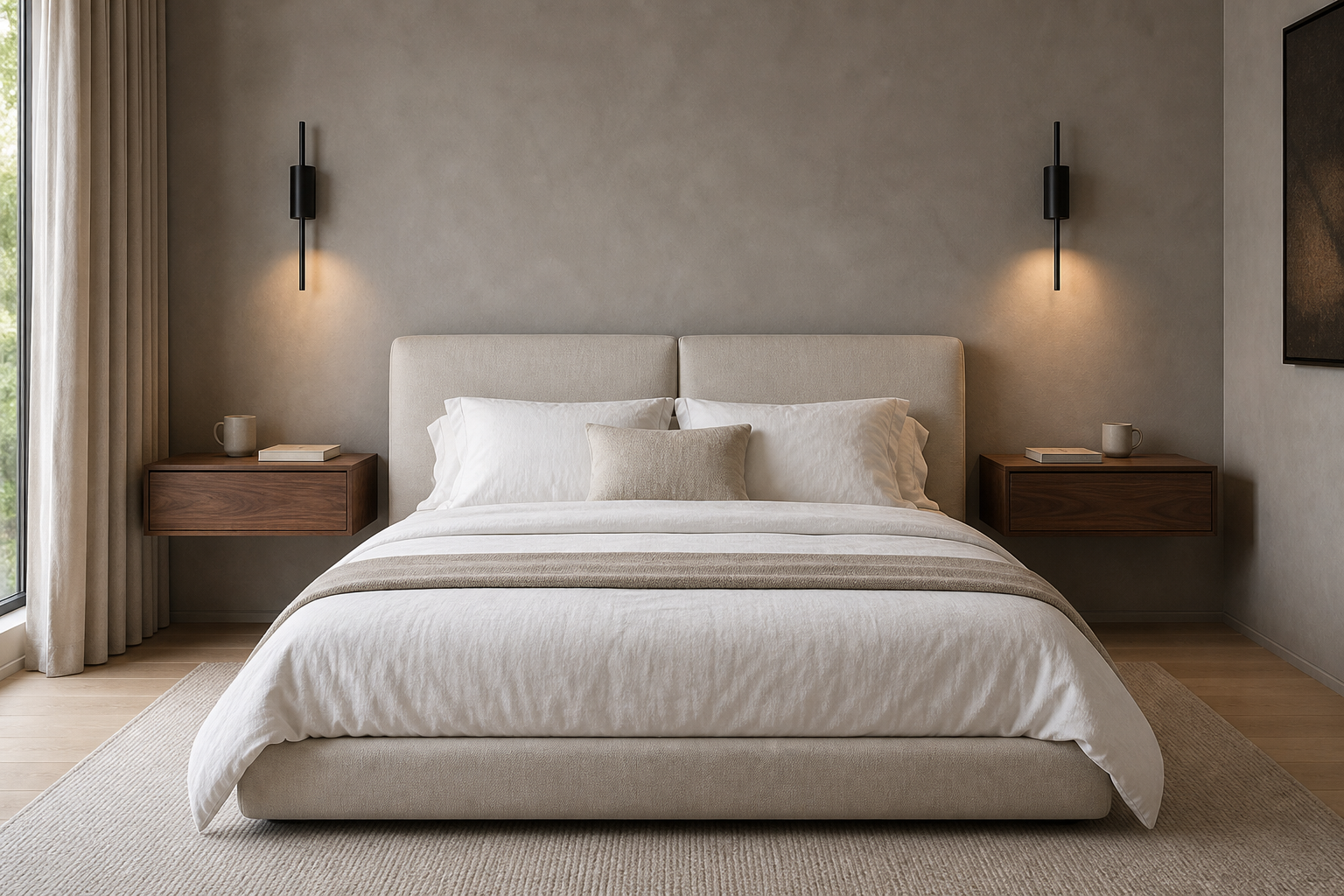

Two compact wall-hung nightstands give this bedroom its most precise detail. Each dark timber-toned box aligns with a side of the low upholstered bed and sits clear of the pale floor, while a slim dark sconce rises above. The bed, broad textured wall, tall curtain, and narrow artwork remain quiet. Symmetry works because identical functions occupy equal visual territories without adding full-height furniture.
Twin Nightstands Establish Equal Bedside Zones
The nightstands are small compared with the bed, but their wall-mounted position makes them the most important functional detail. They change how the bed wall meets the floor. Because they float, the room feels cleaner and less crowded at the edges of the bed.
The paired units sit at matching height and distance from the mattress, so neither side appears improvised. Their width remains inside the pillow zones rather than extending toward the room corners.
Wall Mounting Keeps the Floor Continuous
Both nightstands are matched in size, height and material. That symmetry supports the centered bed and gives the bedroom a restful order. Contemporary bedrooms often rely on this kind of quiet precision rather than decorative layering.
The paired floating-nightstand analysis uses a warmer organic setting. Here, sharper dark boxes and vertical sconces create a more graphic contemporary composition.
Compact Drawers Match the Low Bed Scale
The black sconces sit directly above the nightstands, creating a clear vertical relationship. Light and surface are handled together, not as separate decisions. The warm glow also makes the gray softly textured wall feel softer at night.
One shallow drawer line is visible on each front, but internal storage cannot be inferred. Their small volume is enough to hold bedside essentials without visually widening the bed.
Slim Sconces Extend Each Vertical Axis
The dark timber tone gives the bed wall a warm horizontal note against the gray softly textured wall. It prevents the white bedding and neutral headboard from feeling too pale. Because the nightstands are simple blocks, the wood grain becomes the main detail.
The Textured Wall Makes Dark Boxes Legible
Open space below the nightstands keeps the oak floor and rug visible. That makes the bedroom feel wider and easier to clean visually. This is one of the practical advantages of floating furniture: it can make a standard bed wall feel less heavy.
Side light grazes the softly varied wall and creates a halo around both nightstands. Exact wall finish and timber species remain unclaimed because the photograph proves tone and texture, not composition.
Curtains Soften One Side Without Breaking Balance
Start with the mattress height and mount the nightstands so the top surface is easy to reach from bed. Alignment matters more than size. Use wall sconces or slim lamps above the nightstands so the small surfaces do not have to hold bulky lighting.
Sparse Tops Preserve Bedside Use
I would avoid large table lamps on these nightstands. The wall sconces already solve bedside lighting. I would also avoid oversized decorative objects because the surfaces are intentionally compact.
Aligning Wall-Hung Furniture Before Drilling
The lesson is that bedside storage can feel architectural when the lighting and bed proportions are planned together. The floating nightstands make everyday function feel lighter, cleaner and more intentional.
Set mattress height, reachable top level, and sconce centerlines together. Oversized drawers or pendant cords would crowd the narrow bedside fields that make this wall feel controlled.
The nightstand fronts remain handle-free from the camera angle, so shadow gaps provide their only detail. Small lamps are absent because the sconces already occupy the lighting role.
The bed clears both units and leaves a pale floor strip beneath, keeping cleaning access and the floating effect visually understandable.
Each nightstand top carries only one low object, leaving the dark rectangular planes visible from the bed and doorway. This restraint also keeps the sconces, rather than tabletop lamps, responsible for the vertical emphasis at both sides.
The mattress edge sits slightly forward of the wall-hung units, so their corners remain outside the main sleeping width. That offset gives the bed visual depth and reduces the sense that bedside boxes are pinching the upholstered frame.
The curtain falls outside the left nightstand axis and reaches the floor, adding softness without concealing the floating clearance under either bedside unit.