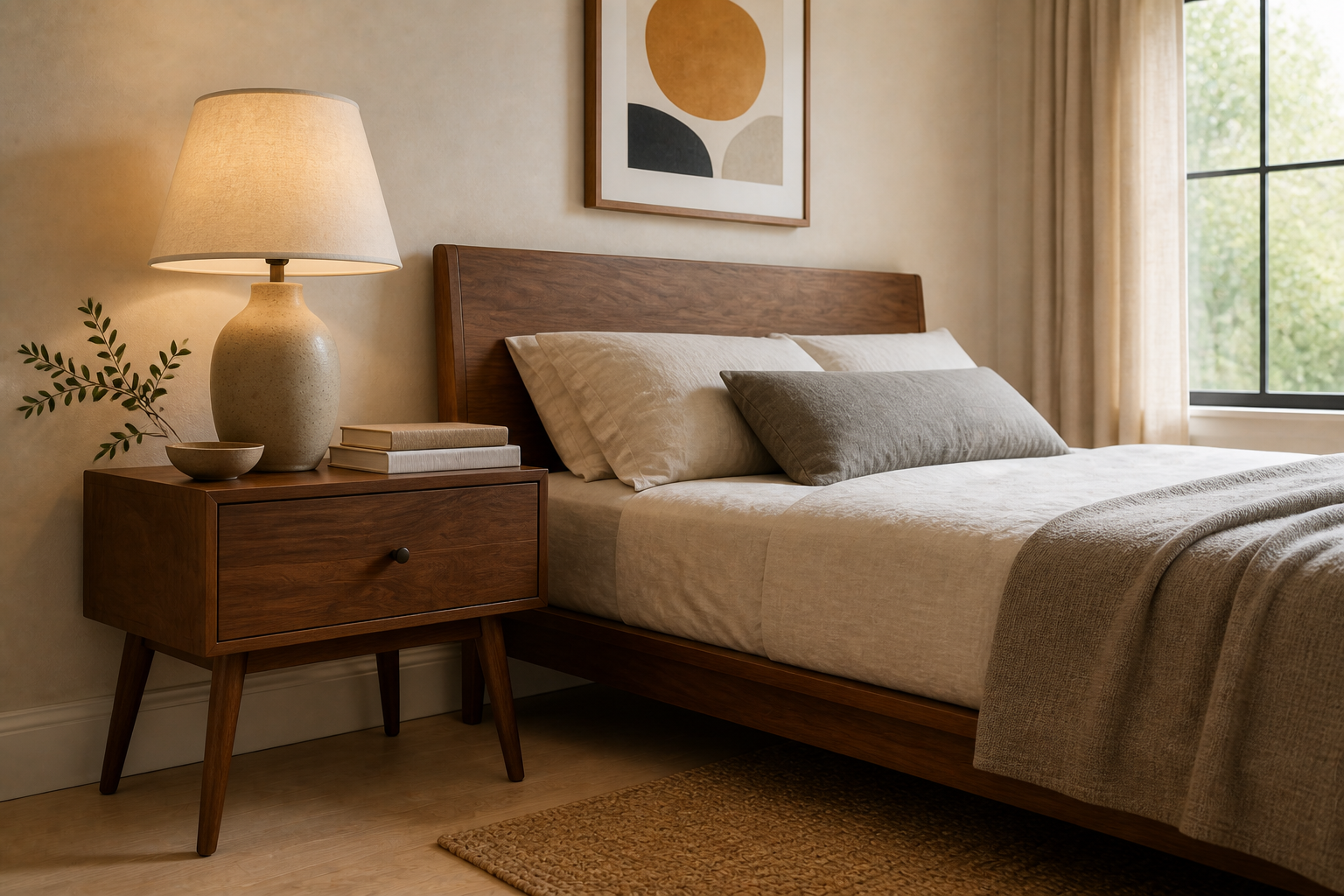

The closest object in this bedroom is also its clearest expression of mid-century design. A dark timber-toned nightstand combines one broad drawer, an open lower profile, and tapered legs beside a low bed in a related finish. A rounded ceramic lamp fills the tabletop without hiding its edge. Pale layered bedding and geometric wall art supply soft and graphic counterpoints, allowing the small piece to carry detail without making the bedside area crowded.
One Drawer Gives the Nightstand a Clear Front
The nightstand is positioned close to the viewer, so its form is easy to read: a simple box, one drawer, tapered legs and warm dark timber tone grain. That clarity is what makes it feel mid-century rather than generic. The piece has enough detail to matter, but not so much that it overcomplicates the bed wall.
A narrow shadow line around the drawer gives the front definition without extra molding. The top extends only slightly beyond the case, keeping the silhouette crisp and making the visible grain and proportions more important than applied decoration.
The angled legs lift the nightstand off the floor, which keeps the bedside area from feeling heavy. This is especially useful beside a low wood bed. The open space under the drawer lets the floor continue visually, making the corner feel lighter.
Four angled legs lift the drawer box enough for the warm floor to remain visible. That open area reduces the nightstand's apparent mass beside the equally low bed and prevents two dark furniture volumes from merging into one continuous block.
A Rounded Lamp Balances the Box Form
The ceramic lamp is large enough to balance the nightstand, but its rounded base softens the straight drawer front. The shade brings warm light to the wall and bedding. Because the lamp color stays neutral, it supports the wood rather than fighting it.
The lamp base occupies much of the top but its circular body and tapered shade introduce curves against the rectangular drawer. Books and one small vessel stay at the remaining edge, leaving the front portion available rather than treating the surface as a display shelf.
The Bed Repeats the Dark Timber Tone
The dark timber tone bed frame and headboard repeat the nightstand's wood tone, giving the room continuity. The bedside table does not feel like an isolated accent. This relationship is important in mid-century rooms, where furniture silhouettes often carry the style.
Pale Bedding Separates the Furniture Silhouettes
The bedding introduces cream, white and gray fabric textures against the strong dark timber tone. Those soft surfaces prevent the wood-heavy area from feeling too hard. The gray lumbar pillow also connects subtly with the cooler tones in the abstract artwork.
The framed artwork above the bed repeats the room's ochre, black and pale neutral tones. Its simple shapes relate to the clean lines of the furniture. It adds mid-century character without requiring more objects on the nightstand.
A Few Small Objects Preserve Usable Surface
Look for a dark timber tone nightstand with a clean drawer front and tapered legs. The piece should be close to mattress height so the lamp is comfortable to reach. Style the top with only a few objects: a lamp, one small stack of books and a bowl or branch are enough.
Choosing Bedside Scale Before Matching Finish
I would not replace the nightstand with a bulky closed cabinet. The open legs are part of the room's lightness. I would also avoid a brightly colored lamp. The bedside area works because wood grain, fabric and warm light remain the main materials.
The floating approach in this minimalist bedroom nightstand analysis removes floor contact entirely. This piece stays freestanding, using tapered legs and a compact drawer box to achieve comparable visual lightness.
The bed frame and nightstand share a closely related dark tone, yet a visible gap and changes in height prevent them from becoming one unit. The pale rug and floor remain exposed beneath both pieces. These interruptions are important whenever several timber-toned objects gather in one corner, because they preserve each silhouette and maintain easy bedside access.
The nightstand top sits close to mattress height, placing lamp switch, books, and bowl within an accessible bedside band. That practical alignment matters more than matching every timber tone exactly, because it connects the small table directly to use from the bed.