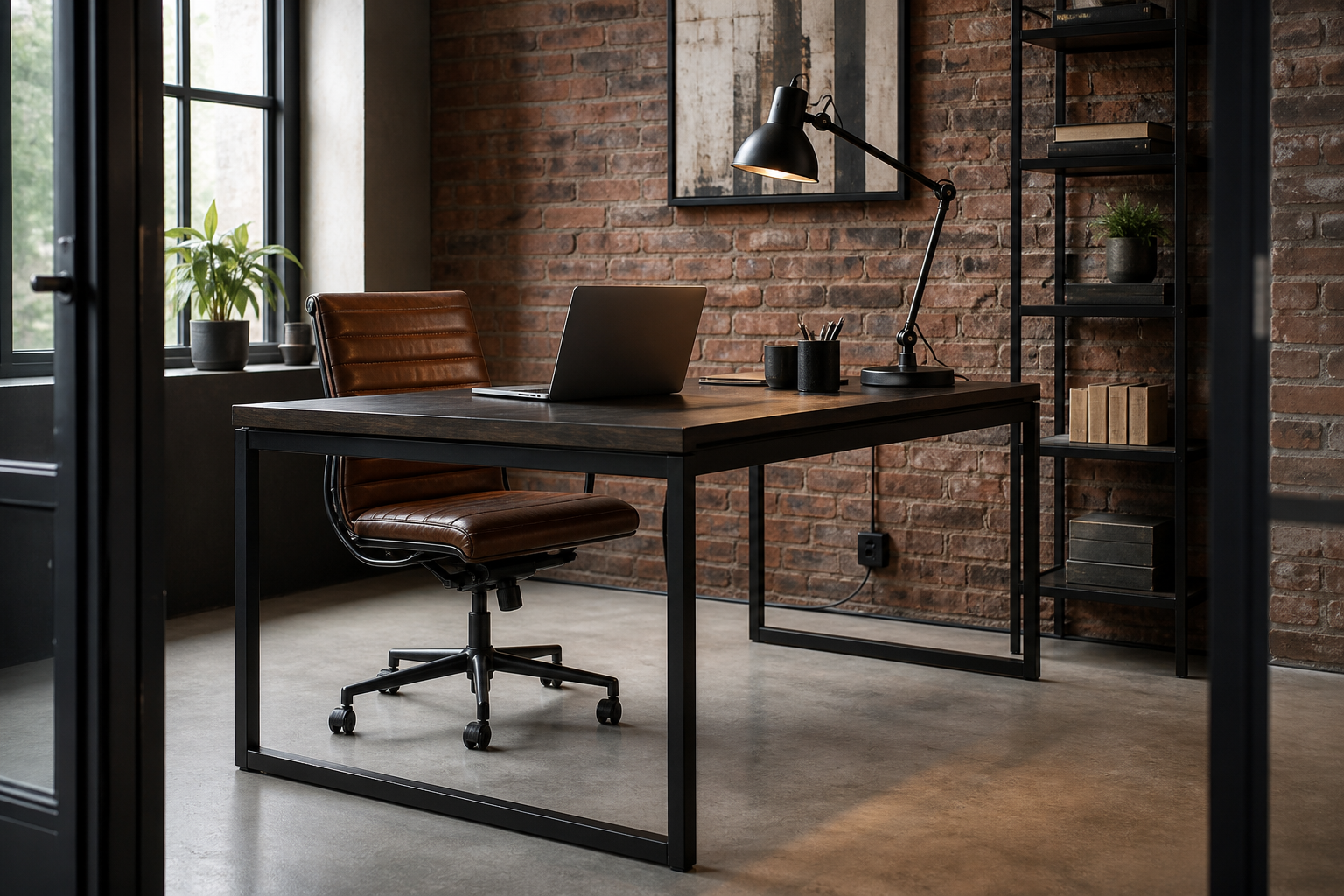

The desk is drawn as an open dark-metal frame supporting a warm timber-toned top, giving this home office a clear industrial working center without creating a solid block. Exposed brick, a tall dark-framed window, gray floor, wall shelf, slim task lamp, brown office chair, laptop, and a few books reinforce the same practical material language. The room feels credible because the strongest geometry belongs to the furniture actually used.
The Open Frame Gives the Desk Structural Clarity
The desk has the strongest geometry in the office. Its dark metal frame draws a clean rectangle against the brick wall and gray floor. Because the frame is open, the desk feels substantial without becoming a heavy block. That openness is important in a compact work room.
Square legs and perimeter rails create a complete rectangle around the working zone while leaving wall and floor visible through the base.
The dark timber-toned desktop keeps the black metal from feeling too severe. It gives the work surface a warmer, more tactile quality. That material pairing is the reason the desk reads as industrial rather than purely utilitarian. Steel gives structure; wood makes it livable.
The minimalist floating-desk office guide removes floor supports entirely. This office keeps visible dark structure as part of its industrial identity.
Exposed Brick Provides a Textured Working Backdrop
The exposed brick wall gives the desk a textured background. Its red-brown color adds depth behind the black frame and brown office chair. The brick also provides enough visual activity that the wall does not need extra decoration. A busier gallery wall would distract from the desk's clean outline.
Brick occupies the complete rear wall and supplies irregular texture behind the precise desk. No brick age or construction history is inferred.
The black task lamp is placed directly on the desk, which makes the workspace feel functional. Its angled arm reinforces the industrial language of visible hardware. The lamp glow also balances the daylight from the window. That gives the desk a usable light source when natural light drops.
A Slim Task Lamp Marks the Active Side
The brown office chair softens the hard metal and brick around it. Its color is close enough to the brick to feel connected, but smoother in texture. It also keeps the office from looking like a workshop. Comfort matters in a home office, and the chair makes the desk feel like a place to sit for hours.
The task light has a narrow stem and compact shade, occupying one corner without cutting across the laptop or window view.
The Wall Shelf Remains Secondary to the Work Surface
The metal shelving on the right continues the industrial vocabulary, but it does not compete with the desk. Its slim frame and sparse objects keep the background controlled. That restraint is important. If the shelves were packed, the desk would lose its clarity as the central work zone.
Start with a desk that has an open black metal base and a real wood or wood-look work surface. The contrast should be visible from across the room. Then add one focused task lamp, a comfortable chair and limited storage nearby. The setup should feel intentional, not overloaded.
Building an Industrial Office Around Useful Openness
Industrial office design works when structure is visible but comfort is not forgotten. Here, the black metal desk gives the room discipline, while brick, leather, wood and daylight make the workspace human.
Set desktop depth from equipment and chair movement, then keep the lower frame open. Drawer pedestals or several under-desk bins would erase the useful visual clearance.
The chair rolls beneath the open frame without meeting drawer pedestals, making the working clearance visible in the photograph.
Books and a plant occupy the wall shelf in a short group, preserving exposed brick around the desk axis.
The desk top extends slightly beyond the metal frame at each side, providing a usable edge without making the base appear undersized. Its warm tone also separates laptop and dark lamp from the similarly dark structural rails below.
Window mullions repeat the desk's straight geometry at a taller scale, while brick joints provide a smaller irregular rhythm behind. These three grids coexist because each occupies a different plane and level of detail.
The open floor beneath the desk remains free of storage boxes, preserving chair movement and the legibility of the dark rectangular frame.