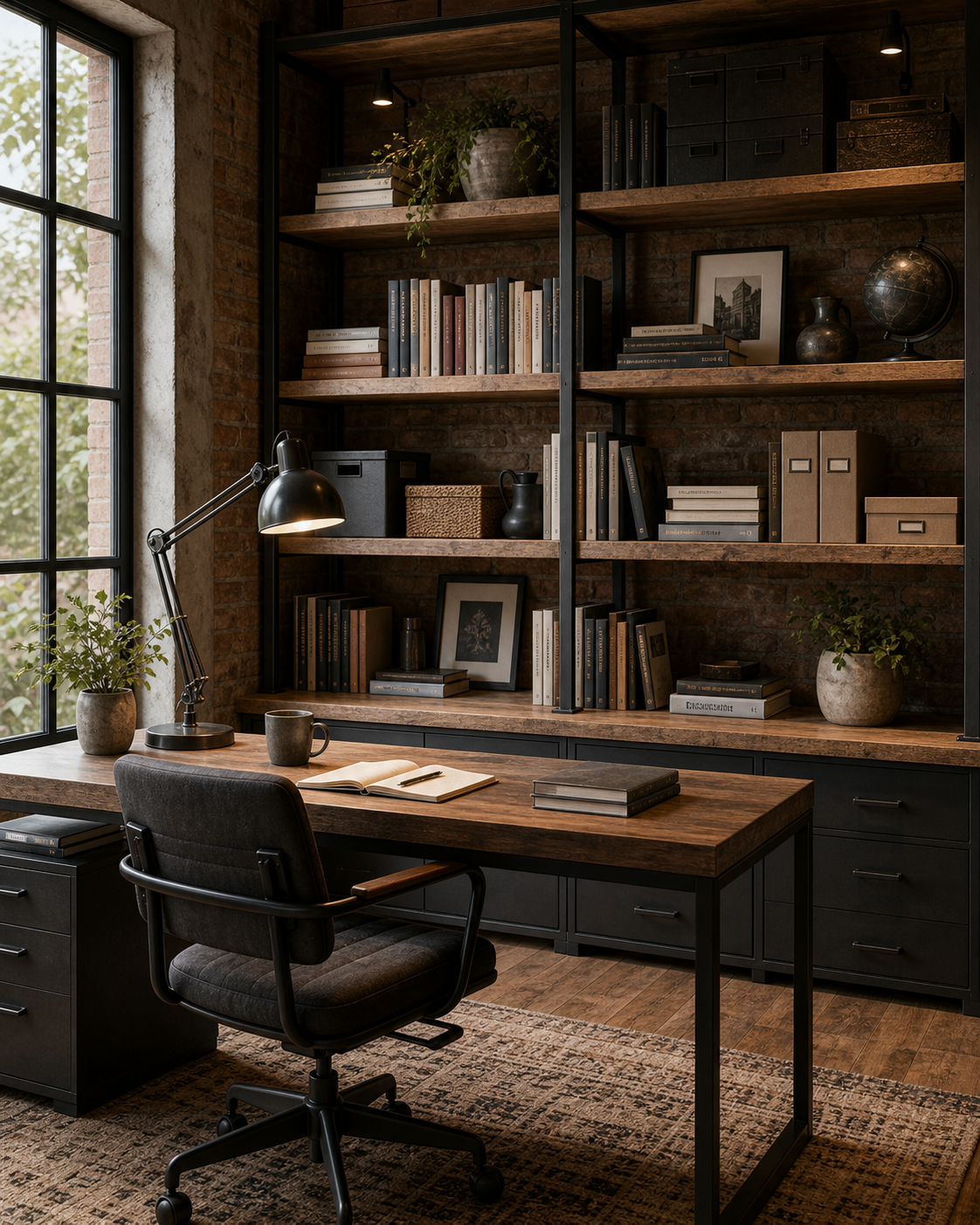

The shelving wall succeeds because display and work remain visually connected but spatially separate. Full-height black steel uprights support thick wood-toned boards against exposed brick, creating large bays for books, boxes, framed images, vessels, and plants. A broad desk stands forward of the wall, so the collection forms a deep backdrop rather than spilling onto the active work surface.
Industrial style often becomes a catalogue of dark metal and rough materials. This room avoids that problem by using spacing as carefully as objects. Dense book groups alternate with open areas, small lights pick out selected shelves, and warm timber repeats from shelving to desk and floor. The result feels used, not indiscriminately filled.
The Steel Frame Establishes a Strong Storage Grid
Dark uprights rise from base cabinets to the top shelf and divide the wall into broad vertical bays. Their visible thickness is enough to hold the composition against the textured brick. Horizontal shelf boards then create consistent levels, giving unlike objects a shared framework.
The grid is not perfectly symmetrical in its contents, which keeps it from looking like a retail display. Structural lines provide order; styling can remain flexible within each bay. This is a more durable strategy than trying to mirror every book stack and box from left to right.
Books Are Arranged as Blocks, Not a Continuous Band
Upright volumes gather into short runs, while horizontal stacks support framed pieces or fill lower gaps. Color stays largely within charcoal, cream, brown, and muted gray, allowing spine variation without turning the wall into a bright mosaic. Empty brick remains visible between groups.
The shelves also reserve different heights for different objects. Taller books and storage boxes occupy broader bays; smaller stacks sit beneath art or vessels. This uses the visible grid efficiently without claiming any concealed category system that the image cannot verify.
Storage Boxes Add Quiet Mass Among Smaller Objects
Black and kraft-toned boxes occupy several shelves, their solid fronts balancing the many narrow book spines. Label holders and lids are visible, but contents are not. Treating them as simple closed storage is accurate; assigning files, equipment, or supplies would be an unsupported narrative.
Boxes are concentrated rather than repeated on every level. That distribution creates heavier visual blocks near the upper right and middle left, countered by plants and framed images elsewhere. The wall remains asymmetrical but balanced through area and tone.
Small Shelf Lights Create Selective Emphasis
Compact black fixtures project from the upper frame and cast narrow pools onto plants, books, and brick. Their housings nearly disappear against the steel, so attention falls on the illuminated objects. The effect adds depth without washing the entire wall evenly.
A black articulated task lamp stands on the desk near the large left window. Shelf lights and desk lamp therefore address different planes: background display and foreground work. Daylight completes the layering, revealing the brick and timber grain that artificial sources accent after dark.
Framed Art and Vessels Interrupt the Book Rhythm
Several dark-framed images lean against the brick within separate bays. Rounded vessels, a globe, and leafy plants introduce silhouettes that contrast with rectangular books and boxes. Each larger object receives some open backing, making its outline legible instead of burying it inside a dense shelf row.
Plants are distributed high and low but remain compact. Their fine leaves soften steel intersections and bring a small green note to the brown-black palette. None projects into the desk zone, so styling does not interfere with the office's working depth.
Base Cabinets and the Desk Ground the Display Wall
Dark drawer cabinets run below the lowest open shelf, creating a continuous storage plinth. Their broad fronts stabilize the varied objects above and provide a visual stop before the wood-toned floor. Only drawers and fronts are visible; internal systems should not be inferred.
The large desk repeats the shelf timber and uses a dark frame that echoes the uprights. An upholstered office chair sits within its opening, while the patterned rug defines the working footprint. To recreate the approach, build the structural grid first, group items by visual scale, and preserve brick or wall around focal objects. Editing the gaps is as important as choosing what to display.