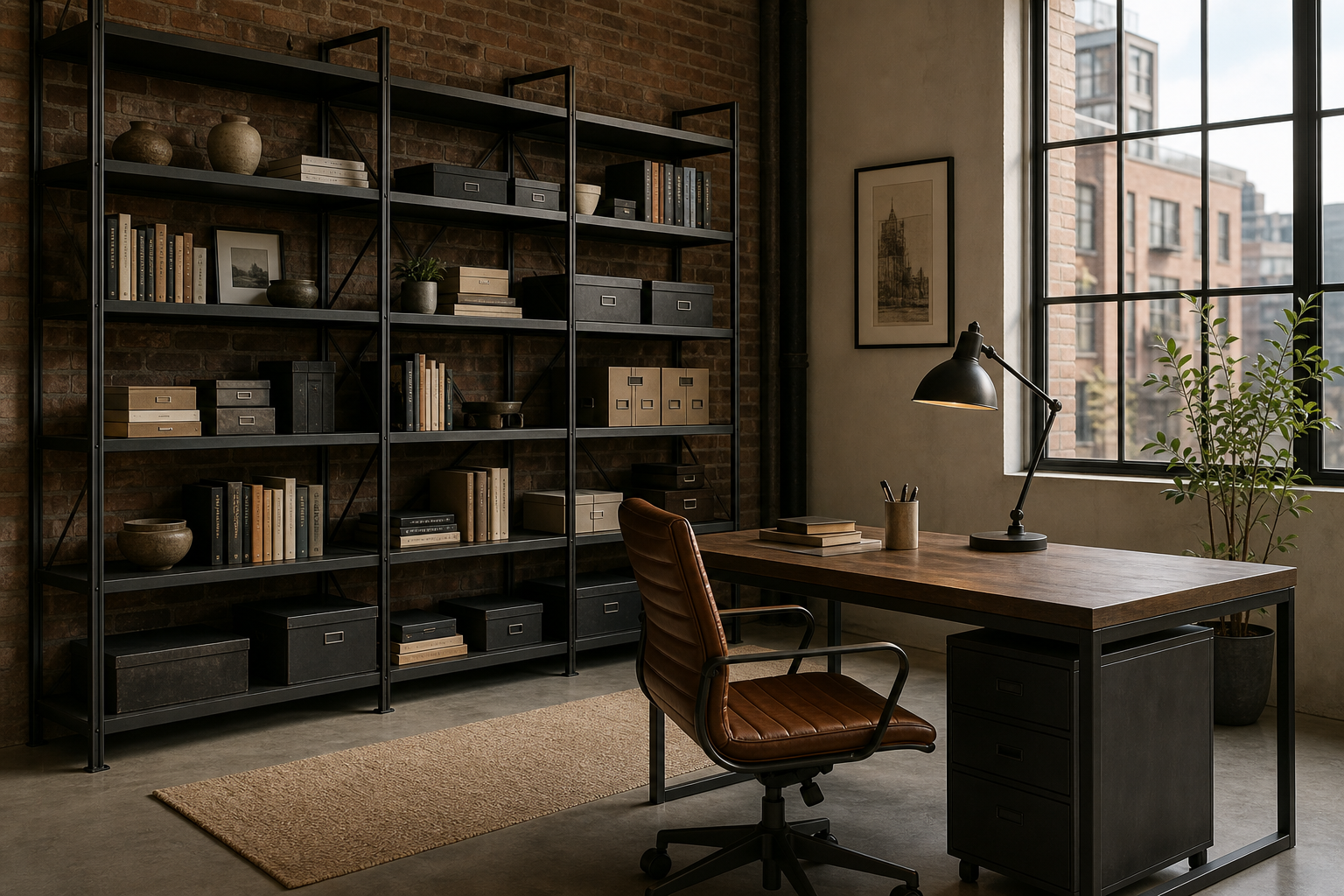

Storage occupies the full brick wall in this office, but the open black metal framework prevents it from becoming an opaque cabinet bank. Three tall bays combine broad dark shelves, slender uprights, and diagonal braces, holding books, boxes, framed work, and pottery with deliberate gaps. A substantial timber-toned desk sits perpendicular to that wall, making the collection a working backdrop rather than an obstacle. Tall gridded windows balance the darker storage with strong side daylight.
The Shelving Wall Gives the Office Its Working Scale
The shelving spans nearly the full height of the brick wall, making it the room's main architectural feature. Its black frame gives the office a strong grid. That grid is useful because the shelves hold many objects without letting the wall feel uncontrolled.
The units rise close to the ceiling and extend across most of the left elevation, giving papers and books a permanent address. Because the uprights are narrow, the eye still reaches the brick between every shelf. Mass is created through repetition, not through solid side panels.
The warm brick gives the black steel a textured backdrop. Without that surface, the shelving could feel too utilitarian. The brick also adds depth behind books, boxes and ceramics, making the storage wall feel layered.
Horizontal boards and diagonal braces form a disciplined grid over the irregular masonry. That contrast is the room's strongest material relationship: precise dark structure contains the collection, while the red-brown wall supplies age, warmth, and surface variation.
Shelf Heights Accommodate Different Object Groups
The desk is placed perpendicular to the shelving, which keeps the storage accessible without turning the work surface toward a busy wall. This layout also leaves a clear path between the desk and shelves.
The Desk Turns Perpendicular to the Storage
The cognac brown upholstered chair brings warmth to the black steel and concrete floor. Its color relates to the brick but feels more comfortable against the desk. The curved arms and padded seat soften the office without weakening the industrial character.
Placing the desk at ninety degrees keeps its long working edge accessible and leaves the shelves readable from the chair. A mobile drawer unit fits below one end without closing the entire underside, preserving legroom and a clear route toward the window.
A Brown Task Chair Softens the Industrial Lines
The black desk lamp gives the work surface a focused point of light. Its articulated shape belongs naturally with the black metal shelving. Because the window provides daylight, the lamp reads as a precise work tool rather than the room's only light source.
Window Light Separates Dark Shelves From Their Contents
Books, boxes and ceramics are arranged in groups, but some shelf bays remain open. Those pauses keep the storage wall from feeling packed. The balance between filled and open areas is what makes the shelving look intentional.
Boxes Control the Smallest Visual Clutter
Choose a shelving unit with a strong metal frame and shelves deep enough for books and boxes. Place it against a textured wall if possible. Then organize by category: books in vertical runs, boxes in repeated sizes and ceramics as visual breaks.
Building a Storage Wall Without Losing Floor Area
I would not replace the open shelving with closed cabinetry in this room. The visible frame is what gives the office its industrial identity. I would also avoid brightly colored storage boxes. The muted palette keeps the brick, leather and steel connected.
The denser library atmosphere in this scheduled dark academia bookcase wall analysis relies on enclosed timber tones. This office uses open metal lines and exposed brick to keep a similarly large storage elevation visually permeable.
The desk lamp, pen cup, and a short book stack occupy only one end of the broad top, leaving a clear central work area. A large plant stands by the window rather than among the shelves. This separation keeps active work, archived storage, and greenery in distinct zones while preserving direct movement behind the chair.
Lower shelves hold the largest dark boxes and heavier pottery, while books and smaller containers occupy eye level. This visible weight gradient stabilizes the tall open frames and leaves lighter objects easier to scan. The arrangement communicates storage priority without claiming anything about the unseen contents.