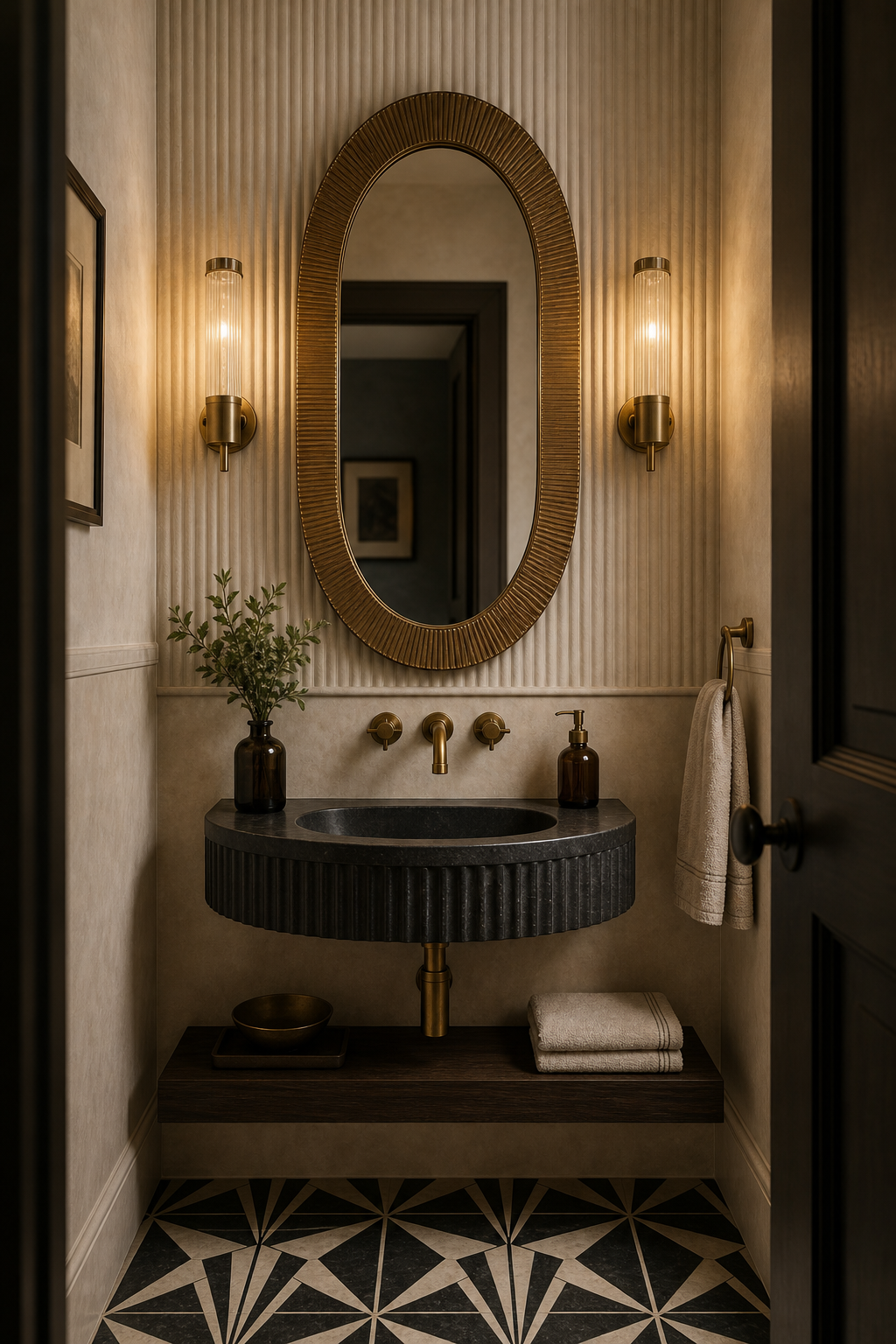

The mirror is designed as an illuminated object rather than a plain reflective surface. Its tall oval glass is surrounded by a wide fluted gold-toned frame, centered between two vertical glass sconces. Ribbed wall panels continue the same fine cadence behind it, while a dark rounded sink and floating shelf provide a grounded lower counterpoint. A high-contrast geometric floor extends the Art Deco language without repeating the mirror motif literally.
The Fluted Mirror Establishes the Powder Room Identity
The tall oval mirror carries the strongest decorative and architectural role in the powder room. Its warm-metal fluting adds depth around the glass, making the mirror feel like a crafted object rather than a flat accessory. The oval shape also softens the narrow room, which is important because the surrounding wall panels and floor tile use strong straight lines.
The frame is broad enough for individual radial grooves to be read around the oval, giving the mirror substantial presence despite the room's narrow width. A fine inner rim separates glass from the more tactile outer band.
The vertical wall panels behind the mirror repeat the same directional rhythm as the fluted frame. This keeps the composition unified from ceiling to sink. Because the panels are warm cream rather than high contrast, they add texture without stealing attention from the warm-metal mirror.
Ribbed Panels Extend the Fine Vertical Rhythm
The warm-metal sconces flank the mirror evenly, giving the compact wall a formal Art Deco symmetry. Their warm glow catches the ribbed wall surface and makes the texture more dimensional. The slim cylindrical shades are also narrow enough for the space, which keeps the lighting elegant rather than crowded.
Wall ribs run vertically rather than radiating, so they relate to the mirror through texture while retaining a distinct direction. Warm light catches alternating ridges and recesses, making the pale wall active without another color.
Paired Glass Sconces Hold a Formal Symmetry
The wall-mounted dark rounded sink gives the lower half of the room visual weight. Without that darker element, the warm-metal and cream surfaces could feel too delicate. Its fluted front relates back to the mirror frame, creating a second layer of ribbed detail at hand level.
The black and cream geometric floor tile introduces a sharp Art Deco base below the softer oval mirror. Its pattern is bold, but it stays mostly below eye level. That placement matters because the floor can add energy without interrupting the mirror and sconce composition above the sink.
The dark sink projects as a shallow rounded basin with a fluted front, concentrating most of the room's visual weight below the mirror. Warm-metal wall fittings remain small and centered, preserving the hierarchy between frame, basin, and floor.
A Floating Shelf Creates a Separate Lower Plane
The dark wood shelf below the sink provides a place for towels and a small bowl while leaving the wall-mounted basin visually open. Its straight horizontal line also balances the vertical movement of the mirror, panels and sink fluting.
Start with a tall oval mirror that has real texture in the frame. A fluted or ribbed warm-metal frame will carry the Art Deco character more effectively than a plain metal edge. Then repeat that rhythm selectively: ribbed wall panels, a fluted sink front or slender sconces. The goal is coordinated texture, not texture everywhere.
Combining Repeated Lines Without Creating Visual Noise
I would not add a busy wallcovering behind this mirror. The ribbed panels already provide the vertical movement the room needs. I would also avoid oversized counter accessories. In a powder room this compact, the mirror, sconces and sink should remain the entire composition.
The stepped geometry in this scheduled Art Deco gold mirror study creates harder angular movement. This powder room uses an oval, radial fluting, and vertical wall ribs for a softer but equally disciplined composition.
A towel hangs at the right beyond the sink edge, and an amber vessel sits at each side of the basin. These useful pieces balance the lower zone without climbing into the sconce field. The mirror reflection reveals a dark doorway, adding depth while keeping the narrow powder-room plan honest.
The shelf below the sink spans the alcove but remains visually separate from the basin, leaving wall and pipe visible between them. Its dark timber tone connects to the doorway without competing with the black-and-pale floor pattern.