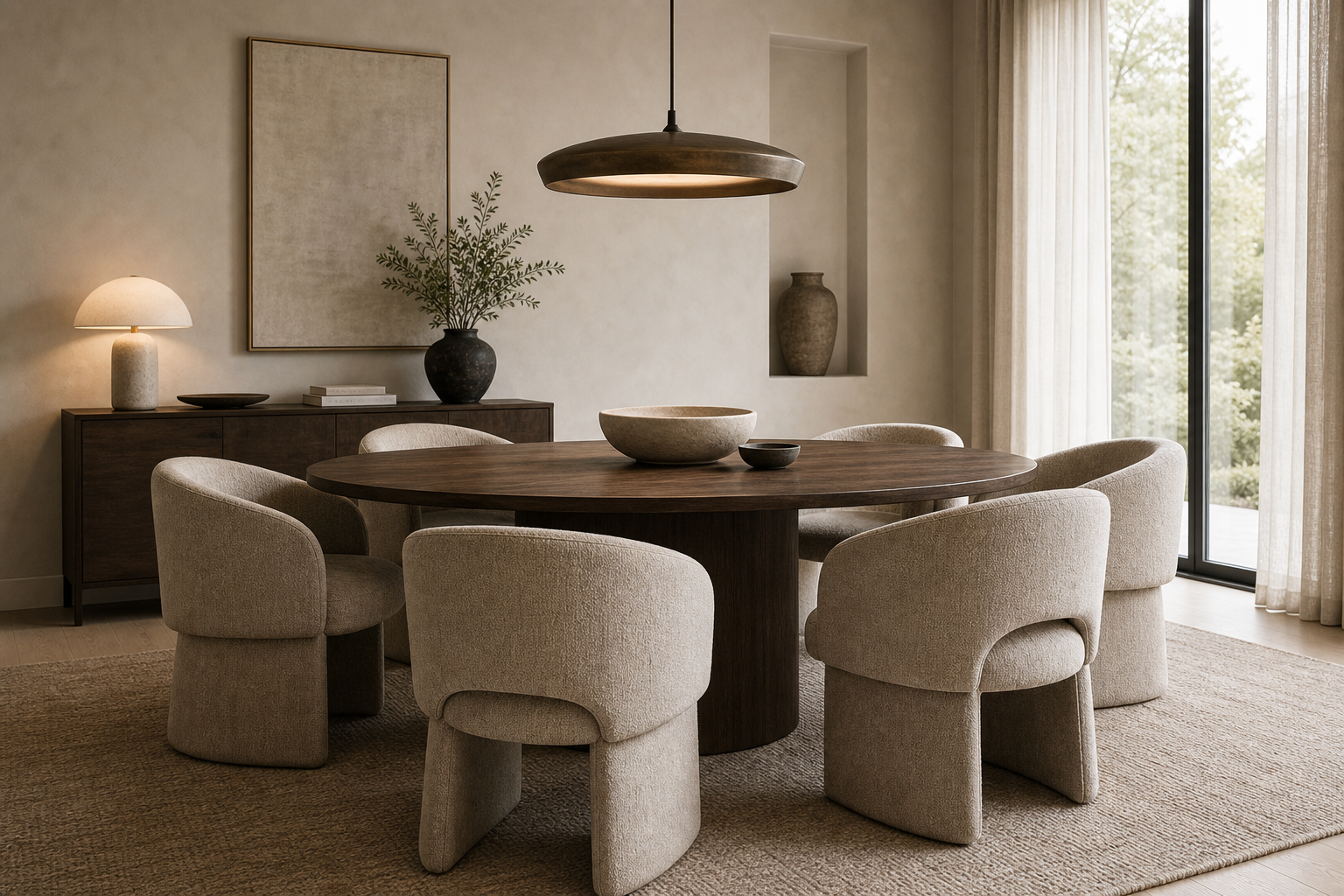

The memorable move in this dining room is at seated height. Five pale chairs wrap the dark oval table with rounded backs that remain legible from every angle, turning circulation around the table into part of the composition. A broad pendant repeats the same softened geometry overhead, while the sideboard and framed artwork hold straighter lines at the perimeter. The result feels contemporary without becoming hard-edged or impersonal.
Curved Backs Shape the Social Center
The chairs occupy the foreground and wrap around the table, so their rounded backs become the strongest furniture shape in the room. Their sculptural form gives the dining area softness before anyone notices the wall art, sideboard or pendant.
Because the chair backs are visible above the tabletop, their repeated arcs become a continuous low rhythm rather than five isolated seats. The two foreground chairs also frame the view toward the center, inviting the eye into the setting without closing the approach.
Pale Upholstery Softens the Silhouettes
The textured cream upholstery makes the chairs feel more relaxed than hard wood seats would. That softness matters in a contemporary dining room. It keeps the room from becoming too formal around the dark wood table.
An Oval Table Completes the Geometry
The table's rounded edge repeats the chair curves, creating a continuous geometry across the seating group. A sharp rectangular table would create more contrast. Here, the oval shape lets the chairs feel natural rather than unusual.
The dark tabletop provides enough contrast to separate every pale back, yet its edge follows their motion. A rectangular top would emphasize corners and make the same substantial chairs harder to pass; the oval shape preserves a softer route at both ends.
Open Gaps Keep the Chairs Approachable
The chairs have rounded backs and solid curved leg forms, which make each seat feel substantial. Because the table is oval, movement around the chairs still feels comfortable. The circulation path is softened by the furniture rather than blocked by it.
No chair appears pinned against a wall or trapped by a table leg. The image leaves distinct pockets between the seats, allowing each curved form to be read and suggesting that diners can pull back without immediately meeting the sideboard or glazing.
The Pendant Holds the Overhead Axis
The pendant echoes the table's broad shape and gives the dining area a clear center from above. Its dark finish also connects to the sideboard and smaller tabletop bowl, grounding the room's otherwise pale palette.
A Quiet Rug Contains the Group
The rug has enough texture to define the dining zone, but it does not compete with the chair silhouettes. That restraint helps the curved chairs remain the main design move. A busier rug would make the floor fight the seating.
The rug extends beyond the front chair feet and visually collects the entire setting. Its low-contrast weave avoids a competing motif, which matters when upholstery, table edge, and pendant are already repeating strong rounded outlines.
The Sideboard Adds a Straight Counterline
The dark sideboard creates a horizontal anchor on the back wall and prevents the room from becoming too soft. Its simple profile is a good counterpoint to the rounded chairs, giving the dining room both structure and comfort.
Selecting Curves Without Creating a Matching Set
Start with chairs that have a clear rounded back and enough upholstery to feel comfortable from every angle. Then pair them with a round or oval table, a quiet rug and one strong pendant. The room should celebrate the chair shape, not bury it under extra pattern.
The solid table treatment in this modern organic dining room study offers a useful comparison. In the present room, comfort comes primarily from chair curvature, and every supporting plane is edited to keep those silhouettes readable.
Curtains and full-height glazing soften the right boundary, while the broad pale wall behind the sideboard remains largely empty. That negative space is doing real work: it gives the substantial upholstered chairs room to project forward without making the dining area feel crowded. The small branch arrangement rises from the table center but stays below the pendant, linking the two levels without creating a dense centerpiece that would interfere with conversation across the oval top.