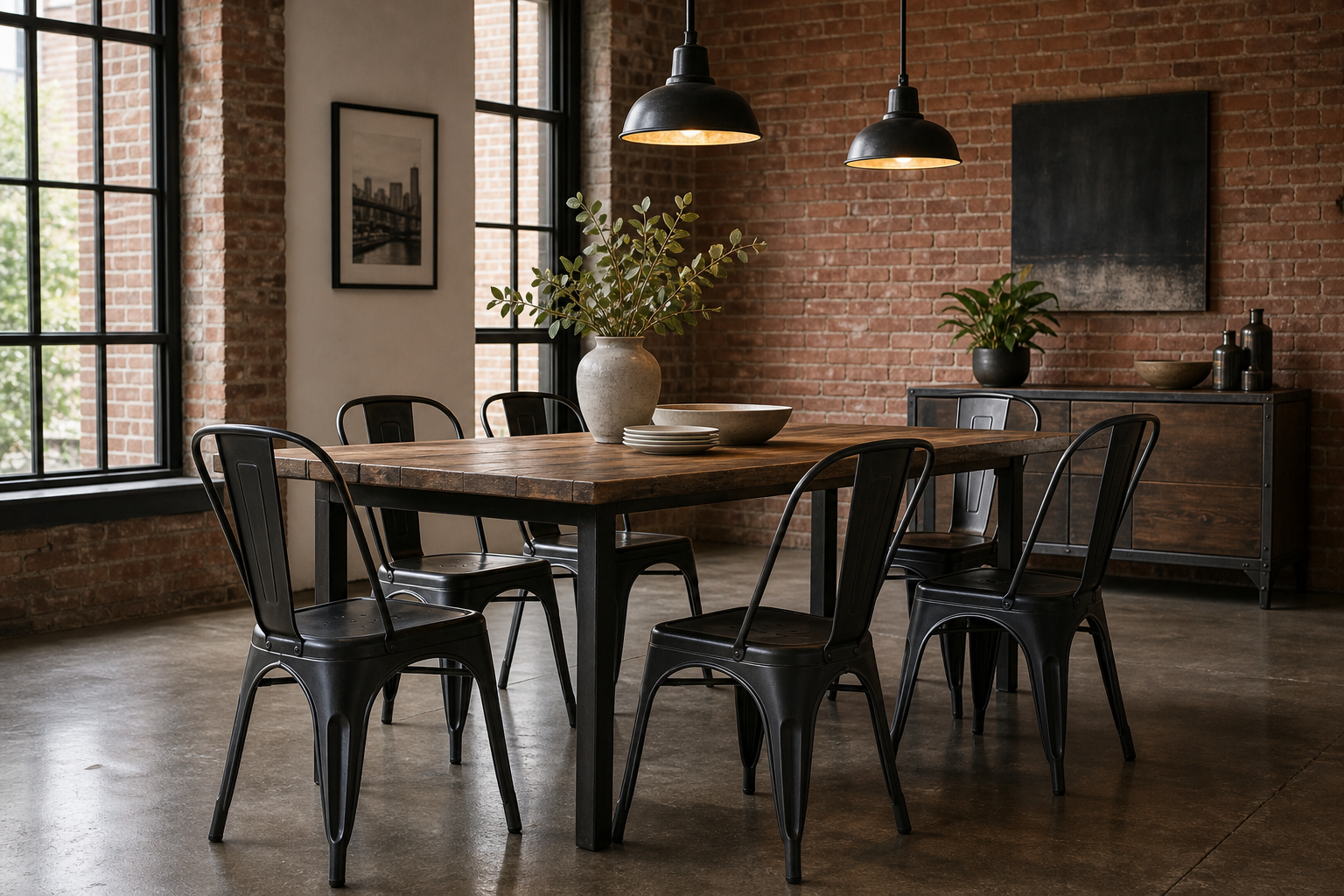

Six black metal chairs establish the dining room's industrial character more clearly than a collection of decorative accessories could. Their slim bent frames repeat around a heavy timber table, creating a dark rhythmic perimeter against the red brick wall and concrete-toned floor. The chairs are visually light, but their repeated silhouette gives them collective authority.
Two black dome pendants hang over the tabletop and reinforce the chair finish, while tall factory-style windows extend the same dark lines vertically. Timber, brick, and metal are therefore not isolated materials; each occupies a distinct scale and direction. The room feels robust because that material hierarchy is easy to understand at a glance.
Repeated Chair Backs Create a Measured Perimeter
Each chair uses a curved upper rail, narrow back panel, tapered legs, and small perforations in the seat. Repetition produces a steady cadence along both long sides and the table ends. Because the frames remain open, the brick wall and table legs can still be seen through the seating group.
The dark finish separates every chair from the warm tabletop without adding another color family. Seats tuck beneath the apron, reducing their footprint when not in use. Exact dimensions cannot be read from the image, but the visible spacing keeps neighboring frames from touching and leaves individual places distinct.
A Heavy Table Gives the Slim Frames a Counterweight
The tabletop is thick, broad, and visibly textured, supported by straight dark legs. Its mass prevents the metal chairs from making the room feel temporary or cafe-like. Wood grain and irregular tonal variation also introduce warmth where hands, plates, and serving pieces meet the furniture.
A large pale vessel with branches occupies the center, accompanied by stacked plates and a low bowl. Their restrained height preserves views across the table. The arrangement demonstrates that a substantial dining surface needs only a few objects when its grain and edge profile already provide visual interest.
Brick and Metal Share the Same Visual Weight
Exposed red brick covers the main wall and wraps the window piers. Its small units create a dense background, while the black chair frames draw broader lines in front. Neither material overwhelms the other because rough masonry is balanced by the repeated precision of manufactured metal.
A dark sideboard combines a black outer frame with warmer mottled fronts. It sits low against the brick, leaving room for a large black artwork above. Bottles, a bowl, and a plant remain contained on the cabinet top, so the rear wall supports the dining group without duplicating its clutter.
Pendant Placement Reinforces the Table Length
Two dome pendants are spaced along the centerline rather than replaced by one oversized fixture. Their broad shades direct light downward and echo the rounded shoulders of the chair backs. The pair also marks the usable span of the table, visually connecting places at both ends.
Warm light is visible inside the dark shades, but an exact bulb temperature cannot be inferred. Daylight from the tall black-framed windows supplies a wider ambient layer and brightens the concrete-toned floor. The combination keeps the brick legible without flattening its texture.
Clear Floor Edges Preserve Circulation
The dining set occupies the center of an open floor with a generous visible margin beside the windows and in front of the sideboard. Chairs can pull back without meeting a rug edge, and the route past the cabinet remains continuous. The polished floor makes those clearances especially easy to read.
To apply the same logic, pair a visually heavy table with chairs whose open frames reduce bulk, repeat the metal finish in overhead lighting, and allow masonry to remain exposed around the group. The room's conviction comes from honest contrast between thick timber, fine metal, rough brick, and an uncluttered floor plane.
Chair legs land directly on the polished floor, where their angled profiles cast fine shadows distinct from the table's square supports. This contrast makes the seating easy to count and keeps the central group from collapsing into one dark mass. At the rear, the sideboard's raised frame and short legs continue that visible-floor strategy, so even the heavier storage piece remains separate from the brick wall and floor plane. Open floor at the table ends also preserves a clear approach to the outer chairs.