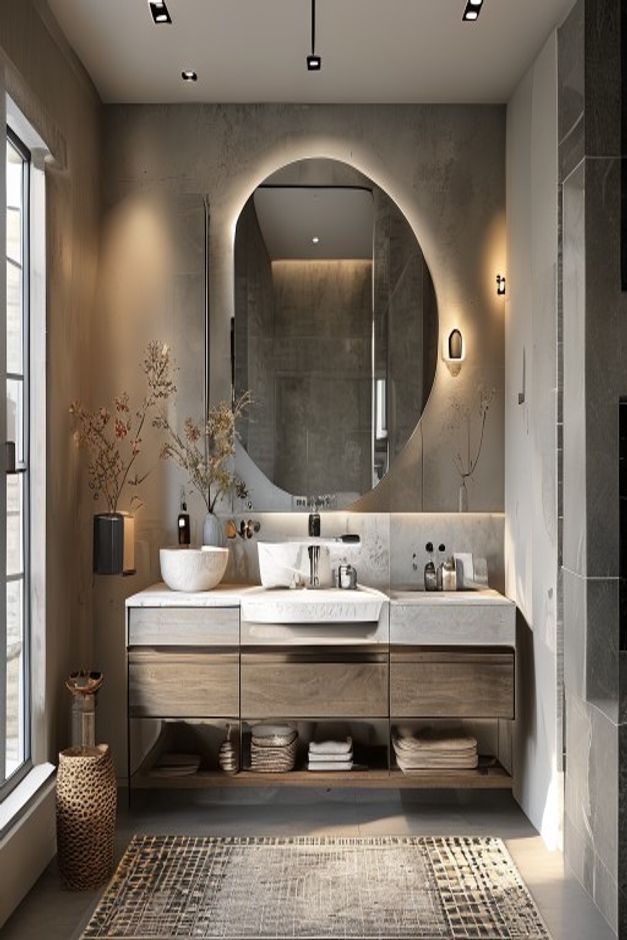

The oval mirror transforms an otherwise rectilinear vanity wall. Its broad curved outline rises above the counter and is surrounded by a soft halo, creating a focal point against gray textured surfaces. The light makes the mirror feel almost weightless, an effective contrast to the substantial floating cabinet below.
Industrial character is present in the dark window frame, compact black ceiling fittings, gray wall planes, and straightforward cabinetry. Curves, warm wood tones, plants, and woven pieces temper those harder elements. The bathroom therefore reads as controlled and tactile rather than cold.
The Oval Mirror Softens a Wall of Straight Joints
Vertical seams divide the wall and vanity fronts into broad rectangles. The mirror crosses those lines with an asymmetrical oval that is wider through its lower half. That difference gives the wall movement while preserving enough blank surface around the edge for the shape to remain clear.
Its scale is generous relative to the vanity, reflecting both the ceiling and deeper room surfaces. A smaller mirror would leave the broad wall underused, while a full-width rectangle would repeat the cabinet geometry and flatten the composition.
The mirror's broad oval nearly fills the central wall but leaves visible textured surface at its sides. That margin is essential; it allows the curved silhouette and backlit halo to be perceived. Extending the mirror to the corners would remove the contrast that gives the feature its graphic clarity.
Backlighting Separates Mirror from Surface
A warm halo is strongest around the upper and right edges, revealing the gap between mirror and wall. This grazing light emphasizes texture without introducing visible side sconces around the main outline. A smaller illuminated object on the right adds another low point of light without challenging the principal mirror.
The Floating Vanity Keeps the Floor Visible
Wood-toned drawers and doors span the wall but stop well above the floor. An open shelf runs beneath them with folded towels and baskets arranged in separate groups. The shadow below and visible floor line make the broad cabinet appear lighter in the narrow room.
The vanity combines closed fronts at hand height with open storage below. The image does not reveal drawer interiors, but the visible hierarchy is practical: everyday counter functions remain above, while soft items occupy the low shelf without adding a freestanding unit.
An open shelf beneath the vanity holds folded towels and exposes the wall behind. The shelf provides a practical lower layer without enclosing the entire base. Because the floor remains continuous under it, the wide cabinet appears shallower and the narrow bathroom retains a sense of depth.
Two Basin Forms Create an Unusual Counter Rhythm
A broad rectangular basin is integrated near the center, and a separate rounded white vessel sits on the left. Both are clearly visible, though the photograph does not explain whether they serve identical functions. Their contrasting forms repeat the room's wider tension between straight cabinetry and the curved mirror.
The rectangular central basin and the smaller round vessel at the left are visibly different forms. Their contrast adds interest across the long top, but the photograph does not establish the smaller vessel's exact function. Treating it simply as a visible counter object avoids inventing plumbing or storage behavior.
The Side Window Adds Hard-Edged Daylight
A tall dark-framed window on the left sends strong natural light across the vanity and floor. Its rigid mullions supply the clearest industrial line in the scene. The warm mirror halo remains visible even in daylight, which helps the focal wall maintain depth rather than becoming a flat reflection.
The floating-cabinet proportions can be compared with this published quiet luxury bathroom vanity. Here, the oversized oval and darker structural details make the visual language more graphic.
Accessories Stay at the Wall Edges
Tall branches occupy the left counter, small bottles gather to the right, and a perforated cylindrical object sits near the window at floor level. These pieces frame the vanity without blocking the basin or mirror center. Their irregular silhouettes soften the strict cabinet run.
The strongest takeaway is to let one curved element carry the drama. The mirror already supplies scale, light, and shape, so cabinetry and wall finishes remain restrained. Additional patterned tile or multiple decorative sconces would weaken that hierarchy and make a compact bathroom much harder to read.