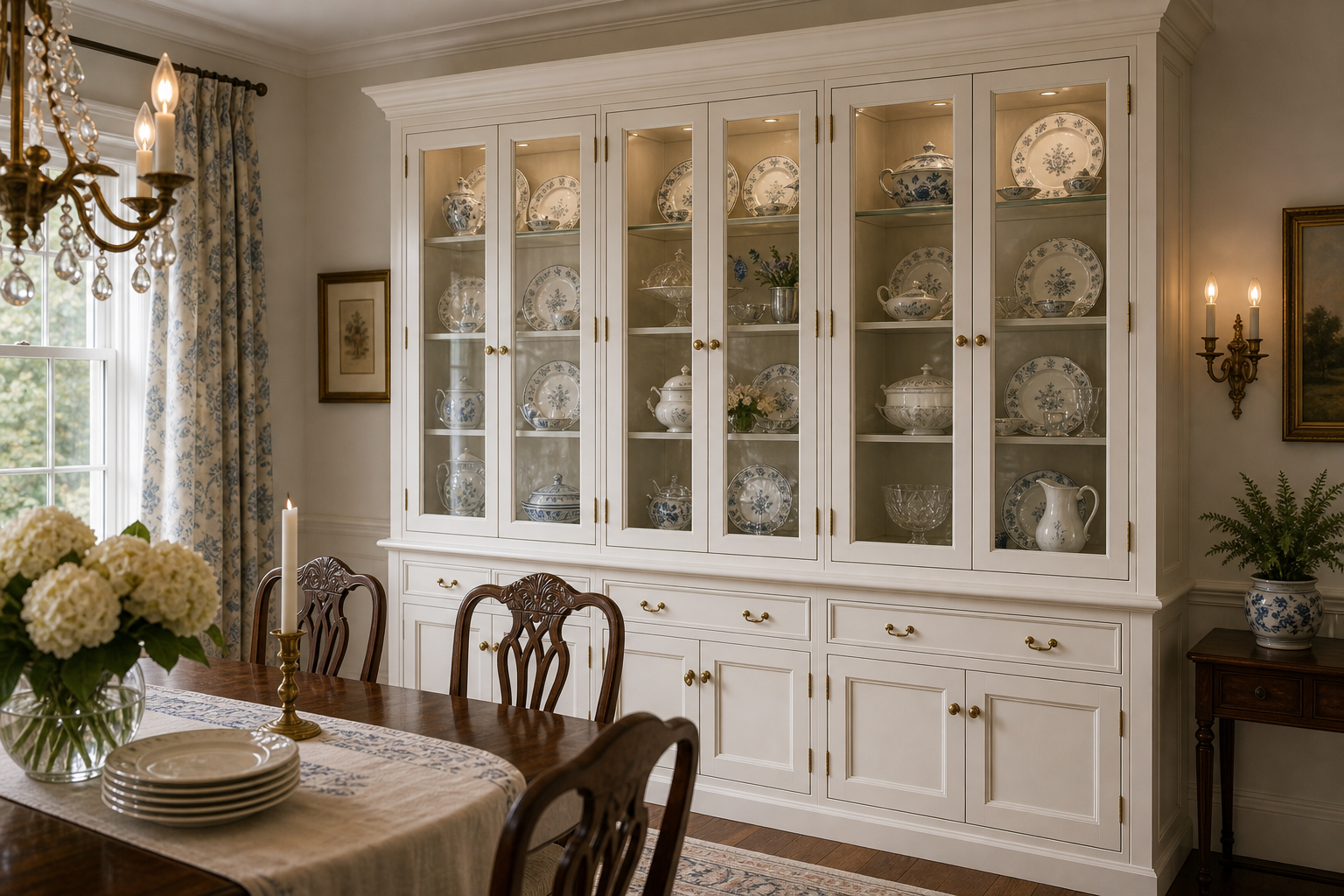

A single feature gives this dining room its identity: full wall china cabinet.
Glass-front upper doors handles the next practical requirement, wall sconces extends the view, and pale drapery closes the composition at the perimeter.
The China Cabinet Becomes the Dining Room Architecture
Lower drawers and cupboards is positioned along the direction already set by full wall china cabinet.
The junction around traditional dining chairs should stay precise and easy to maintain. A related spatial decision appears in japandi Dining Room Table Centerpiece, though its strongest element occupies another plane.
Sample the finishes of traditional dining chairs and chandelier together in existing light, because their contrast determines whether the focal area reads cleanly.
Glass Doors Give Display Without Full Exposure
A change of material occurs where the room’s dining chairs meets chandelier, but their junction remains simple.
A homeowner should first test access to wood dining table from the normal approach. Only after that route works should the position of glass-front upper doors be fixed. The contrast with california Casual Dining Room Sideboard Styling makes the role of proportion especially clear.
Align lower drawers and cupboards to one visible edge of that china cabinet and leave the other side less formal; this maintains order without forcing symmetry.
Lower Storage Grounds the Tall Cabinet Wall
The same upper doors occupies only the area needed for its function. The remaining exposed floor or wall keeps the larger geometry of the same china cabinet intelligible.
The clear strip around wood dining table should remain visible after doors, chairs or working elements are in use. Static appearance alone is not a reliable test of the plan. Another material response can be seen in french Country Dining Room Upholstered Chair, where the hierarchy is deliberately different.
Keep the approach from wall sconces toward the nearby dining table free of projections, especially when furniture or fittings are in their operating positions.
The Table Sits Far Enough Forward to Breathe
Viewed diagonally, these upper doors bridges the distance from this china cabinet to the room’s dining table.
Review the room from its entrance and principal use position. These and cupboards must reinforce the nearby china cabinet from both views rather than disappearing behind it. The different emphasis in art Deco Dining Room Geometric Wall Art provides a useful comparison of scale.
Allow the room’s china cabinet to remain the largest uninterrupted shape.
Chandelier and Sconces Create a Formal Light Rhythm
An intentional asymmetry appears between the nearby and cupboards and the pictured dining chairs.
Preserve the tonal difference between those prominent dining chairs and chandelier.
Use pale drapery to finish the perimeter only after furniture, circulation and lighting have been resolved at the center.
What This Cabinet Wall Teaches
The broad field formed by chandelier supplies a resting plane behind the more articulated the existing dining chairs.
Keep stronger color close to those dining chairs and use chandelier for visual rest.
Measure the usable gap from the nearby upper doors to the pictured dining table before choosing any additional piece; that interval carries the room’s daily movement.
The plan is most persuasive where the room’s and cupboards meets the open route beside that prominent dining table. Neither condition has been treated as leftover space.
Any future layer should answer an existing line, tone or use. A new object that ignores the pictured china cabinet and the same dining chairs would introduce a separate visual argument where the room currently maintains one clear idea.
The cabinet wall succeeds as architecture because display remains above eye level while opaque cupboards and drawers form a heavier base. That division keeps tableware accessible without exposing every dining-room object.
FAQ
Are glass-front cabinets practical in a dining room?
Begin with that prominent china cabinet and verify the clear route around the existing dining table.
How should a dining table relate to a cabinet wall?
The visible solution relies on contrast between these dining chairs and chandelier, plus enough open surface for both materials to remain distinct.
Do china cabinets need lighting nearby?
Follow the alignment from the room’s upper doors toward those prominent wall sconces.