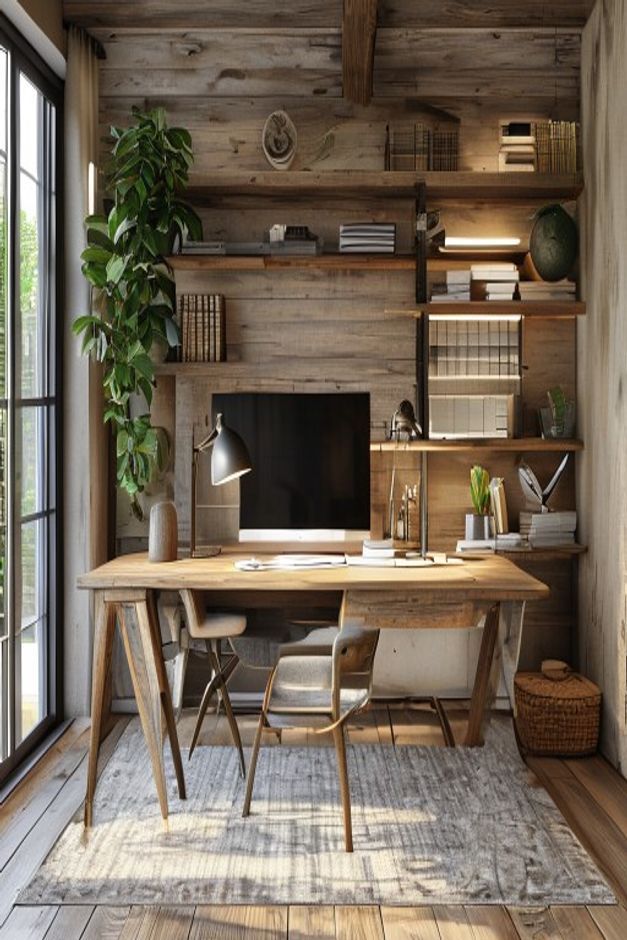

The shelving wall turns a compact office into a vertical workspace rather than relying on floor cabinets. Long wood-toned boards span the paneled rear wall above and beside a central monitor, carrying books, files, and small objects at several heights. Narrow integrated lights mark selected shelves, separating active reference zones from quieter display areas.
A simple trestle desk occupies the foreground, leaving its underside open around two light-framed chairs. Full-height glazing on the left brings daylight across the worktop and rug, while a tall plant softens the transition to the shelves. The room feels productive because storage rises behind the desk without enclosing the user's legs or approach.
Long Shelves Use the Full Width of the Work Wall
The upper boards extend nearly from the plant to the right wall, producing a broad horizontal structure against vertical wood paneling. Their varying lengths respond to the monitor and desktop below rather than forming a rigid retail grid. This gives files and books clear zones while preserving patches of visible wall.
Shelf thickness is substantial enough to relate to the rough ceiling beam and trestle legs. Very thin boards would appear fragile against those elements. The consistent warm tone ties storage, desk, floor, and ceiling together without requiring identical grain.
A central black support descends through several shelf levels and aligns near the desktop edge. This darker vertical line prevents the long boards from appearing unsupported and relates to the monitor, lamp, and window frames. Its placement also divides reference storage into two readable zones.
Integrated Light Makes Selected Levels Useful
Warm linear light appears beneath several shelves on the right, illuminating book spines and a file organizer. The light is localized instead of continuous across every board, creating a practical hierarchy. Areas closer to the desktop receive more emphasis than the highest display level.
A small desk lamp adds a separate pool on the worktop. Because the window dominates during the photographed daytime condition, these fixtures read as supplements for focused work rather than an invented all-purpose lighting scheme.
The Trestle Desk Keeps the Center Visually Open
A broad wood-toned top rests on angled trestle supports. The legs occupy the outer edges and leave the central knee zone free, allowing the two chairs to approach from opposite sides. This open base prevents a small office from becoming a stack of storage boxes.
The monitor sits close to the center of the rear wall, with papers and small tools distributed along the top. The desk remains visibly active, but objects are low enough that the shelves retain their continuity above it.
The desktop thickness and rounded front corners soften the trestle geometry. Daylight reveals scratches or tonal variation across the surface, which keeps the workspace from looking overly polished. The broad top remains the room's active horizontal plane beneath the more permanent wall storage.
Two Chairs Suggest Flexible Use Without Crowding
One chair faces the monitor from the near side, while a second sits behind the desk. Their slim metal-toned frames and pale seats occupy little visual volume. This arrangement can support a short conversation or shared task without adding a permanent lounge chair to the narrow room.
Window and Plant Balance the Storage Density
Tall black-framed glazing runs along the left edge and introduces the room's brightest plane. A leafy plant rises between the glass and shelving, breaking the hard boundary with an irregular silhouette. Its position uses a narrow vertical gap rather than consuming the working aisle.
The incoming light reveals the panel grain and casts shelf shadows across the wall. That variation keeps an extensive wood palette from flattening into one brown surface, while the pale rug returns brightness at floor level.
A Clear Foreground Protects the Work Route
The rug extends beneath the desk and chairs but leaves the approach from the doorway unobstructed. A single woven basket sits at the far-right wall rather than beside a chair leg. This protects the route to both seating positions and keeps loose storage outside the active foot zone.
The transferable strategy is to assign the wall to reference material, the desk to current work, and the floor to circulation. When those layers remain distinct, rustic surfaces can feel warm and substantial without making a compact home office look visually overfilled.