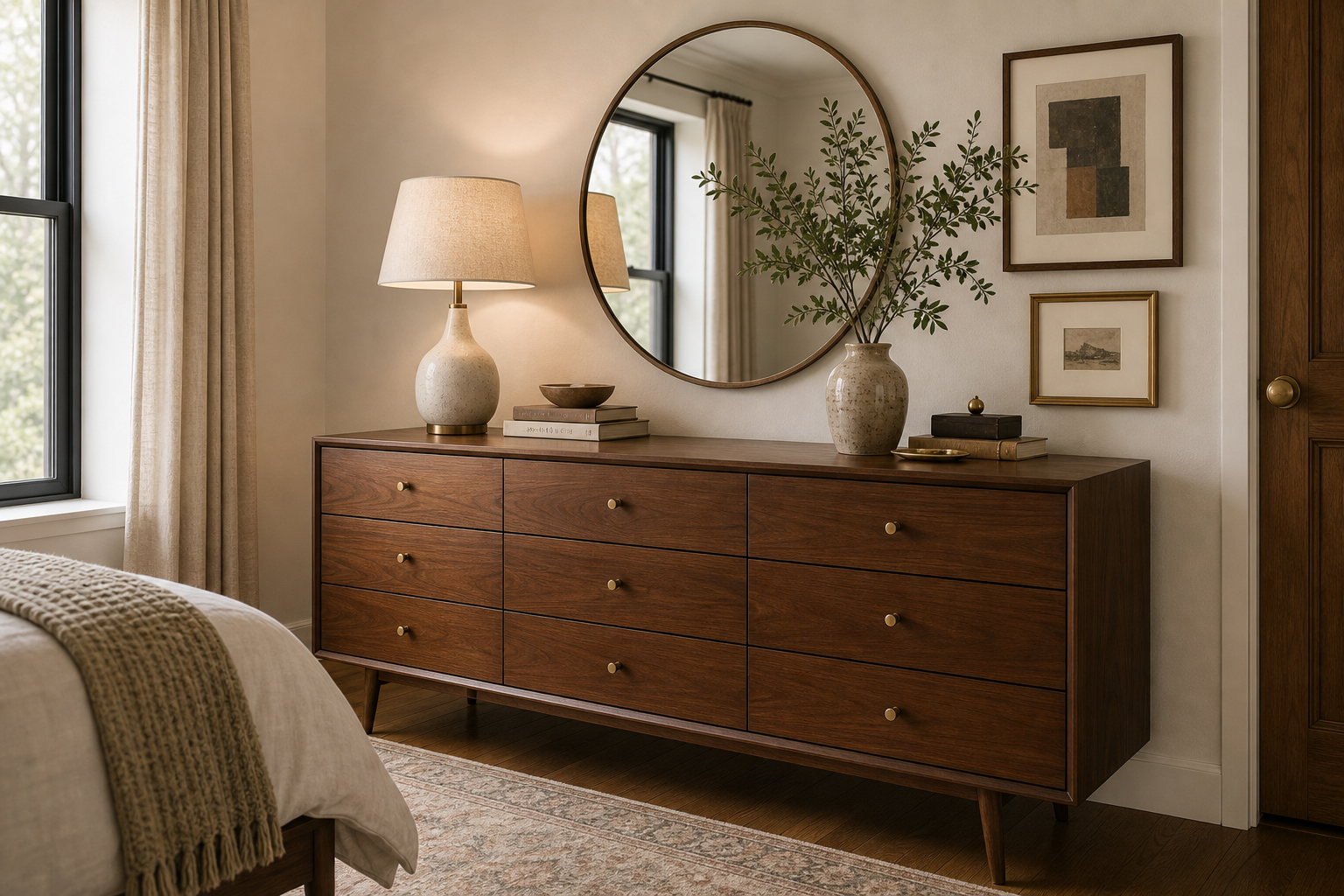

The dresser is substantial enough to carry an entire bedroom wall, yet its long raised body avoids appearing heavy. Nine flat drawer fronts form a three-by-three grid, small round brass-toned knobs punctuate that geometry, and tapered legs expose a continuous strip of dark floor beneath. Styling respects the furniture's ordered facade rather than obscuring it.
A large round mirror occupies the central upper wall, but the objects below are deliberately asymmetrical. A shaded ceramic lamp and low stack of books sit to the left; a taller branch vessel, small boxes, books, and dish sit to the right. The unequal groups balance through height, volume, and the mirror's stable center.
The Drawer Grid Supplies the Strongest Pattern
Three drawer columns and three horizontal rows create nine broad rectangles across the front. Fine reveals remain visible between every panel, and one small knob sits near the center of each drawer. This regular grid gives the dresser architectural clarity before any object is placed above it.
The image does not reveal drawer interiors or joinery, so organization systems should not be assumed. What matters is the visible scale: the dresser spans most of the wall but stays lower than the adjacent door handle and window midline, preserving room for mirror and art.
Tapered Legs Keep a Long Cabinet Off the Floor
Slim angled legs and a recessed lower rail lift the body above the dark timber floor. The shadow beneath makes the furniture appear lighter and allows the edge of the patterned rug to pass nearby without meeting a solid plinth.
The Round Mirror Interrupts Rectangular Furniture
A large thin metal-framed circle hangs above the middle drawer column. Its lower edge remains clearly separated from the dresser top, while its diameter relates to roughly one third of the furniture width. The curve softens the repeated rectangles of drawers, pictures, window, and door.
Lamp and Branches Balance Different Kinds of Height
The lamp at left builds a compact vertical with a rounded ceramic base and broad pale shade. At right, a similarly toned vessel carries open leafy branches above the mirror midpoint. One side gains visual density; the other gains height and transparency.
Their pale mottled surfaces correspond without matching exactly. Warm lamp light washes the left wall, while daylight from the black-framed window reveals the branches at right. Exact ceramic composition and bulb temperature cannot be confirmed.
Books Act as Low Horizontal Spacers
Two short book stacks sit beneath a shallow bowl on the left and small dark boxes on the right. Their long edges repeat the drawer lines and create low platforms for smaller objects. Keeping the stacks compact leaves broad areas of timber top visible.
Art Extends the Arrangement Beyond the Mirror
Two framed works hang to the mirror's right: a larger abstract geometric print above and a smaller landscape below. Their dark and gold-toned frames relate to the dresser knobs and mirror edge. The staggered pair fills the wall toward the door without becoming a symmetrical gallery.
The Dresser Relates to the Bed Without Copying It
A pale bed edge and chunky knitted throw enter the left foreground, contrasting with the dresser's dark timber tone. The muted patterned rug bridges those elements at floor level. Neutral curtains beside the black-framed window add a soft vertical plane opposite the timber door.
The dresser remains visually distinct from the bed, but shared cream, taupe, and dark brown tones keep both within one restrained palette. Green branches supply the only saturated color, preventing the top from becoming a collection of similarly brown objects.
Editing the Top Protects Daily Use
Objects occupy four contained groups and leave the front half of much of the top clear. Nothing hangs over drawer edges or obscures knobs. That open surface is as important as the styled areas because it preserves the furniture's practical character.
For a similar dresser, begin with one large curved element above, then balance a compact light source against a taller open branch arrangement. Use books to support small pieces and preserve uninterrupted timber between groups. Styling feels composed when it reveals the drawer grid instead of competing with it.
The door at right remains fully legible because the dresser stops before its trim, preserving a narrow pale wall strip between furniture and opening.