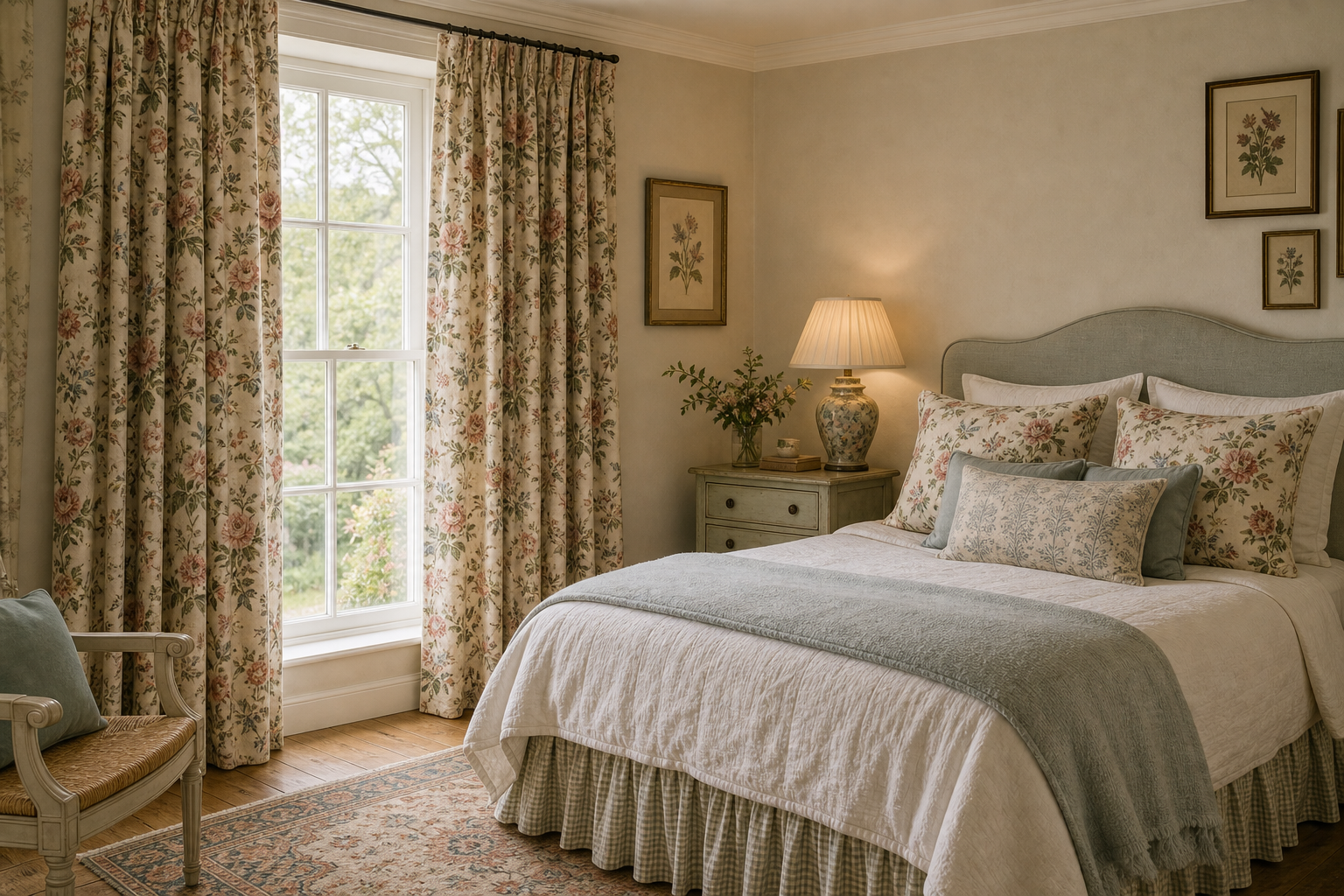

The room's floral pattern is concentrated in two places that can be read together: full-height curtains around the window and large pillows against the bed. The repeat is recognizably related without covering every textile. This creates an English country atmosphere through controlled continuity rather than an indiscriminate mix of prints.
Muted rose, sage, cream, and soft blue travel from fabric to artwork, lamp, rug, and throw. A pale curved headboard and white coverlet provide enough quiet area between those patterns. The bed remains restful because the floral elements frame it at the window and pillow layer instead of consuming the entire composition.
Full-Height Curtains Make the Window a Patterned Wall
Four gathered panels extend from a dark rod near the cornice to the timber floor. Their generous folds create vertical bands of flowers and foliage on both sides of the tall sash window. The central glass remains uncovered, preserving a strong view into the pale green garden.
The curtain scale suits the high opening: small floral motifs would dissolve at this distance, while the visible rose and leaf clusters remain legible. Fabric fiber and lining cannot be confirmed. What matters spatially is the floor-length drop and the way paired panels widen the perceived window.
Matching Pillows Bring the Window Pattern to the Bed
Two large floral pillows sit in front of white sleeping pillows and repeat the curtain's rose-and-green motif. Their rectangular shape occupies the main patterned layer without hiding the pale headboard. A blue-gray floral lumbar cushion introduces a related but finer print at the center.
Solid muted blue cushions sit behind the lumbar pillow, giving the eye a pause between floral scales. This sequence is carefully graduated: white at the back, large floral print, solid blue, then fine blue motif. The stack feels collected because each layer changes either scale or density.
The Curved Headboard Provides a Calm Outline
A pale upholstered headboard rises gently at the center and drops toward both sides. Its plain textured surface separates the patterned pillows from botanical pictures on the wall. The curve also softens the strong vertical lines of curtains, window casing, nightstand, and picture frames.
The headboard is wide enough to hold the pillow arrangement without extending far beyond the mattress. Exact upholstery fiber is uncertain, but its muted gray-green tone is visible. That color sits between the foliage print and the blue throw, quietly linking both sides of the palette.
A Checked Bed Skirt Adds Pattern at a Different Scale
A muted small-scale check appears beneath the white coverlet, visible along the foot and right side of the bed. Its regular grid contrasts with the organic floral motifs above. Because the check is low and partly shadowed, it adds depth without becoming another focal pattern.
The white coverlet forms the broadest textile plane and carries only a subtle crinkled texture. A blue-gray throw lies across the lower bed in one calm band. These large solids are essential; they give the more detailed curtains, pillows, rug, and bed skirt separate places to register.
The Bedside Group Repeats Color Without Copying Fabric
A painted two-drawer nightstand supports a patterned ceramic lamp, glass vase of branches, small candle, and books. The lamp's pale body contains blue-green decorative marks that relate to the bedding, while its pleated shade echoes the curtain folds at a much smaller scale.
The tabletop group remains below the adjacent botanical picture, preserving a clear hierarchy between furniture and wall art. Warm lamp light creates a concentrated glow beside the headboard. Exact lamp temperature is not visible, yet its local warmth balances the cooler garden daylight at the window.
Botanical Art and a Muted Rug Complete the Garden Logic
Three framed botanical works are spaced around the bed rather than arranged as a dense gallery. Their aged-looking dark and gold-toned frames add fine linear contrast to the pale wall. A patterned rug below combines soft rust, blue, and cream, grounding the room's repeated floral colors.
A woven-seat chair appears at the lower left with a blue cushion, adding another natural texture without introducing new pattern. To adapt this approach, repeat one floral fabric at two major locations, separate those repeats with broad plain surfaces, and vary secondary patterns by scale. The room feels layered because every print has a distinct job.