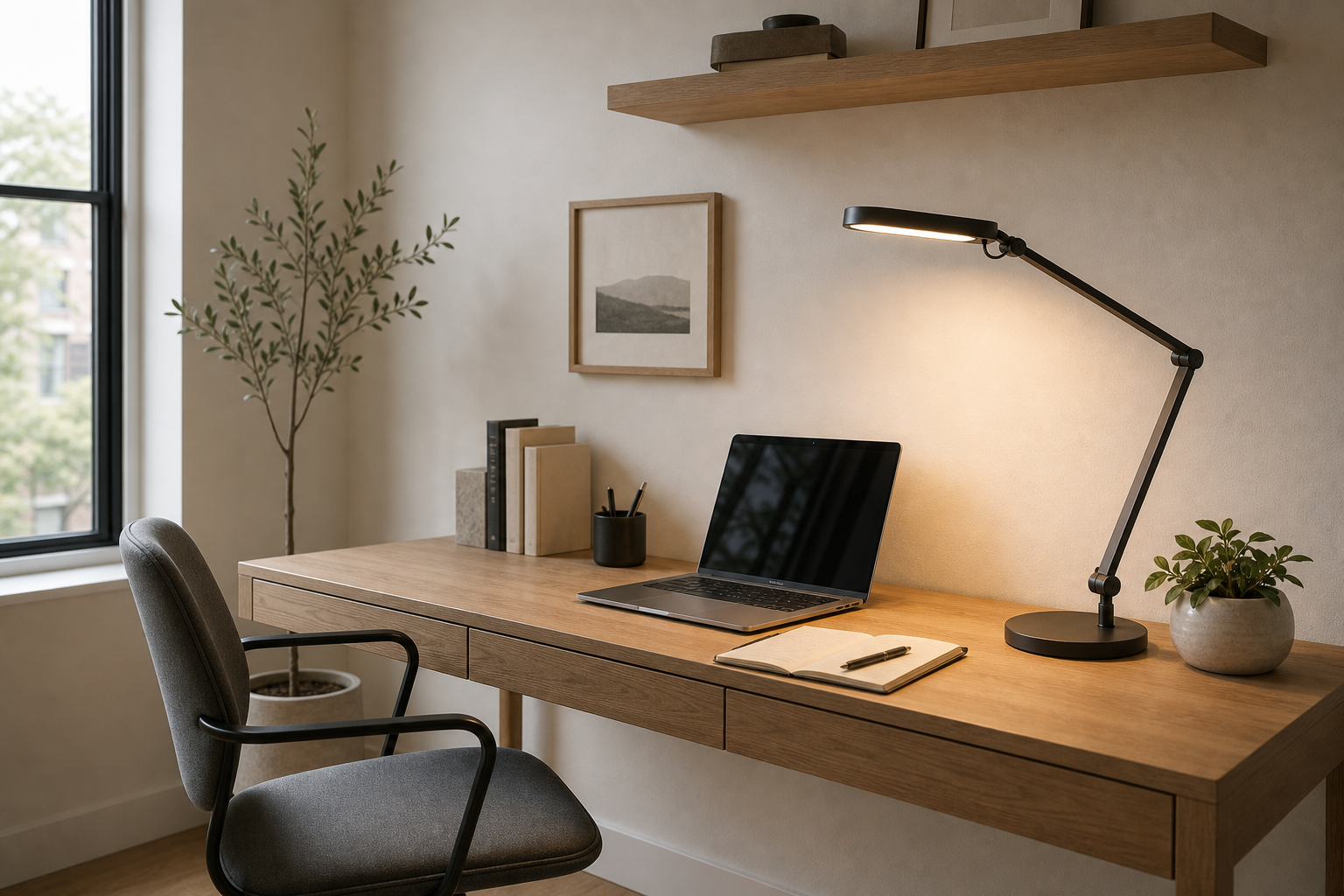

The black articulated lamp is not merely an accessory on this desk; it determines how the entire workstation is read. Its long angled arm reaches over the laptop and places a compact horizontal shade above the active part of the timber surface. Against a pale, largely empty wall, that dark mechanical line becomes the office's clearest visual gesture.
Daylight arrives from the tall window at the left, yet the lamp remains useful because it addresses a different task. The window supplies broad ambient light across the room, while the adjustable fixture can concentrate illumination on the keyboard, notebook, or reading material. This separation between general and local light gives a small office more control without filling the ceiling with fittings.
An Adjustable Arm Reaches the Actual Work Zone
The lamp base sits toward the right rear corner, safely beyond the main hand position, while two hinged joints carry the shade inward. That geometry frees the center of the desk and avoids placing a light source between the user and the laptop. A comparable setup should be tested from the seated position: the shade needs to reach the work, but the arm should remain outside the primary sightline and clear of the screen edge.
Side Daylight and Task Light Work in Sequence
The window is perpendicular to the desk rather than directly behind the screen. As a result, natural light travels across the worktop and reveals its grain without creating a bright opening on the wall immediately in front of the user. The desk lamp can take over as daylight falls. The layered approach echoes the practical lighting hierarchy in this Scandinavian home office desk lighting study, although this room uses a freestanding articulated fixture instead of a broader ambient scheme.
A Long Timber Surface Keeps Equipment in Proportion
The desk spans most of the wall and includes two shallow drawers beneath its front edge. That width gives the laptop, books, notebook, plant, and lamp individual breathing space. Nothing has been stacked around the light base, so its joints remain free to move. The uninterrupted front line also makes the work surface feel architectural rather than like a small table pushed against a convenient wall.
The Chair Preserves the Lamp's Working Geometry
A compact dark chair with open arms tucks beneath the left half of the desk. Its back remains lower than the worktop when seen from the doorway, allowing the light, screen, and wall to stay visible. The seat is centered on the laptop rather than on the full desk width, an important distinction when a wide surface contains both an active work zone and quieter storage space.
One Floating Shelf Balances the Horizontal Desk
A thick timber shelf sits high on the wall and extends from the right edge toward the center. Its asymmetrical placement answers the desk below without compressing the framed print or lamp arm. Only a few dark objects occupy the shelf, so it reads as a calm upper datum. Filling that ledge with many small items would create visual noise directly above the screen and weaken the disciplined lighting composition.
Dark Details Give the Pale Office Definition
The lamp, chair frame, window mullions, laptop screen, and small desk accessories repeat black in narrow, functional lines. Timber remains the secondary material, appearing at the desk, drawer fronts, shelf, and picture frame. A small plant and tall branch introduce the only concentrated greenery. The room stays minimalist because contrast follows use: dark elements identify equipment and edges, while the broad wall and floor remain quiet.
The wall area directly behind the laptop is intentionally left blank, reducing contrast around the screen and giving the lamp arm a clean field in which to move. The framed print sits above the book group rather than over the display, while the plant remains below shade height. These offsets prevent the desk from developing a false center around decoration. They also show a practical order for a compact office: screen first, light reach second, tools within hand range, then art and greenery in the remaining peripheral zones. The result supports concentration without making the workspace visually sterile.
The pale planter remains below the lamp shade, ensuring leaves cannot cast distracting shadows across the keyboard or interrupt adjustment of the lower arm.