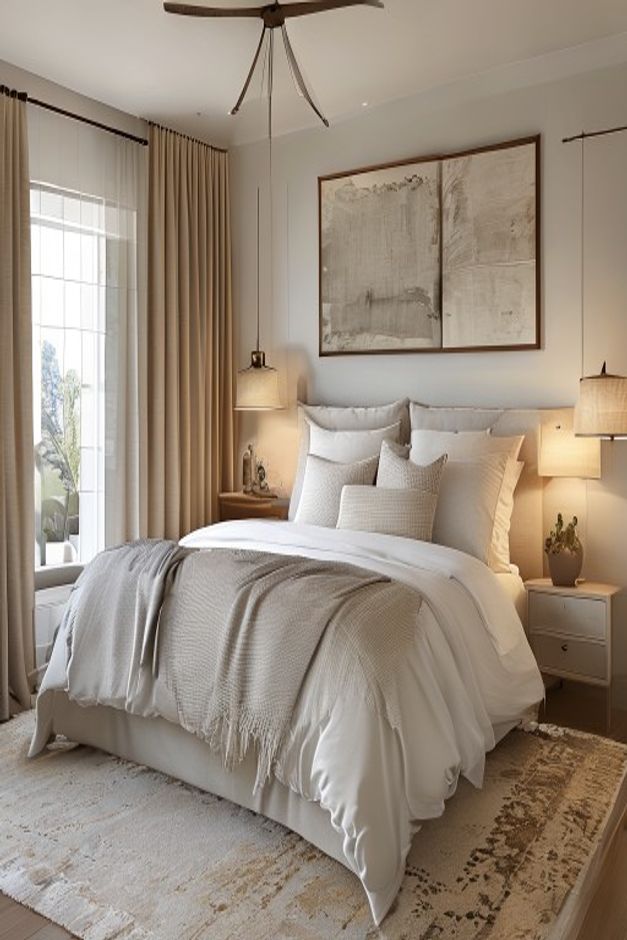

The lighting around this bed is deliberately layered rather than perfectly matched. Slender pendants descend near both sides, shaded table lamps add lower pools of warmth, and daylight enters through the tall window at the left. The combination gives a neutral bedroom depth while keeping the floor and nightstands relatively uncluttered.
A large framed diptych above the bed establishes the visual center, but light determines how the composition is experienced. Warm glows collect at pillow height, bright window light washes the curtain folds, and the pale bedding reflects both. The result feels contemporary and comfortable without depending on a decorative feature wall.
Pendants Free the Narrow Bedside Surfaces
A small dark pendant drops at the left, and a larger fabric-shaded pendant hangs near the right. Both occupy air rather than table space, leaving the nightstands available for a few compact objects. Their cords also create fine vertical lines that relate to the full-height curtains.
The fixtures are not identical, yet they sit at comparable functional heights. This is useful in an asymmetrical room where the window compresses one side of the bed. Equal light at the pillows matters more than matching every shade and suspension detail.
Each hanging shade occupies a narrow vertical strip beside the bed, leaving the artwork and headboard unobstructed. Their unequal appearance does not harm the room because both descend to comparable functional heights. The eye reads a balanced pair of lighting zones rather than demanding identical decorative objects.
Table Lamps Add a Lower, Softer Layer
A shaded lamp glows on the right nightstand, while a smaller source is visible nearer the left side. These lower fixtures fill the gap between the pendants and mattress, preventing harsh contrast at eye level. Their warm shades also introduce a domestic note that offsets the cleaner black hanging hardware.
The Bed Remains the Brightest Mass
White duvet folds and layered pillows form the largest pale area in the room. Taupe throws and textured cushions add depth without reducing that brightness. Because the lighting is distributed around the bed rather than aimed from one overhead point, those layers retain visible relief after dark.
The upholstered bed base and headboard stay quiet beneath the abundance of cloth. A stronger frame or dark headboard would create another heavy outline below the art. This restraint keeps the visual sequence clear: rug and bed at the base, artwork above, then the fine ceiling fixtures.
Full-Height Curtains Manage the Bright Window Edge
Taupe curtains hang close to the ceiling along the left wall, with a translucent layer at the glass. Their folds soften direct daylight and turn the window into a broad vertical surface rather than a bright cutout. The curtain color repeats in the bedding, linking the window and bed.
A more curtain-led neutral scheme appears in our published warm neutral bedroom with linen curtains. Here, the drapery primarily supports a lighting story by controlling the strongest daytime source.
The curtain stack occupies the wall beside the left nightstand without spilling across the bed. Its vertical folds create a soft boundary to the bright opening and echo the long pendant cords. Keeping the fabric gathered at the edge preserves daylight while avoiding a hard transition from glazing to painted wall.
Large Art Balances the Window's Scale
The broad two-part artwork spans much of the wall above the headboard. Its muted abstract surface is large enough to answer the tall window without introducing a competing color. A dark slim frame relates to the rods, pendant cords, and ceiling fan overhead.
The two framed panels are centered over the headboard as one broad composition. Their combined width approaches the bed rather than either nightstand, reinforcing the sleeping zone and keeping visual weight away from the bright window edge.
The Room Avoids a Single Decorative Fixture
A ceiling fan with a restrained dark structure occupies the upper center rather than a prominent chandelier. This lets the bedside lights provide atmosphere where it is needed. The room's comfort comes from several modest sources working together, not from one central object asked to illuminate every surface.
For a similar bedroom, resolve the bed position, window clearance, and nightstand widths before choosing fixtures. Pendants can recover table space, while shaded lamps provide softer local light. This photograph succeeds because those choices respond to unequal wall conditions instead of forcing superficial symmetry.
The ceiling fan remains pale and visually separate from the lower bedside lights. It occupies the room's center without replacing the more focused fixtures beside the bed.