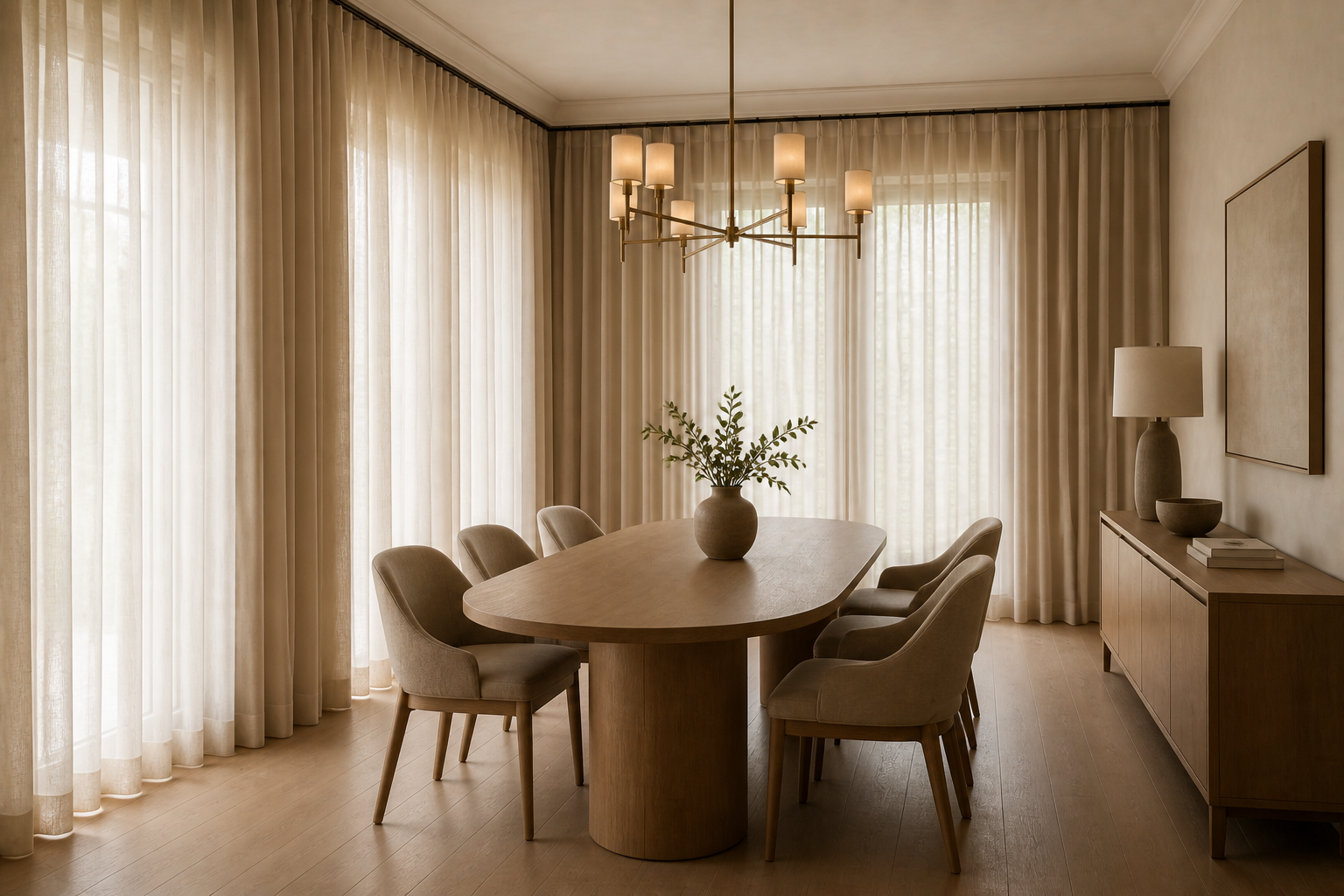

The window wall has been turned into a continuous luminous backdrop with full-height pale curtains. Their close vertical folds soften the glazing and bring the apparent room height down to the oval table and rounded chairs in front. A fine chandelier provides the only dark overhead line, while a low sideboard stays at the perimeter. Quiet luxury here comes from the control of daylight, scale, and repetition rather than conspicuous finishes.
Full-Height Drapery Creates a Luminous Wall
The linen panels begin near the ceiling and fall to the floor, which visually stretches the window wall. That vertical movement makes the dining room feel taller without adding architectural trim. The fullness of the fabric also matters. Thin panels would look temporary, while these repeated folds give the room weight and softness.
Curtain panels extend across several glazed openings, hiding the interruptions between individual windows and producing one broad background. They appear to meet both ceiling and floor, which removes short exposed wall bands that could visually reduce the room's height.
The curtains diffuse daylight instead of exposing the windows sharply. That filtered light gives the timber-toned table, chairs and floor a gentle tonal shift. This is where the room feels expensive in a quiet way. The light is controlled, but the space still feels natural.
An Oval Table Fits the Softened Perimeter
The oval table softens the strong vertical rhythm of the drapery. Its rounded ends make the dining area feel easier to move around than a sharp rectangular form would. The central pedestal also keeps the floor below the table visually lighter, which helps the curtain wall remain the dominant backdrop.
The table's curved ends ease movement between chair backs and the curtained perimeter. Its solid cylindrical base also keeps the center calm, avoiding multiple legs that would add another vertical rhythm beneath already prominent fabric folds.
Rounded Chairs Repeat the Gentle Geometry
The chairs repeat the softness of the drapery in a smaller scale. Their curved backs and muted fabric make the dining setting feel comfortable without drawing attention away from the windows. Their color stays close to the curtains and walls, which is important. Quiet luxury relies on small shifts in tone rather than high contrast.
The chandelier introduces a precise metal line above the table. It gives the dining area a center point while the curtain wall remains wide and atmospheric. Its shaded lights are gentle rather than theatrical, which suits the filtered daylight and warm wood.
Dark slender arms spread above the table without approaching the curtain plane. This contrast allows the light to identify the dining axis from across the room while its open frame leaves the filtered windows visually continuous behind it.
A Low Sideboard Avoids Competing With the Windows
The sideboard runs along the wall without competing with the tall drapery. Its low profile gives storage and surface space while preserving the room's vertical emphasis. The lamp, bowl and framed art above it create a quiet secondary moment, not a separate focal wall.
Begin with curtain height and fullness. Mount panels as high as the room allows, and choose enough fabric that the folds look intentional when closed or partly open. Then keep the dining furniture in related tones. Pale wood, taupe upholstery and warm ivory fabric work together because none of them interrupts the light.
Specifying Drapery Around a Working Dining Zone
I would not shorten the drapery to the window frame. The full-height drop is what gives the room its quiet sense of scale. I would also avoid bold chair colors in this specific room. The value of the design is in the soft transitions between fabric, wood and daylight.
The more fixture-led quiet luxury dining lighting analysis builds drama overhead. This image uses the chandelier as punctuation while full-height fabric controls the room's atmosphere.
A small branch arrangement stands on the table and rises into the light field without reaching the chandelier. Its irregular silhouette relieves the strict curtain folds at the center. The sideboard holds only a lamp and a few low objects, ensuring the perimeter remains secondary to filtered window wall and dining group.
Curtain hems finish in a controlled line at the floor, allowing chair legs and sideboard base to remain readable against them. That tidy termination is crucial when fabric occupies nearly an entire elevation.