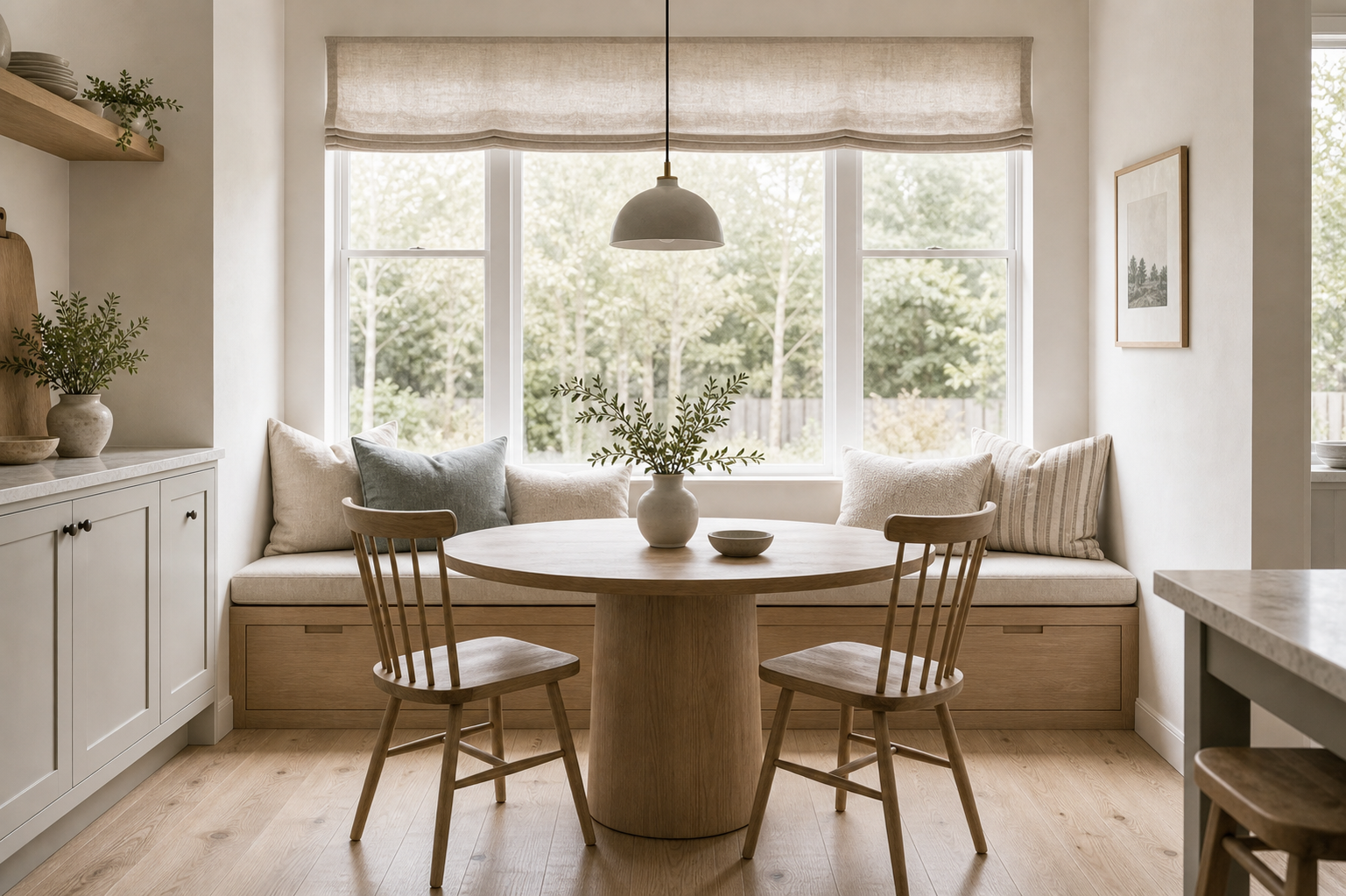

A bright window bay has been converted into a dining place without turning the kitchen into a furniture obstacle course. The built-in banquette occupies the full width below the glazing, while a round pedestal table and two open-backed chairs complete a compact three-sided arrangement. Pale cushions keep the seat visually continuous with the window, and surrounding cabinetry makes the nook feel embedded in the room rather than added after the plan was finished.
The Banquette Claims the Window Bay
The banquette fills the wall below the window and creates the main reason to use this corner. Its built-in base makes the seating feel planned, not improvised, which is especially important in a compact kitchen nook.
The seat runs wall to wall inside the bay, eliminating narrow unusable gaps at either end. Its back remains low, so the window frame and outdoor view stay fully legible above the cushions. The construction reads as part of the perimeter rather than a freestanding bench.
The window gives the banquette its best quality: daylight at the back of the seating area. Daylight reaches the cushion directly below the glass, giving the built-in seat a bright, useful position beside the kitchen cabinetry.
A Pedestal Table Frees the Inner Edge
The round table keeps movement easier between the chairs, banquette and adjacent kitchen surfaces. Its single pedestal also gives the seated area more leg room than a heavier table base would.
A single central support leaves knees and feet less obstructed on the banquette side. The circular edge also reduces sharp projections into the routes between the chairs and nearby cabinetry, an especially useful decision where the dining zone is reached from more than one side.
Two Open-Back Chairs Complete the Nook
The wood chairs face the banquette and turn the window seat into a real dining arrangement. Their open backs are useful because they do not block the view of the cushion, window or table.
Slender chairs can be pulled away without creating a solid barrier in front of the window seat. Their vertical backs echo the window divisions but allow light through, preserving the sense that the arrangement belongs to the bright bay.
The Pendant Marks the Table Center
The pendant centers the table and gives the nook a clear point of focus from above. Its simple dome shape fits the Scandinavian restraint and does not compete with the window.
The cream cushion and pale pillows keep the built-in seat from feeling heavy. The soft gray and striped pillows add just enough variation while staying close to the room's quiet palette.
Lower Drawers Give the Seat a Working Role
The drawer fronts below the cushion make the banquette base feel useful rather than purely decorative. They also keep the lower line clean, which suits the Scandinavian approach to practical simplicity.
Visible drawer fronts align beneath the cushion in a clean horizontal band. Their presence confirms storage without inviting speculation about internal organizers. More importantly, the recessed pulls keep the base smooth where feet and chair legs move close to it.
Planning a Nook That Does Not Block the Kitchen
Start with a window wall that can hold a built-in seat without blocking kitchen movement. Then use a round table, slim chairs, a simple pendant and pale cushions. The goal is to make the nook feel easy to enter and pleasant to sit in.
The Scandinavian kitchen island study organizes a larger central work zone. This nook demonstrates the same preference for pale surfaces and clear circulation at a smaller scale, using the window perimeter for dining instead of consuming the kitchen center.
Cabinetry at both sides of the bay stops below or beside the glazing instead of climbing across it. This creates a clear bright center for dining and places storage on the perimeter, where door and drawer movement does not conflict with seated knees. The table is close enough to the banquette for use but leaves its rounded edge visible on both sides. That readable gap distinguishes the furniture from the built-in base and helps the compact nook avoid looking overfilled.
The pendant hangs above the table rather than the seat, so it marks the shared surface without interrupting the window view. Its dark rim also supplies one concise contrast against cabinetry and pale fabric.