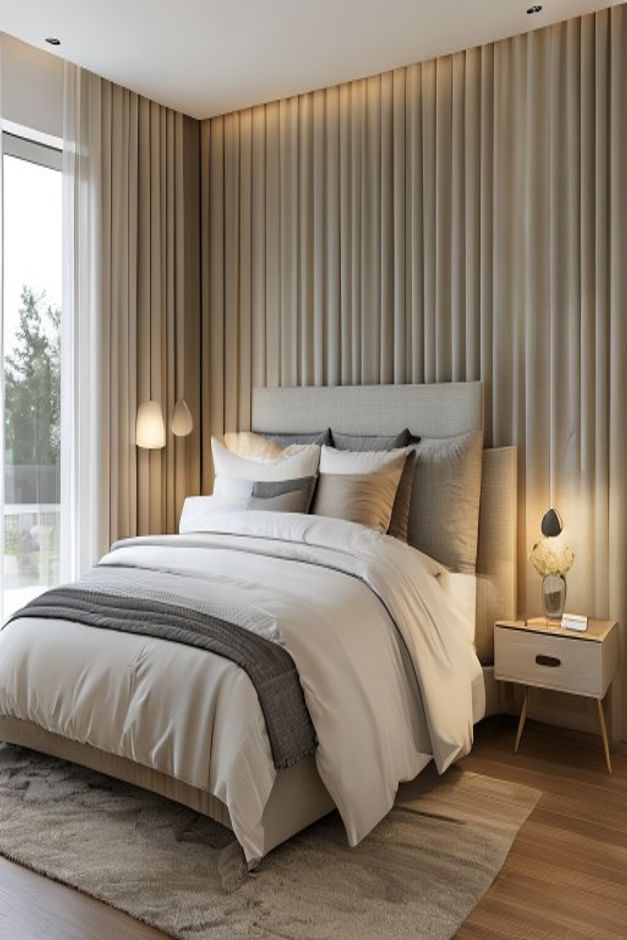

The bed wall is not painted, paneled, or covered with conventional artwork. Instead, dense vertical folds extend from floor to ceiling and continue around the left corner, turning drapery into the room's principal architectural surface. The effect is soft, but it is not casual: repeated pleats create a disciplined rhythm behind the headboard.
This treatment changes how the room's proportions are perceived. The continuous vertical lines make the ceiling appear higher, while the broad upholstered headboard and generous bed hold the lower half steady. Warm light grazes the fabric from above and beside the bed, revealing depth that a flat wall finish could not provide.
Pleated Fabric Replaces a Conventional Feature Wall
Closely spaced folds cover the entire visible rear wall rather than stopping at the width of the mattress. That full-span approach is essential. A narrow panel of fabric would look decorative; the continuous treatment reads as part of the room enclosure and gives the bed a sheltered setting.
The color remains close to taupe and warm gray, allowing shadow to create the strongest contrast. Each fold has a light edge and a darker recess, so the surface changes throughout the day without introducing a printed pattern. The material itself cannot be identified precisely, but its weight is sufficient to hold a consistent vertical form.
The Corner Is Softened Rather Than Emphasized
At the left, the pleated surface turns toward the window wall and meets a sheer curtain at the glazing. This makes the corner read as a continuous textile transition instead of a hard junction between backdrop and window treatment. The bed consequently feels nested within the room rather than placed against one isolated elevation.
The turn also hides the sharp difference between the solid wall and the bright glazed opening. Instead of ending at a visible corner seam, the folds lead into the sheer window layer. That continuity is especially persuasive from the bed, where the room reads as one soft perimeter rather than separate wall and curtain treatments.
An Upholstered Headboard Creates a Quiet Horizontal Break
The broad pale headboard crosses the vertical folds at shoulder height and establishes the primary horizontal line. Its simple rectangle is deliberately free of tufting or trim, because the wall already provides strong texture. The headboard projects just enough to separate pillows from fabric while remaining visually integrated with the neutral backdrop.
White bedding expands the bright center below it, and a dark gray throw introduces a lower horizontal band. These layers keep the eye moving down the composition instead of following the pleats uninterrupted from ceiling to floor.
Bedside Lights Puncture the Textile Rhythm
Small hanging lights appear on both sides, but they do not match exactly. Their rounded forms interrupt the vertical lines and cast localized warmth onto the folds. A slim nightstand and low surface at the right provide practical support without covering much of the draped wall.
The room also receives daylight from the large opening on the left. During the day, that side light sharpens the pleat shadows; after dark, the bedside fixtures create warmer, shorter gradients. The tonal curtain strategy in this warm neutral bedroom with linen drapery offers a less enveloping comparison, while the present image treats cloth as architecture.
The Room Needs Restraint Everywhere Else
A large soft rug, plain bedding, one narrow nightstand, and a small vase are enough to support the draped envelope. Additional wall art would sit awkwardly against the folds, and bulky case furniture would hide the floor-to-ceiling effect. The visible furniture therefore remains low and lightly detailed.
This bedroom's practical lesson is not simply to hang curtains higher. The entire composition has been edited around one tactile surface: the bed is centered, the headboard is quiet, lights are compact, and the palette stays narrow. Without those supporting choices, a fully draped wall could become theatrical. Here it feels controlled, warm, and appropriate to rest.
Dust, movement, and access would need practical consideration in a real installation, yet the visible composition offers one clear rule: keep floor contact tidy. The panels fall in controlled lines beside the bed and do not pool across the walking area. That disciplined lower edge is what allows the treatment to look architectural rather than temporary.