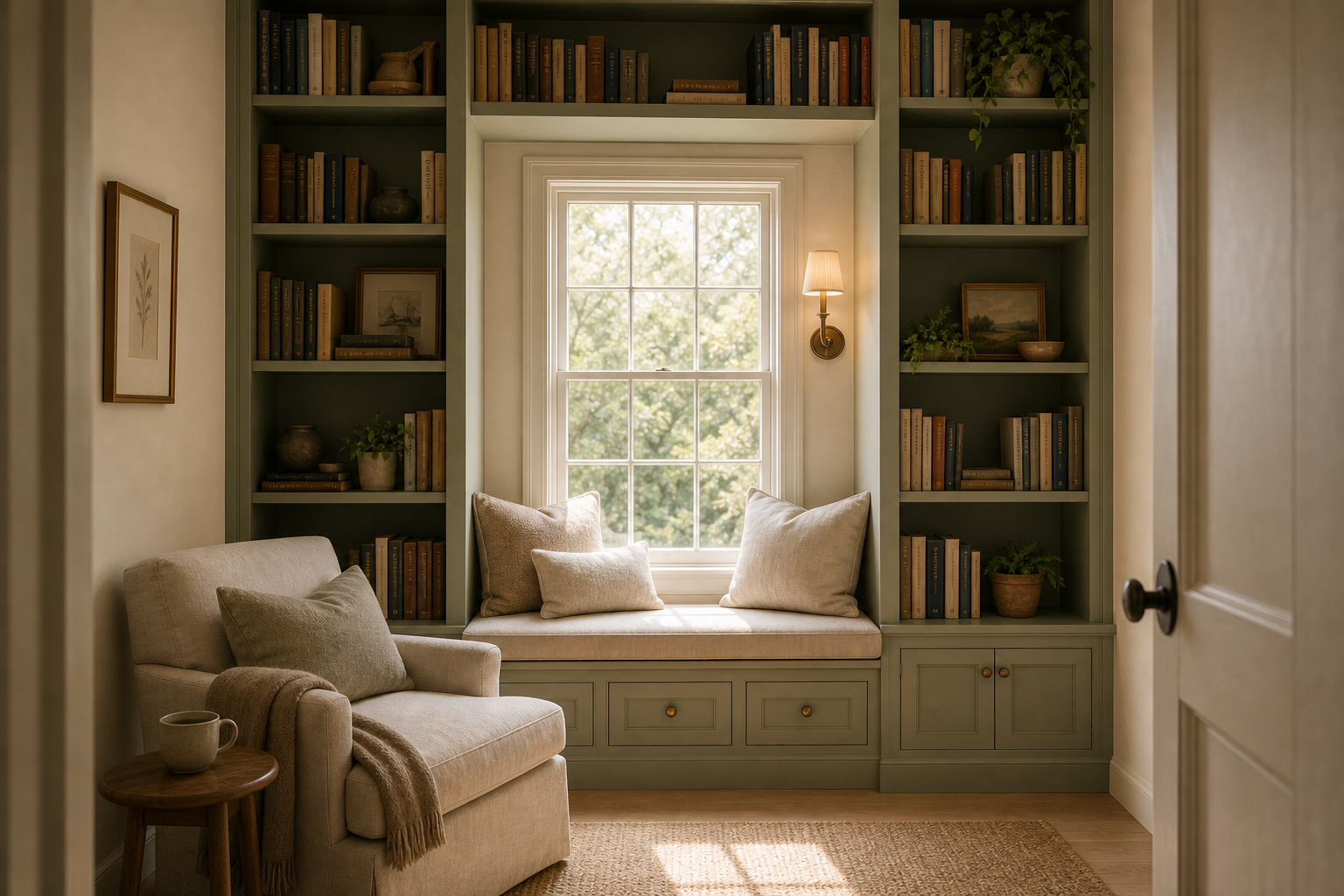

The window is treated as the center of a full storage elevation rather than as an interruption between bookcases. Tall timber-toned shelves rise on both sides, while a cushioned seat and lower drawers occupy the sill zone. Books, pottery, and framed objects are distributed unevenly enough to avoid a showroom grid. An armchair enters the foreground as a second reading position, but the daylight-filled window bench remains the architectural destination.
Bookcases Turn the Window Into a Complete Wall
The shelves rise on both sides of the window, giving the seat a strong architectural frame. That frame makes the nook feel built into the room rather than placed there. The muted sage color also helps the shelves read as one continuous feature.
The shelf towers reach close to the ceiling and remain equal in width, creating a deep frame around the opening. Their darker tone intensifies the window's brightness, while the centered seat prevents the storage from reading as two unrelated cabinets.
The cushioned bench turns the window base into a real seat. Linen pillows add back support and make the depth feel comfortable. Drawers below the cushion give the built-in a finished base without interrupting the seating.
A thick cushion spans the bench and several pillows gather mainly at the ends, leaving usable space in the middle. The seat remains below the sill, so daylight and the view are not reduced by a high upholstered back.
Lower Drawers Give the Bench a Stable Base
The wall sconce adds reading light beside the window seat, which means the nook can work beyond daylight hours. Its warm brass tone also complements the cabinet hardware below.
Shelf Objects Leave the Vertical Frames Readable
The books bring color and rhythm to the shelves without looking chaotic. Their muted spines suit the calm palette. Because the shelves are organized in groups, the wall feels full but not messy.
Books stand vertically, lie in small stacks, and share bays with pottery and art. Empty portions of shelf remain visible between groups. Those gaps keep the built-in structure legible and stop the collection from forming one dense patterned wall.
Small Wall Lights Mark the Reading Position
The upholstered armchair creates a second reading position in front of the built-ins. It makes the nook feel like a small library corner rather than only a window seat. The side table gives the chair a practical place for a cup or book.
An Armchair Adds a Second Orientation
The woven rug adds warmth under the chair and seat area. It helps the nook feel more intimate within the larger room. Its natural texture works with the linen pillows and pale wood floor.
A Pale Rug Softens the Approach
Start with the window and build shelves around it rather than adding freestanding bookcases later. Include a cushion, pillows and a sconce so the shelves support reading rather than only display.
Balancing Books, Seating, and Daylight in One Elevation
I would not paint the shelves a high-contrast color in this room. The soft sage keeps the nook cozy. I would also avoid overfilling every shelf. Some open space helps the books and plants breathe.
The wraparound storage in this scheduled Wabi-Sabi reading nook study creates a more enclosed retreat. This design keeps the center open to daylight and uses two tall side towers to define the nook.
Sunlight reaches the bench and nearby floor, giving the central bay a brighter value than the shelf towers. A small lamp glows on the right side but remains below the bookshelves' upper half. Natural and local light therefore identify the seat without requiring concealed shelf illumination not visible in the image.
Lower drawers run beneath the seat and terminate at the bookcase towers, producing a stable base across the central bay. Their broad fronts are much quieter than the shelf contents above. This change in scale prevents storage detail from running continuously from floor to ceiling.
The foreground armchair turns slightly toward the window seat and establishes a second place to read without blocking the drawers. Its pale rounded body contrasts with the straight shelf towers, while a small side surface stays close to the chair. The central approach to the built-in remains open, so both seating choices can coexist in the same nook.