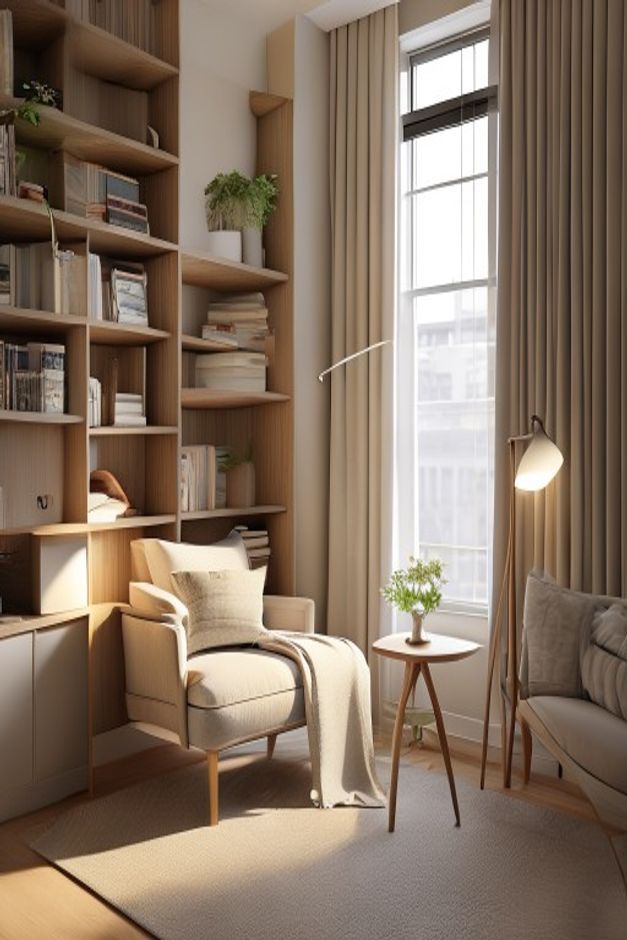

The chair sits at the exact meeting point between book storage and daylight. Full-height wood-toned shelving fills the left wall, while a tall window and curtains define the right. Angling the pale armchair slightly into the room allows the sitter to reach books, receive side light, and maintain an open route past the small round table.
A slim floor lamp stands near the window, and a partial gray sofa appears at the far right. These additional pieces could have crowded the corner, but their narrow profiles remain outside the chair's immediate footprint. The arrangement works because each object occupies a separate edge around one clear seated center.
The Armchair Occupies the Brightest Usable Corner
The chair sits forward of the shelving rather than being pushed deep beneath it. This position gives the back and arms room to remain visible and lets daylight reach the pale upholstery. Raised wood-toned legs keep the lower silhouette open against the carpeted floor.
Its slight angle responds to the window and the room beyond. A chair set square to the shelves would feel like part of the storage wall; turning it gently makes the seat a destination while preserving access from the foreground.
The chair's front edge remains inside the shelving bay rather than projecting fully into the shared room. This protects the line past the partial sofa and makes the nook feel attached to the wall. Its generous cushion still provides a distinct destination within that compact footprint.
A Round Table Fits the Gap Without Creating a Corner
The small three-legged table sits between chair and window. Its circular top holds a vase while leaving visible clearance around the chair arm and curtain. A rectangular table would introduce a projecting corner precisely where the user approaches the seat.
The table height aligns closely with the lower arm area, making it visually plausible for a book or cup without claiming the center of the nook. Its warm tone also connects the chair legs to the shelving behind.
The table is set slightly forward of the window frame, keeping its legs away from the curtain hem. This small offset prevents fabric and furniture from competing at floor level. It also leaves the vase silhouetted against daylight rather than disappearing into the shelf background. Its three legs remain clear of the chair's front foot.
The Floor Lamp Uses the Curtain Edge
A narrow lamp stands just beyond the table, with its shade directed toward the chair. The base occupies a small strip beside the curtain and does not cross the chair's forward path. Its warm local glow is visible even though daylight dominates the scene.
The published cottage reading nook with wood shelving places the chair within a denser book wall. This contemporary corner shows how a slender freestanding light can work when the window edge leaves a precise vertical gap.
Shelving Wraps the Nook Without Closing It
Bookshelves rise to the left and continue through a shallower central bay. Books, boxes, and plants occupy selected levels, while some compartments remain open. The varying depths create an enclosing backdrop without projecting over the chair.
Lower closed fronts appear beneath the shelves, concentrating visual weight near the floor. This lets the upper storage feel lighter and keeps the chair from competing with a wall of equally dense objects at every height.
A narrow shelf return projects near the window at mid-height, holding a plant and book stacks. It bridges the deeper bookcase to the curtain wall without creating a full cabinet beside the chair. The resulting step in depth makes the enclosure gradual rather than abrupt.
The Sofa Edge Defines a Shared Room
Only part of a gray upholstered sofa is visible at the right, but its proximity changes the nook's role. The chair remains an individual reading seat while still participating in a larger living area. A clear gap between sofa and round table prevents the two zones from collapsing into one tight furniture cluster.
The useful planning lesson is to protect three relationships simultaneously: chair to books, chair to window, and chair to approach. Once those are fixed, the table and lamp should occupy residual edge space, never the central path. That order gives the corner daily purpose without isolating it from the room.