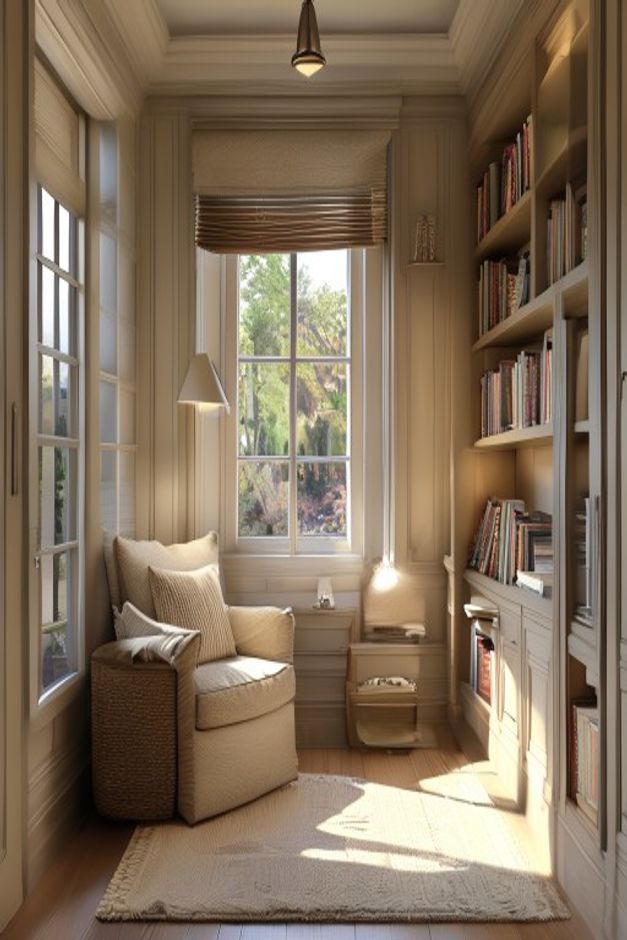

Two windows meeting at the corner define this reading nook before the chair or bookcase is considered. One tall opening faces the seat, while a second runs along the left wall, bringing daylight from two directions. The upholstered chair occupies the sheltered angle between them and the built-in shelves on the right.
Traditional molding gives the narrow bay visual weight, but the plan remains light because the windows dominate two surfaces. A fitted bookcase supplies depth on the third, and compact drawer units fill the small area beneath the front window. The result uses every wall differently without compromising the central floor route.
Corner Windows Expand a Narrow Footprint
The left and front windows create intersecting views, so the nook never ends at a solid wall. Their pale frames and deep trim establish strong verticals around the chair. Even though the space is physically narrow, the eye can travel outward in two directions, reducing the sense of enclosure.
Roman shades sit high enough to leave most of the glass exposed. Their horizontal folds provide a useful counterpoint to tall mullions and bookcase uprights. The treatment appears capable of softening glare without hiding the window proportions that make the nook distinctive.
The two glazed planes meet without a bulky cabinet at their junction. This leaves the corner visually permeable and makes exterior light appear to wrap around the seat. Curtains and the Roman shade control each opening differently, adding softness without disguising the geometry of the window bay.
The Chair Occupies the Only Solid Corner
A pale skirted armchair sits against the left window wall and faces slightly into the room. Its high cushions create a comfortable enclosure, while the skirt forms one quiet mass below. The chair does not project across the centerline, leaving a clear approach to the shelves and small units ahead.
The chair is turned away from the shelf face just enough to create a direct relationship with the front window. Its pale upholstery catches light from both sides, while the darker legs maintain separation from the rug. A square placement against either wall would make the bright corner feel less spatially generous.
Built-In Shelves Give the Bright Bay Visual Depth
A full-height bookcase covers the right wall with books, lower cabinet doors, and several open sections. Its warmer, darker recesses balance the extensive glazing. The shelves remain shallow enough that they do not visually squeeze the chair from the side.
This relationship between light and storage appears in our published cottage reading nook with wood shelving, although the present room gains more spatial complexity from two perpendicular windows and traditional trim.
Small Drawer Units Use the Space Below the Window
Two compact drawer pieces step across the wall beneath the front opening, offering narrow surfaces for a glass, books, and a lamp. Their different heights respond to the sill and maintain access to the chair. Because they stay close to the wall, the rug and central path remain unobstructed.
Nothing in the image confirms the contents of these drawers, but their visible proportions are instructive. Low, shallow furniture can provide support where a standard side table would be too broad, especially when windows and radiators or trim limit the available wall.
The shallow drawer pieces remain below the sill line, preserving the two-window corner as a continuous source of light.
Task Lights Work at Three Heights
A slim shaded lamp stands near the chair, a small glowing fixture sits on the low storage, and a compact pendant marks the ceiling. Their light points move from seated level to overhead without duplicating the same form. Daylight remains primary, while the smaller sources make the nook credible after sunset.
The corner succeeds because it preserves a simple hierarchy: windows provide space and atmosphere, the bookcase provides storage, the chair provides use, and small lights support reading. More furniture would weaken that clarity. The design lesson is to fit functions into the room's existing vertical zones rather than filling the open floor.
The ceiling pendant identifies the bay from above, the standing light reaches beside the chair, and the small lamp near the window supplies a lower point. Their forms are visibly different, so they do not create a showroom-like set. Instead, the vertical range makes the small nook feel occupied from floor to ceiling.