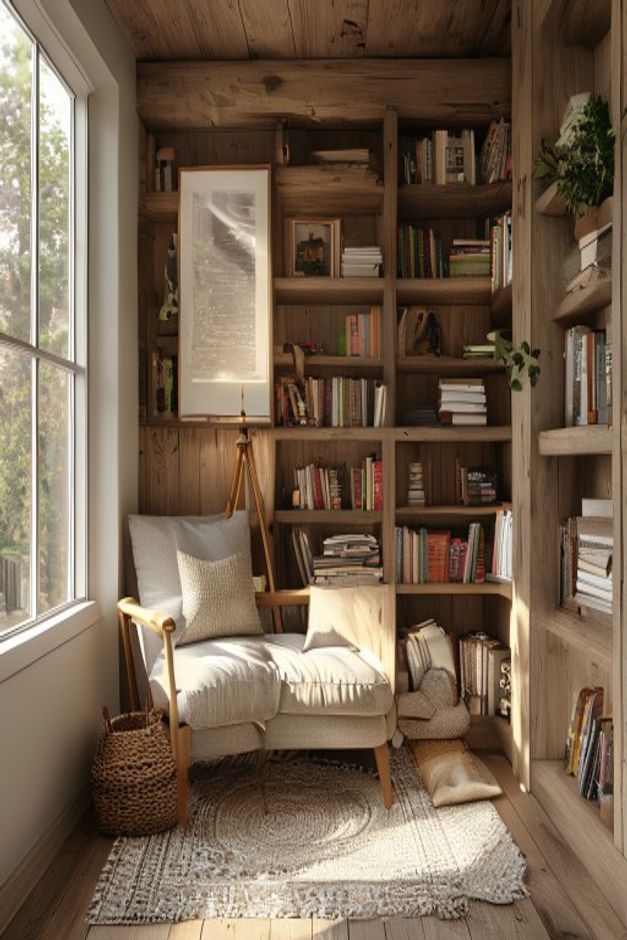

This reading nook feels less like furniture placed in a corner and more like a small library carved from timber. Wood-toned boards line the rear wall and ceiling, while bookshelves continue around the right side. The chair sits within that enclosure beside a large left window, giving the reader both a protected interior and an immediate outward view.
The amount of wood could easily make a narrow space feel heavy. Daylight prevents that outcome, as do the pale upholstery and light rug concentrated around the seat. Books and a few plants provide color in small doses, allowing the enclosing material to remain the dominant experience.
Shelves Turn the Corner Instead of Stopping at One Wall
The rear bookcase spans the width behind the chair, then a second run continues along the right wall toward the camera. This L-shaped arrangement creates depth and places books within reach from more than one direction. It also avoids the abrupt visual edge that a single end-wall unit would create in such a long, narrow bay.
Shelf heights vary and several vertical supports are irregularly spaced. That looser structure suits the rustic setting and accommodates books stacked both upright and horizontally. The bays are full but not identical, so the library reads as accumulated rather than manufactured as a uniform display.
The lowest compartments remain close to the chair and hold books within seated reach, while upper bays accommodate less immediately accessible stacks. This visible distribution gives the wall a practical gradient. It also leaves enough open shelf edge that individual volumes can be removed without disturbing an entire decorative arrangement.
The Timber Ceiling Completes the Enclosure
Boards continue overhead in the same warm family as the shelves and wall lining. This continuity makes the nook feel intentional from every seated view. Knots and tonal shifts remain visible, giving the ceiling texture without a separate decorative treatment.
Because the ceiling is visually active, there is no prominent central pendant in the photograph. The absence is beneficial: an oversized fixture would interrupt the timber plane and compete with the large window. Local lighting near the chair is enough to support the nook's purpose.
A Single Window Keeps the Wood from Closing In
The left window fills much of the wall and brings bright, cool daylight into the warm enclosure. Its pale frame produces a clean edge against the timber. The chair is positioned close enough to benefit from the view while leaving a narrow strip of floor between the seat and glazing.
The relationship between window and joinery recalls this published cottage reading nook with wood shelving, but the present space is more enveloping because wood continues overhead and along the side wall.
The Chair and Lamp Form a Compact Working Pair
A pale cushioned armchair occupies the only clear floor zone, angled slightly toward the window. Its visible wood arms relate to the surrounding shelves without losing separation. A tall tripod lamp rises behind it, placing light above shoulder level while keeping the base outside the main foot area.
Loose cushions and a small floor pillow add comfort, yet they remain close to the chair. Their placement avoids turning the narrow foreground into a second seating zone. A woven basket at the window side contributes useful texture and stays low enough not to interrupt daylight.
A Light Rug Marks the Seat Inside a Darker Shell
The pale textured rug extends beneath the chair and into the foreground, creating a visual clearing within the timber-lined room. Its straight edges align with the narrow passage, while fringe softens the lower boundary. Books and shelf uprights remain dense around the perimeter, so this open central patch is essential to the nook's sense of comfort.
The space would not improve by filling the remaining shelves or adding another chair. Its strength comes from contrast between a rich perimeter and a simple center. For homeowners, the transferable principle is to concentrate storage vertically and around the edges, then protect one adequately lit seat and the floor area immediately in front of it.
The foreground narrows between the side shelves and window wall, yet the chair does not block that approach. Its front edge sits behind the rug's open leading area, creating a small landing before the seat. Maintaining that pause is more important than squeezing another table into the niche.