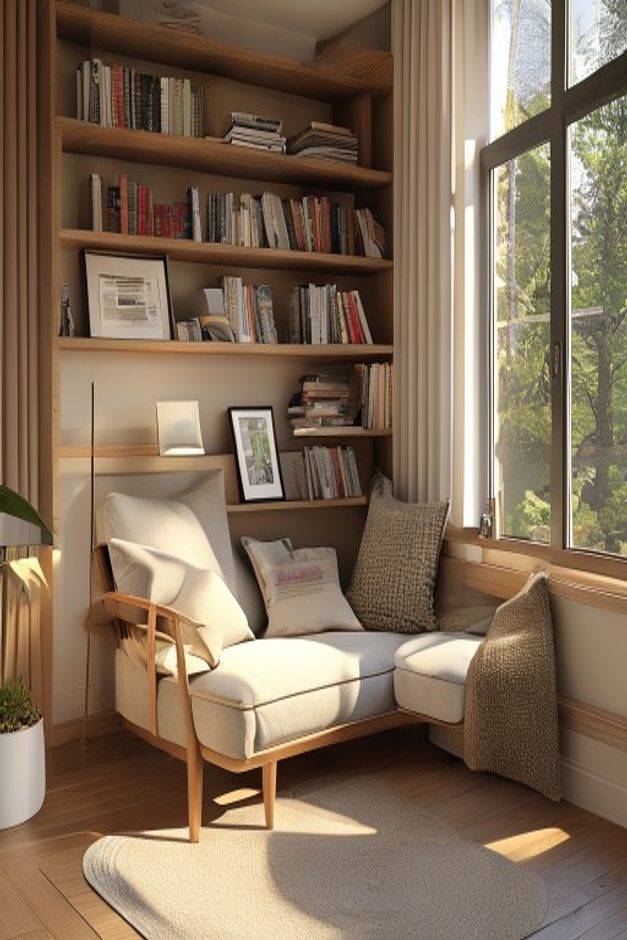
The lounge chair gives this reading nook its character because its low, angled profile mediates between a wall of books and a full-height window. A pale cushion rests within a darker frame, and the seat extends forward enough to support a relaxed posture without becoming a bulky recliner. It is unmistakably the room's working center.
Everything nearby protects that role. The shelves rise vertically behind the chair, curtains form a soft edge at the glazing, and a slim light occupies the narrow gap between furniture and window. Plants and a round rug introduce smaller curves, but none interrupts the seated sightline toward daylight.
The Chair's Low Profile Preserves the Window
The chair back reaches only partway up the glazing, allowing the window to remain visually continuous above it. Its seat angles gently backward while the front cushion projects toward the room, creating a clear invitation to sit. Raised dark supports leave visible air beneath the upholstery and make the piece appear lighter on the rug.
This proportion is especially effective beside tall architecture. A higher wingback would divide the window and create a solid block in front of the curtains. The selected chair instead establishes comfort at human scale while leaving the room's vertical dimensions intact.
Book Storage Supplies a Dense Counterbalance
Full-height shelves occupy the wall behind and to the left of the seat. Books create a varied pattern of dark and light spines, with occasional objects and plants breaking the rows. The visual density is intentional: it balances the open brightness of the window on the opposite side.
Shelf uprights remain straight and regular, so the collection never loses its architectural frame. The chair sits just ahead of that grid rather than being pushed tightly inside it. A small separation keeps the sitter from feeling enclosed by stored items and lets the furniture silhouette remain readable.
A Slim Light Fits the Narrow Window Edge
A narrow vertical light stands between the chair and the curtain. Its small footprint avoids conflict with the forward reach of the seat, while its height places illumination near reading level. The dark stem also relates to the chair frame and the deeper tones within the shelves.
The large window provides the dominant daytime source, casting soft light across the pale cushion. The fixture is best understood as a localized supplement rather than the room's visual centerpiece. This division lets the nook adapt from daylight reading to a quieter evening condition without adding another table.
The Round Rug Softens a Rectangular Corner
A pale circular rug sits beneath the chair and extends into the open foreground. Its curved boundary interrupts the repeated rectangles of books, window panes, and shelving. The shape also defines the nook without drawing a hard line across the circulation route beside it.
The rug's center sits close to the chair rather than the geometric center of the entire corner. That offset acknowledges the seat as the point of use. It also leaves a larger arc of soft surface in front, exactly where feet meet the floor when the chair is approached or occupied.
Plants Bridge the Shelves and the Outdoor View
Several green plants appear at different heights, including low floor foliage and smaller shelf plants. Their irregular leaves soften the precise storage grid and visually extend the landscape seen through the glazing. Because they cluster near edges, they do not crowd the seat or obscure the primary light source.
The botanical accents remain secondary to books and chair. That restraint is important in a compact nook: one large floor plant at the wrong position could reduce the usable approach or cover the slim task light. Here greenery occupies residual space rather than claiming active floor area.
Open Floor at the Front Makes the Seat Approachable
The chair faces a broad, uncluttered foreground, and no coffee table or cabinet blocks access to it. That openness matters because the extended seat already projects toward the center. The user can approach from the side, turn, and sit without negotiating another object.
For homeowners choosing a similar focal chair, the practical sequence is to protect the window first, confirm the chair's forward reach, and only then add a rug or light. The published cottage reading nook with wood shelving demonstrates a more upright arrangement; this room is distinctive because its low chair makes the nook feel horizontal and unhurried.