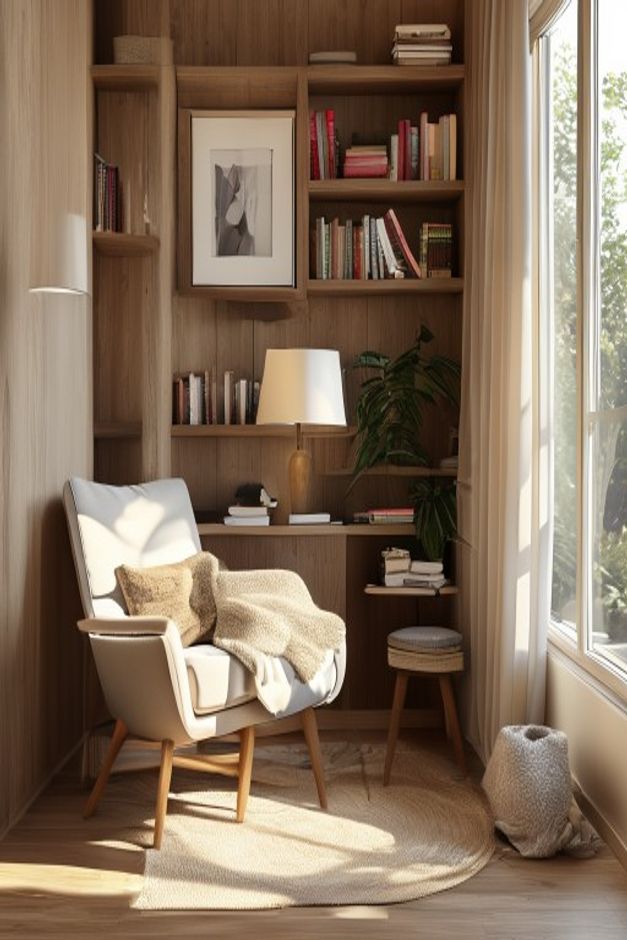
Wood paneling gives this reading nook its strongest identity. It covers the rear wall, continues through the built-in shelves, and turns a small corner into one continuous enclosure. The surface is warm and visibly grained, but the image does not support naming a species; its importance comes from continuity rather than pedigree.
A pale lounge chair interrupts that darker background at the center, while a large window opens the right side to daylight. A table lamp, low stool, circular rug, plant, and folded throw complete the setting. Each object is modest in scale, allowing the wall treatment to remain the room's architectural argument.
Continuous Paneling Makes the Corner Feel Purpose-Built
Vertical and horizontal wood-toned boards cover the wall around the shelving rather than stopping at an arbitrary edge. This continuity removes the visual break between storage and background. The nook feels carved from one fitted volume instead of assembled from a freestanding bookcase and unrelated wall finish.
The panel joints introduce a broad, calm rhythm that is larger than the smaller shelf divisions. That hierarchy prevents the books and objects from making the wall restless. A pale ceiling and bright window keep the warm enclosure from appearing heavy at the top and side.
Panel tones vary subtly where daylight crosses the surface, so the wall avoids becoming a single dark plane. The broad board pattern is most legible beside the chair and around the shelves. Those uninterrupted areas are as important as storage because they allow the enclosing material to be understood at room scale.
Built-In Shelves Preserve the Material Language
Open shelves sit within the paneled wall and carry books, vessels, and a few small pieces. Their edges share the wall's warm tone, so storage reads as part of the architecture. Darker gaps behind objects provide depth without requiring a contrasting painted backing.
Contents are spaced unevenly, with some shelf areas left open. That editing allows the panel grain and shadow lines to remain visible. Packing every compartment would conceal the very surface that distinguishes this nook from a generic reading corner.
The Pale Chair Creates Necessary Separation
A generously cushioned chair stands just forward of the shelves. Its light upholstery produces the largest tonal contrast in the room, immediately identifying where the user sits. Curved cushions and a softly folded throw also temper the straight panel joints behind.
The chair is angled slightly toward the window rather than set square to the shelving grid. That small rotation responds to daylight and makes the arrangement feel occupied, not displayed. Its raised base leaves a narrow shadow beneath, keeping the substantial seat from merging with the rug.
A Round Rug Establishes a Small Occupied Field
The circular pale rug extends beneath the chair and into the foreground. Its curved edge contrasts with the wall boards, shelves, and window frame, signaling a softer zone inside the architectural enclosure. The rug is large enough to hold the chair visually but does not run wall to wall.
Daylight Opens One Side of the Wood Envelope
A large window occupies the right wall, and full-height curtains soften its edge. Light falls across the chair and reveals subtle differences in the panel surface. Without this bright opening, the continuous wood might close the nook too tightly; the glazing supplies both relief and direction.
A compact table lamp on the left adds a second, localized source near the seat. Its small shade remains below the shelves and does not interrupt the wall's broad continuity. The two sources therefore perform different visual roles: the window opens the room, while the lamp marks the intimate reading position.
Small Objects Stay Outside the Main Approach
A low stool and plant occupy peripheral positions near the chair, leaving the foreground free. The stool's compact top can support a book or cup without creating the bulk of a conventional side table. Plant foliage introduces an irregular silhouette against the rectilinear paneling.
Compared with the published cottage reading nook with wood shelving, this room derives its atmosphere from wall continuity rather than shelf capacity alone. The transferable sequence is to establish one enclosing material, integrate storage within it, then use a single pale seat and a bright opening to prevent visual weight from becoming oppressive.