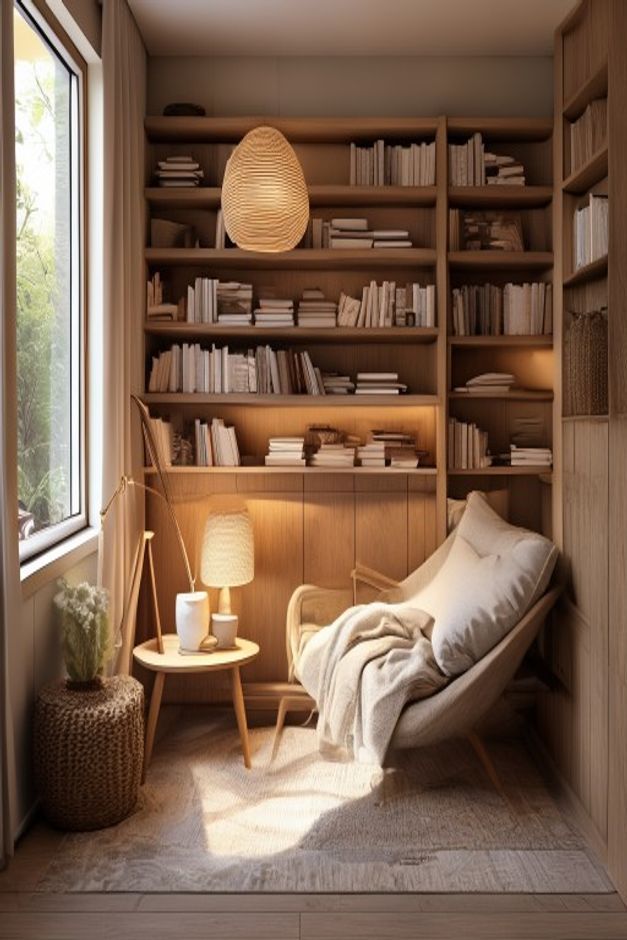

The shelving does more than store books; it forms three sides of a small interior enclosure. A broad bookcase fills the rear wall, continues onto the right, and meets a wood-toned ceiling edge above the chair. This continuity makes the reading nook feel carved from fitted joinery rather than assembled from separate furniture pieces.
A pale angled lounge chair occupies the lower-right corner, receiving daylight from the tall window on the left. A small round table, compact lamp, woven stool, and textured rug remain low, allowing the shelves to retain their architectural authority. Two warm light sources add depth without disguising the room's subdued material palette.
Shelves Wrap the Corner as One Continuous Volume
Horizontal boards run across the rear wall and turn into a narrower bookcase at the right. Similar wood tones make the junction read as one construction. The sitter is therefore held by storage on two sides while the window opens the third side to daylight.
This enclosure is visually strong, but shelf depths remain shallow enough that they do not project over the chair. The lower closed panels also keep the floor edge calmer than the book-filled levels above.
The right-hand shelves are shallower and narrower than the broad rear bookcase. That reduction matters beside the chair: it preserves shoulder space while still completing the wrapped effect. The joinery changes depth to fit the seated body instead of forcing a uniform cabinet profile.
Book Grouping Leaves the Architecture Visible
Books are stacked vertically and horizontally in pale, muted groups. Open spaces remain above many stacks, revealing the shelf backing and shadows. Those gaps are important because they prevent the full-height wall from becoming a flat field of spines.
A published cottage reading nook with wood shelving uses a more open room edge. This nook is distinct because the bookcase turns the corner and creates a deeper sense of retreat.
The Lounge Chair Sits Diagonally Within the Joinery
The pale chair is angled toward the window rather than aligned with either shelf wall. Its sloping back and raised wood-toned frame introduce a diagonal against the dominant grid. A large cushion and folded blanket give the seat enough softness to balance the extensive fitted wood.
The chair's front legs remain clear of the side table, leaving a visible approach from the foreground. Its low back also stops below the illuminated shelf band, so stored books and warm light remain readable behind it.
The chair frame uses slender arms and legs, so the lower cabinet fronts remain partly visible through and around it. This transparency keeps movable seating distinct from the fitted joinery. A fully upholstered base would merge with the rug and make the corner feel more congested.
A Small Table Creates a Focused Working Edge
The round side table stands between chair and window with a tiny lamp, cup, and pale vessel. Its compact diameter fits the remaining gap without projecting into the center of the rug. Fine legs preserve a view of the floor and separate it from the heavier shelving.
Pendant and Shelf Light Occupy Different Heights
A large softly textured pendant hangs near the upper-left shelves, while a warm linear glow appears beneath a lower shelf behind the chair. The pendant identifies the volume from above; the shelf light gives depth to the book wall closer to seated height.
The small table lamp adds another localized point below them. Exact output and color temperature cannot be confirmed, but the visible hierarchy is clear: broad overhead presence, a horizontal shelf wash, and a compact bedside-like glow.
The Window Prevents the Wood Envelope from Closing In
Tall glazing occupies the entire left edge and sends light across the rug, chair, and lower cabinet fronts. A full-height curtain softens that boundary without covering the whole opening. The bright vertical plane counterbalances the continuous warm shelving.
To apply the principle, establish one wrapping storage volume, leave visible backing around book groups, and place the chair diagonally toward the opening. Keep secondary surfaces low and compact so they support the seat without breaking the sense of an intentionally enclosed nook.
A small woven stool stands near the left edge below the window and introduces another rounded form. It stays outside the chair-table relationship, so it can support an object without narrowing the direct route to the seat. Its texture echoes the pendant at a lower level.