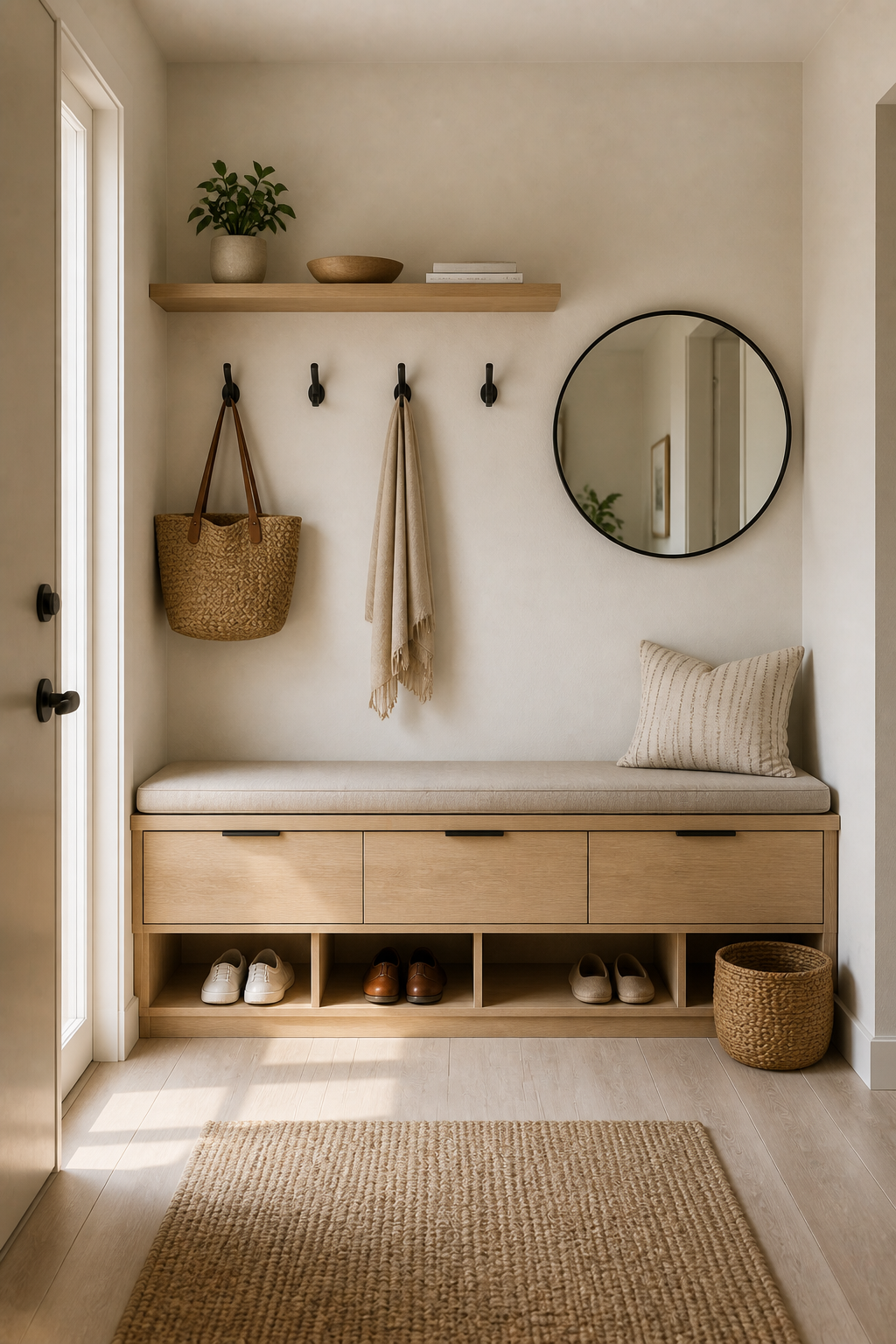

The storage bench resolves this entryway as one vertical system rather than a collection of freestanding organizers. A cushioned seat rests above broad drawers and open shoe cubbies; black hooks occupy the paneled wall; and a floating shelf finishes the composition overhead. Every layer has a visible purpose, yet the unit keeps a straight, shallow profile beside the doorway.
Minimalism here is not emptiness. Shoes, a bag, a scarf, baskets, a plant, books, and a bowl are all visible. The room remains composed because those items are assigned to clearly bounded zones and the route from the glass-paneled door stays open. The design edits circulation first, then fits storage into the remaining wall depth.
The Bench Consolidates Sitting and Storage
A long wood-toned bench runs nearly the full width of the recess and carries one pale cushion. Its horizontal top creates a comfortable visual pause beneath the tall hook wall. Because the seat is built into the storage rather than added in front, it does not claim a second strip of floor.
The cushion stops inside the timber frame and leaves a narrow visible edge around it. That detail keeps the bench construction legible and prevents the upholstery from looking oversized. A loose pile of pillows would consume the useful sitting span, so the single cushion is a disciplined response to a working entry.
Drawers Hide Volume Without Hiding the Whole System
Three wide drawer fronts sit directly beneath the seat on the left and center. Their minimal hardware and broad proportions create a quiet base. The photograph does not reveal their contents or mechanisms, but the closed fronts visibly absorb storage volume that would otherwise add more small shapes to the entry.
Open cubbies are reserved for shoes at the right, where pairs can be reached without opening a door into the route. Mixing closed drawers and open bays is more practical than insisting on one storage type everywhere. The elevation remains calm because both share the same bench frame and shelf lines.
Wall Hooks Use the Vertical Zone Above the Seat
Four dark hooks are spaced across the paneled backing, with a bag and scarf demonstrating usable clearance. Their height keeps hanging items above the cushion while leaving enough separation that garments do not collapse into one dense bundle. The contrast makes each position obvious against the pale wall.
A broad rail behind the hooks protects the composition from looking like isolated dots. It also aligns with the bench below and floating shelf above. This repeated horizontal geometry gives the entry order even when the items hanging from it are irregular.
The Floating Shelf Completes the Storage Elevation
A thick wood-toned shelf spans the wall above the hooks and holds a plant, bowl, books, and a small framed piece. These objects stay well above shoulder level and do not interfere with sitting or hanging. Visible blank wall beneath the shelf prevents the upper display from pressing down on the bench.
The shelf should not be mistaken for concealed cabinetry; only its open top and underside are visible. Its strength is visual completion. It repeats the bench material at a lighter height and creates a boundary so the hook panel does not seem to end arbitrarily.
A Round Mirror Provides a Separate Checkpoint
The black-framed round mirror sits beside the storage unit rather than above the hooks. This placement gives it a clear reflection zone and introduces one curve among doors, drawers, panels, and shelves. Its dark rim connects with the hooks and nearby door hardware without expanding into another heavy surface.
The Door Route Remains Visibly Unobstructed
The glazed exterior door opens along the left side, and the floor between it and the bench remains clear apart from a flat rug. Baskets stay inside cubbies or beneath the system rather than migrating into that passage. The entry therefore supports arrival, sitting, and shoe storage without requiring users to step around loose furniture.
The most transferable decision is to measure the circulation strip before choosing bench depth. Build drawers, shoe bays, hooks, and one upper shelf within a single wall plane, then leave the opposite side quiet. This photograph shows that useful storage can remain visible and still feel minimal when every object has a spatial boundary.