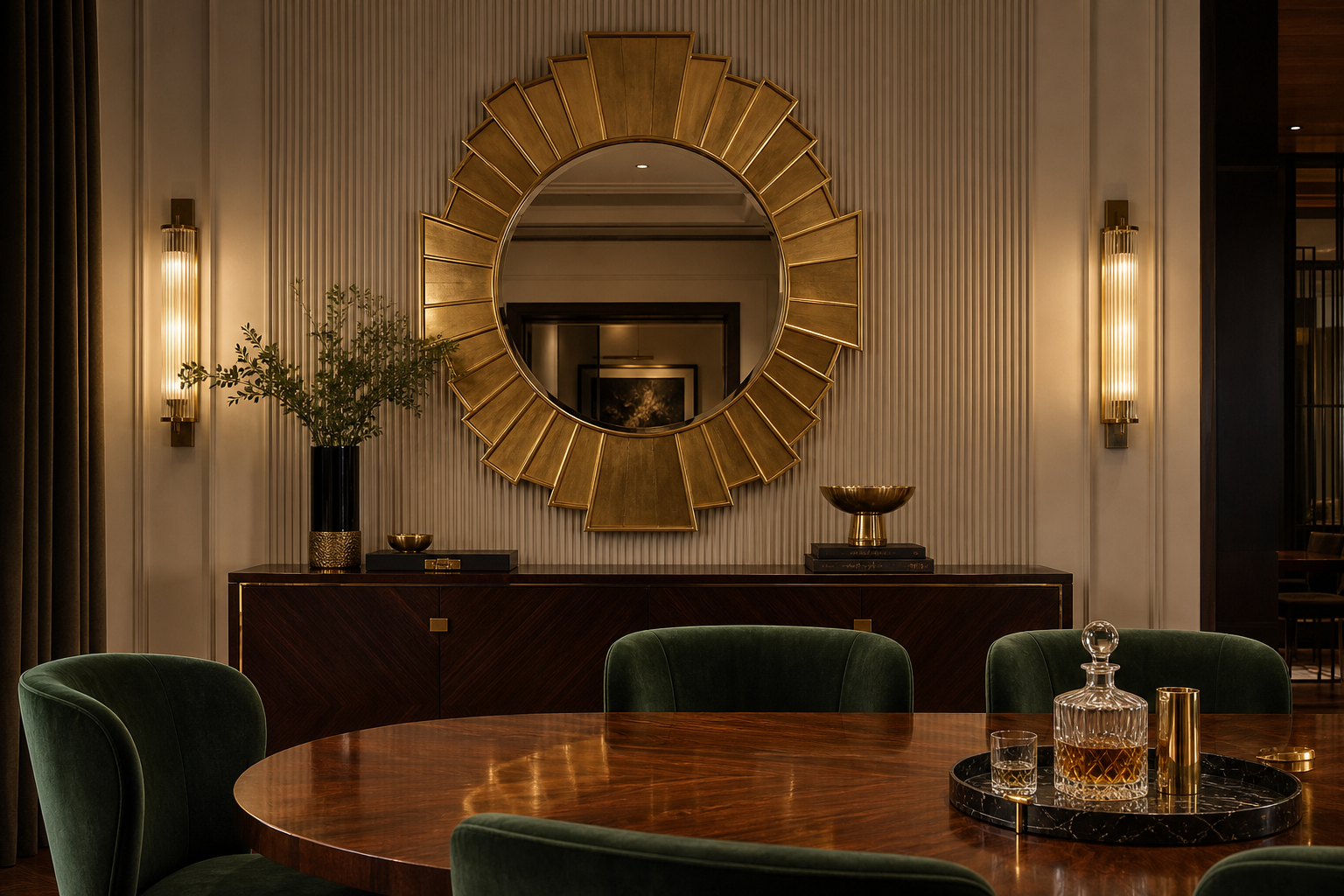

The mirror is large enough to function as part of the dining-room architecture. A circular center is surrounded by broad gold-toned fan segments, creating a sunburst profile against vertically fluted dark wall panels. Slim illuminated sconces flank the frame, while a dark sideboard provides a long base below. Muted green chairs and a round dining table occupy the foreground without challenging the highly controlled mirror wall.
The Sunburst Mirror Commands the Dining Elevation
The mirror is oversized and centered, which makes it the dining room's strongest vertical moment. Its stepped gold-toned frame gives the wall an Art Deco rhythm before the table or chairs enter the composition. Because it sits above a long sideboard, the mirror has enough visual base. That pairing keeps the large frame from looking like it is floating.
The outer frame extends far beyond the reflective center, so most of the visual impact comes from geometry rather than the mirror surface itself. Its scale is justified by the broad wall and long cabinet directly below.
The gold-toned frame uses repeated fan-like segments around the round mirror. That geometry is what makes the piece feel Art Deco rather than simply decorative. The finish also catches the warm sconce light, so the mirror changes subtly across the wall instead of reading as a flat metallic object.
Fluted Panels Supply a Vertical Counterpattern
The fluted wall panels provide a fine vertical texture behind the mirror. They make the gold-toned shape sharper because the background has its own disciplined rhythm. A plain wall would still show the mirror, but it would not give the same depth. The fluting makes the whole wall feel designed as one composition.
Vertical ribs catch narrow highlights behind the radial frame. The earlier fluted Art Deco mirror analysis uses similar line repetition in a compact room; here, the pattern expands to dining-room scale and a darker background.
The two slim sconces sit on either side of the mirror and create a formal axis. Their vertical glow balances the mirror's round center and stepped outer frame. This is more effective than a single overhead fixture for this wall. The light belongs to the mirror, not just the room.
Sconces sit outside the widest frame points and create warm vertical bars at equal height. They illuminate the composition without placing a pendant or picture light directly in front of its layered geometry.
A Dark Sideboard Gives the Large Frame a Base
The dark timber-toned sideboard grounds the mirror with a strong horizontal line. Its polished surface and gold-toned trim feel consistent with the dining table and metallic accents. The sideboard also gives the wall a practical serving surface. That function matters because the mirror wall still has to belong to a dining room.
The sideboard top carries only a few low vessels, preserving a dark horizontal field below the active frame. Storage function remains present, but the cabinet does not compete through open shelves or a second display grid.
The muted green upholstered chairs bring softness into a room of polished wood, gold-toned and glass. Their curved backs echo the mirror's round center without repeating the same shape exactly. The color adds depth, but it stays dark enough to feel sophisticated beside the dark dining table.
The Round Table Repeats Only the Central Curve
Start with a mirror that has real scale. It should be wide enough to command the wall above the sideboard and detailed enough to justify being the focal piece. Then keep the supporting elements disciplined: one sideboard, two sconces, a controlled wall texture and a limited group of gold-toned or glass objects.
Letting One Statement Piece Carry the Room
I would avoid a busy gallery wall around this mirror. The frame already provides geometry, shine and pattern. I would also avoid bright accent colors on the sideboard. The room works because the palette stays deep, warm and controlled.
Resist adding art, shelves, or numerous bright objects around a mirror of this scale. Its radial outline, fluted background, and paired lights already resolve the elevation; restraint elsewhere is what makes the statement credible.
The table occupies the foreground as a dark circular plane, visually linking the mirror center to the dining function below. Chair backs remain low enough that the sideboard and complete sunburst outline stay visible.
Low glassware and a decanter stay beneath mirror height, keeping reflective objects confined to the dining surface instead of multiplying them across the wall.