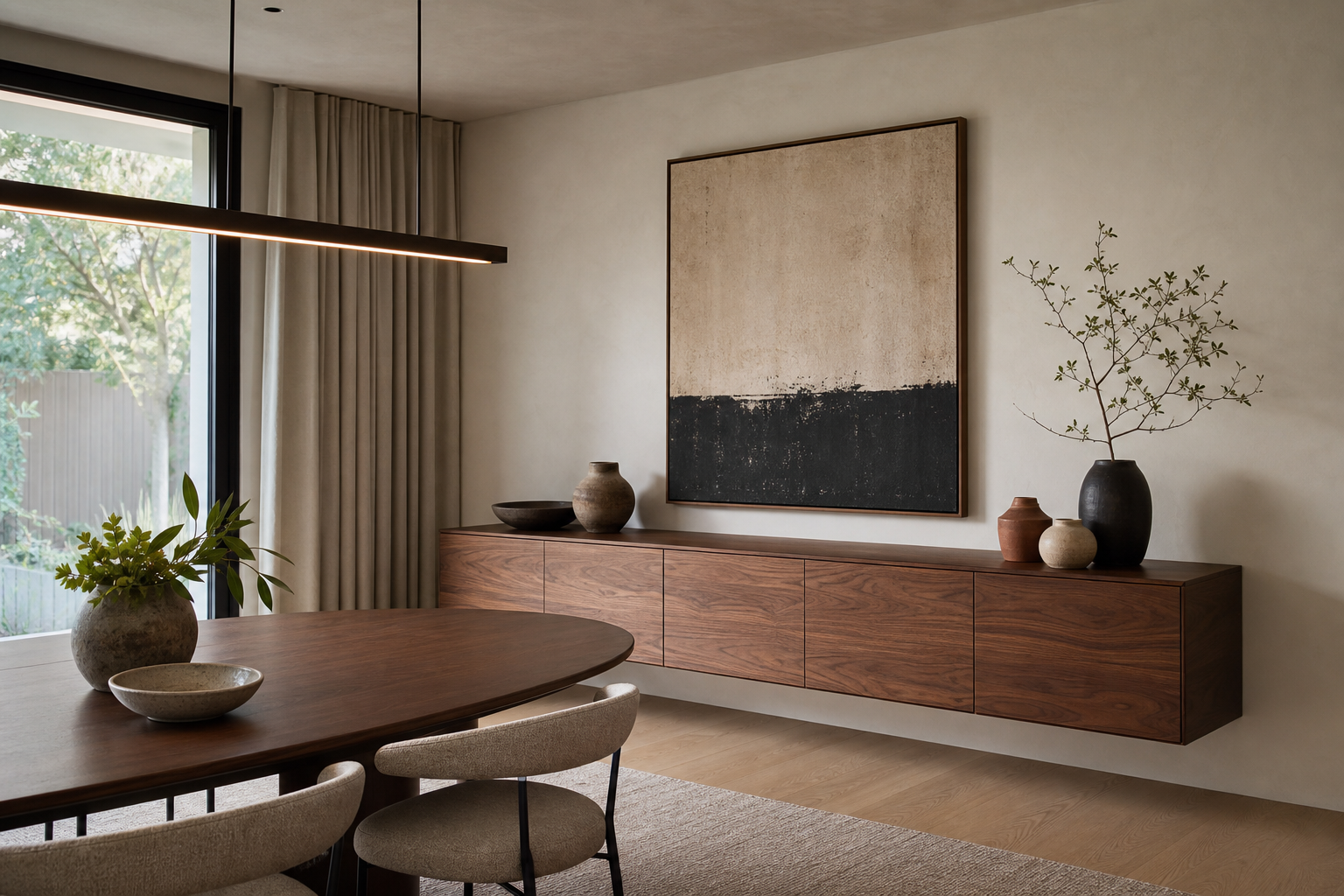

The sideboard spans most of the dining wall but never reaches the floor. Its long timber-toned volume is lifted on a deep shadow gap, allowing the pale floor to continue below and reducing the apparent weight of substantial closed storage. One oversized abstract artwork occupies the wall above. An oval table, upholstered chairs, linear pendant, dark vessels, branches, and garden glazing support the same horizontal composition without duplicating it.
The Sideboard Creates a Long Floating Datum
The timber-toned sideboard stretches across the main dining wall, making it the room's strongest horizontal element. Its clean doors create storage without breaking the wall into visual clutter. The visible gap below the cabinet gives the timber tone volume a lighter profile. That small line of space is what keeps the piece from feeling heavy.
The cabinet begins beyond the window edge and runs beneath the artwork without projecting into the dining path. Its width gives the wall architectural presence even though it remains a single piece of storage.
The large abstract artwork is centered above the sideboard and scaled to its length. It gives the wall height while the cabinet holds the lower proportion. Because the artwork uses muted tones, it adds presence without stealing the wall from the timber-toned storage.
The continuous dark line below is deep enough to separate cabinet and floor from across the room. The quiet-luxury dining drapery study creates vertical softness at the perimeter; this room relies on one sharp low horizontal to organize the wall.
Oversized Art Balances the Cabinet Length
The visible timber tone gives the dining room warmth against the pale wall. Without that wood tone, the room could feel too gallery-like. The sideboard also connects to the dining table in the foreground, so the storage and eating area feel related.
Artwork is nearly as wide as the central cabinet section and rises well above it, producing a deliberate stack of two large rectangles. Small pictures or multiple shelves would fragment that measured relationship.
Closed Doors Keep Dining Storage Visually Quiet
The linear pendant above the table repeats the sideboard's long direction. This keeps the room's geometry calm and intentional. Its thin glow is restrained, which suits a dining room where the wall composition is already strong.
The Oval Table Softens the Wall Geometry
The oval dining table softens the straight cabinet line. Its curve keeps the room from becoming too rigid. The upholstered chairs add quiet comfort and scale, while their dark legs relate to the black accents in the pendant and artwork.
The table's curved ends ease movement between chair backs and wall storage. Its darker top relates to vessels and pendant details while avoiding a literal match with the long cabinet front.
The ceramic vessels on the sideboard are grouped with enough space around them. They add height and texture without covering the timber tone surface. The branch arrangement at the right end gives the wall a more natural vertical note, balancing the large artwork.
Sparse Vessels Preserve the Timber-Toned Surface
Start with the wall length and choose a cabinet that feels substantial but not floor-heavy. The lower gap should be visible enough to make the piece feel lifted. Then size the artwork above the sideboard, not as a separate afterthought. The cabinet and art should read as one dining wall.
Building a Dining Wall From Two Large Elements
I would avoid open shelves above this sideboard. The wall already has a strong relationship between storage and artwork. I would also avoid many small objects on the cabinet top. The contemporary mood depends on generous spacing.
Select cabinet length and mounting height before choosing art. Once those two masses are proportioned, keep objects low and sparse. Extra shelves would reduce negative space and make the floating volume feel like one layer in a crowded display.
Branches rise only at the cabinet's right end and stop below the artwork center. This off-center vertical accent relieves the long horizontal stack while leaving most of the storage top visibly clear.
Curtains remain at the window edge and do not extend behind the cabinet, preserving a clean meeting between soft fabric and floating storage.
Chair backs overlap the cabinet only below its midpoint, so diners remain visually connected to the wall composition. The elevated storage still reads as a continuous band when every seat is occupied.