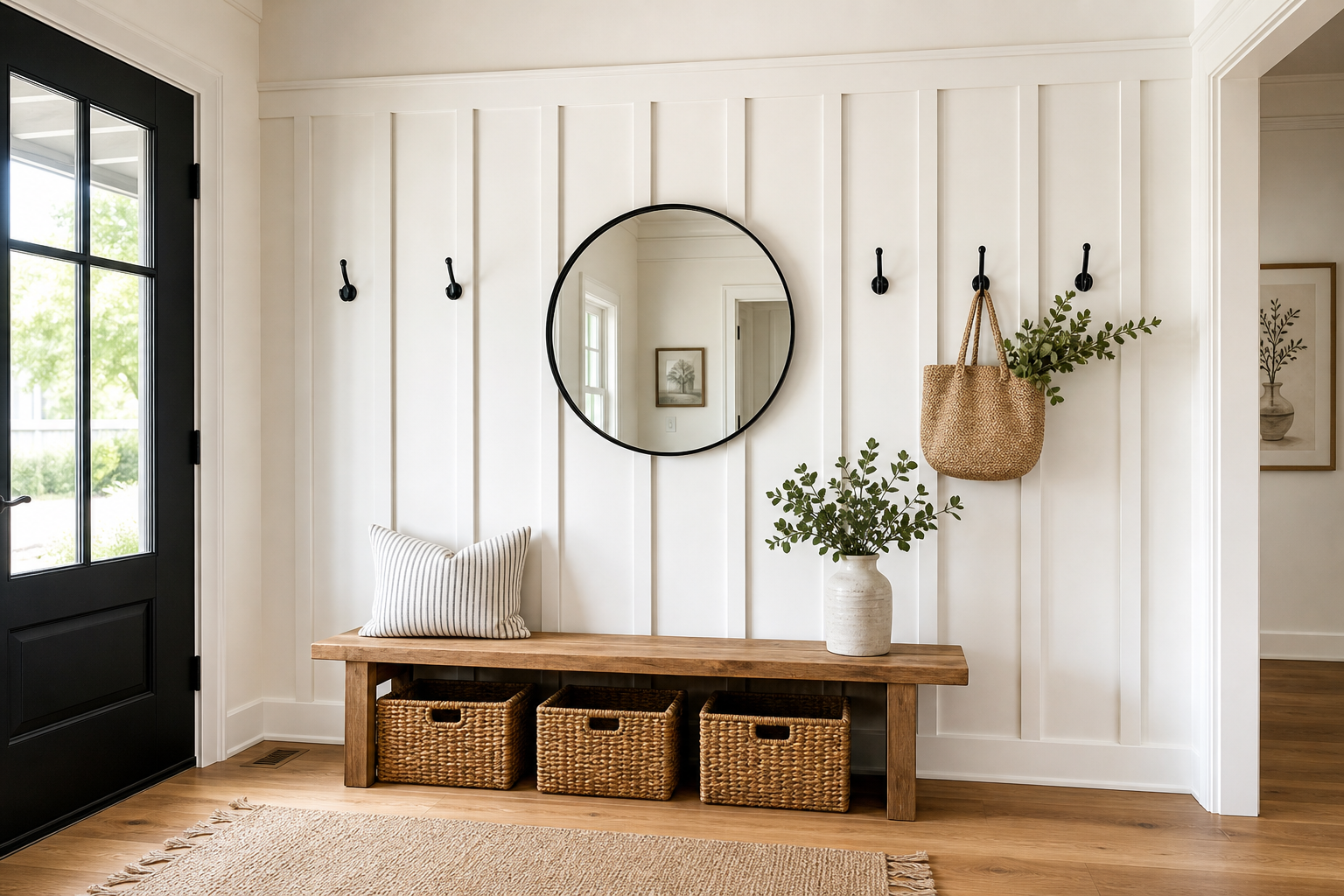

Full-height board and batten gives this entryway a strong architectural rhythm from baseboard to crown. Narrow vertical battens create repeated bays for dark hooks, a centered round mirror, hanging bags, and a simple timber-toned bench. Three woven baskets occupy the floor below, while a black glazed door and side daylight provide contrast at the room's edge. The wall works because structure, storage, and arrival habits follow the same measured grid.
Full Height Turns Paneling Into Entry Architecture
The vertical battens fill the wall from bench height to crown, so they create the strongest rhythm in the entryway. That rhythm makes the hooks and mirror feel placed, not random. Because the paneling is painted warm white, the wall feels bright while still having depth.
The battens continue behind mirror, hooks, and bench rather than ending at a dado height. Their uninterrupted rise makes a small functional wall feel taller and more complete.
The black hooks sit between the vertical lines of the wall, which keeps them organized across a wide surface. They read as part of the design rather than scattered hardware. Their dark finish also connects to the front door and mirror frame, giving the entry a clean graphic edge.
Hooks occupy separate vertical bays and hold only a few objects, preserving the panel rhythm between them. The warm-minimalist entryway hook guide uses a plainer wall; here, applied battens provide the placement logic.
The Round Mirror Interrupts the Grid at the Center
The round mirror breaks the strict vertical pattern of the battens. That contrast keeps the entry from feeling too linear. Its black frame is thin enough to feel modern, but strong enough to hold the center of the wall.
The circular mirror is centered over the bench and crosses several narrow bays, creating one large counterform against repeated verticals. Its slim dark rim relates to hooks and the adjacent door frame.
The timber-toned bench gives the entry a useful landing point below the paneling. Its simple shape lets the wall remain the main feature. The honey wood tone also warms the white paneling and black accents.
Woven Baskets Fit Beneath Without Blocking the Path
The three woven baskets under the bench turn storage into a tidy lower layer. They repeat natural texture without interrupting the clean panel wall. Because the baskets are aligned, the storage looks intentional rather than improvised.
Three baskets slide beneath the open bench with visible gaps at their sides. Their contents are not shown, but their exact position demonstrates how movable storage can remain within the furniture footprint rather than narrowing circulation.
Hanging Bags Demonstrate Real Drop-Zone Spacing
The black glass-panel door gives the entry strong contrast on the left side. It makes the white vertical wall paneling feel brighter and more deliberate. The door also confirms this is an active entry, not just a styled hallway wall.
Start by setting the batten spacing before choosing hooks or a mirror. The accessories should fit the panel rhythm, not fight it. Use a bench that is simple enough to sit below the wall without hiding the paneling. Baskets can handle storage while preserving the clean farmhouse look.
Coordinating Panel Layout With Daily Arrival Tasks
I would avoid filling every hook with bulky coats in the final design view. The wall needs some open space to show the panel rhythm. I would also avoid a heavy dark bench, because the lighter wood keeps the entry welcoming.
Lay out battens from mirror center, hook needs, and bench width instead of dividing the wall arbitrarily. Misaligned hooks or a cabinet wider than the panel sequence would make functional additions look detached from the architecture.
The bench seat remains mostly clear, giving a real place to pause during arrival. Bags stay on hooks and baskets stay below, so three levels of use do not collapse into one cluttered surface.
The glazed door stands close to the paneled wall but remains outside the hook and bench zone. Its black frame supplies contrast while preserving a direct exit path.
A small branch arrangement rises beside the mirror but remains outside its circular outline. The greenery softens repeated battens without concealing the hooks, bags, or measured wall bays that organize daily use.