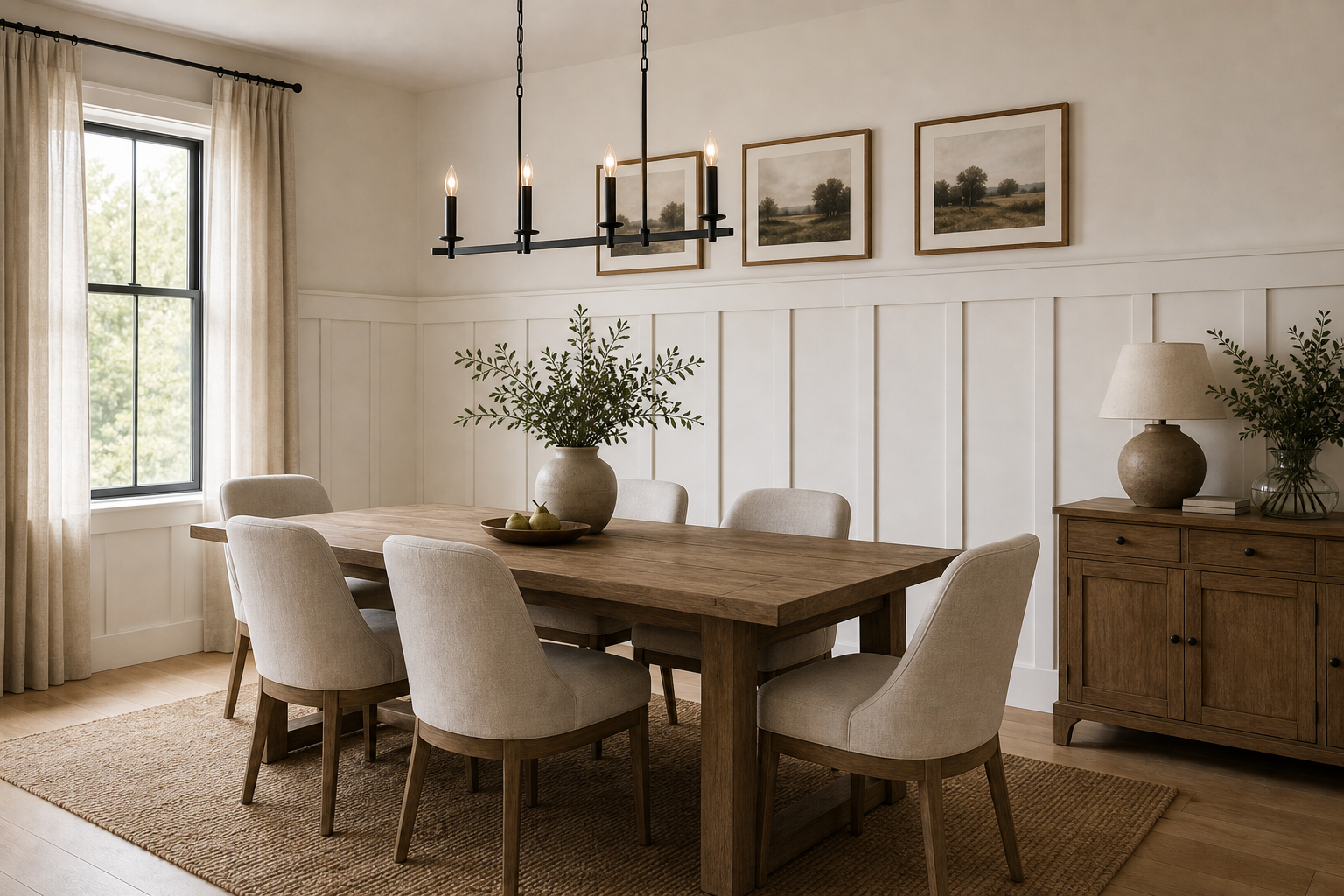

Board-and-batten paneling wraps the dining wall at chair-back height, giving the room a measured architectural base without making the upper walls busy. A long timber-toned table sits parallel to that grid, surrounded by pale upholstered chairs. Three framed pictures align above the cap rail, while a slim dark chandelier marks the table center. The sideboard continues the lower furniture line and leaves the panel rhythm visible around it.
The Paneling Establishes a Consistent Lower Datum
The paneling stretches across the dining wall and creates a clear lower zone. Its vertical battens add rhythm behind the table without requiring bold color. Because the upper wall stays plain, the paneling reads as architecture rather than decoration.
The cap rail remains below the artwork and above much of the chair backs, creating a clear transition between detailed lower wall and plain upper field. This proportion lets the paneling feel substantial without turning it into a full-height feature wall.
The rectangular timber-toned table sits in front of the paneled wall with enough visual weight to match it. Its straight lines make sense against the grid. The natural wood warms the white wall and keeps the room from feeling too crisp.
Battens are spaced broadly enough that each panel remains calm behind the furniture. Their fine shadows add rhythm across a pale surface, while the table and chair arrangement introduces a second, looser cadence in front.
The Table Runs Parallel to the Wall Grid
The upholstered chairs soften the strong lines of the wall and table. Their rounded backs bring comfort to the structured room. Their neutral fabric also keeps the focus on proportion instead of pattern.
Upholstered Chairs Soften the Repeated Rectangles
The black linear chandelier repeats the table's long shape and gives the dining area a precise center. Its dark finish also connects to the curtain rod and cabinet hardware, adding definition to the warm white room.
A Linear Chandelier Marks the Table Axis
The framed landscapes sit above the panel cap, which gives them a clear resting line. This placement keeps the artwork from floating awkwardly. The repeated frames echo the measured rhythm of the battens below.
The sideboard continues the wood tone of the table and gives the dining room a secondary storage surface. Its height stays below the artwork zone, so it does not interrupt the board and batten composition.
The Sideboard Sits Within the Paneled Zone
Start by choosing a panel height that works with the chair backs and table scale. The wall should feel protective, not chopped in half. Keep artwork above the cap rail and use lighting that aligns with the table rather than the entire wall.
The sideboard top sits close to the cap rail and carries only a branch vessel and a few ceramics. Its timber tone relates to the table, but the surrounding pale panels stop the two furniture pieces from merging into one heavy lower band.
Setting Panel Height Around Chairs and Furniture
I would not paint the paneling a high-contrast color in this exact room. The warm white keeps the dining space calm. I would also avoid overly rustic chairs, because the upholstered seats are what keep the farmhouse style current.
The ceiling-led composition in this scheduled dining-room beam study places rhythm overhead. Here, the measured lines remain at wall and furniture height, producing a brighter farmhouse envelope around the table.
Chair backs stay below the panel cap in much of the view, allowing both furniture and wall detail to remain legible. The table leaves clear floor along the window side and before the sideboard. Paneling may organize the room visually, but circulation succeeds because the dining group never presses against that architectural perimeter.
The chandelier's horizontal bar is shorter than the table and centered between its ends. Small vertical candle-like elements rise from it without echoing every batten below. This difference in spacing keeps lighting connected to the table rather than visually attached to the paneled wall.
The large window sits perpendicular to the paneled wall and sends light across batten edges, making their shallow relief visible without a contrasting paint color. Curtains stay beyond the dining-chair line and soften the corner. Architecture remains legible because daylight arrives from the side rather than flattening the grid frontally.