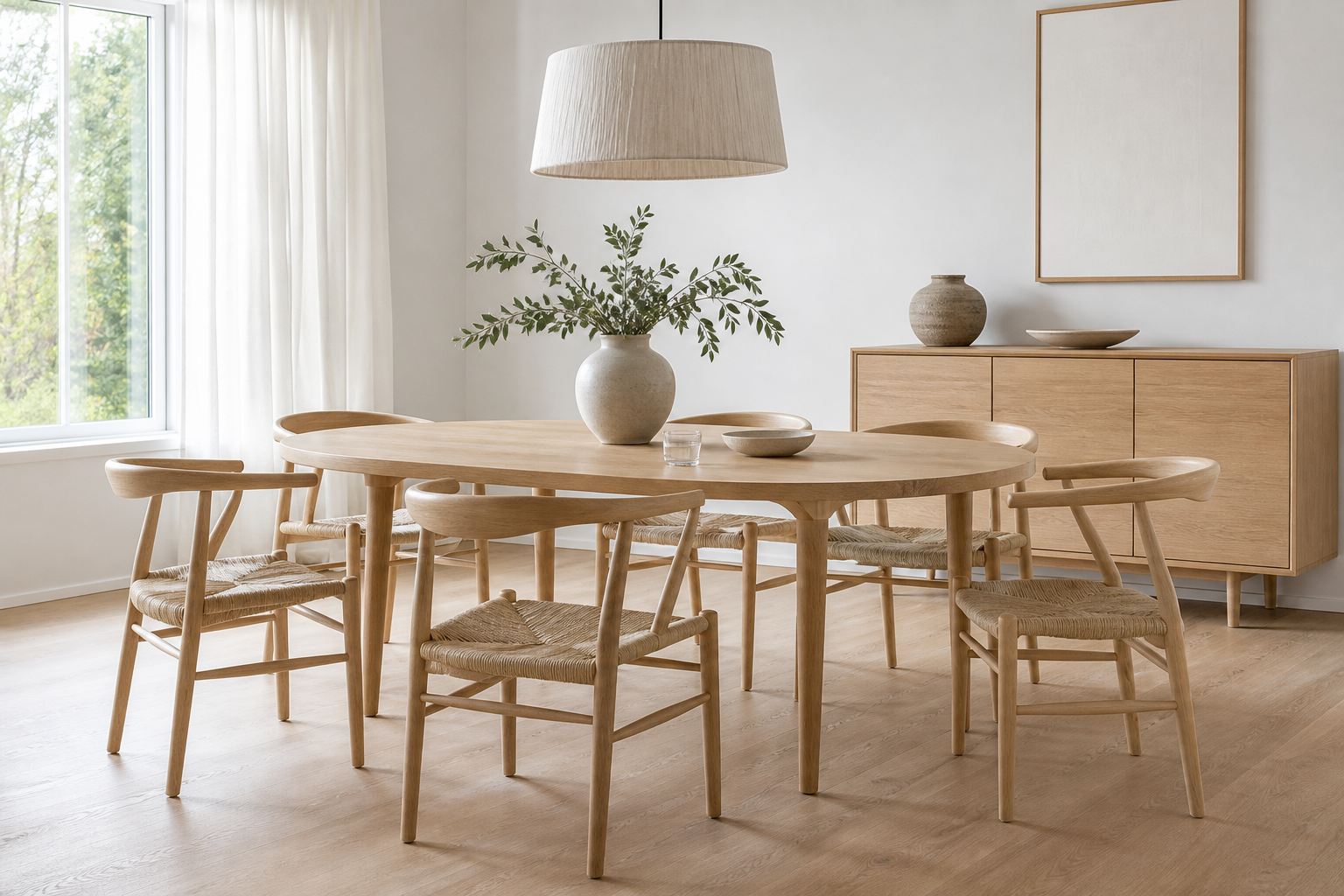

Six curved light-timber chairs establish the dining room's strongest rhythm around an oval table. Rounded back rails echo the tabletop ends, while woven seats introduce a finer texture without darkening the open frames. A large pale pendant, low sideboard, restrained artwork, branch vessel, warm floor, and broad windows support the same airy geometry. Repetition works because the chair remains visually light from every angle.
Repeated Chairs Define the Dining Room Rhythm
The light timber tone chairs are repeated on every side of the oval table, which makes them the room's strongest visual rhythm. Their rounded backs echo the table edge rather than cutting against it. Because the frames are pale and open, six chairs can sit in the room without making the dining area feel dense.
Chair spacing is even around both long sides and table ends, making circulation points legible while preserving a continuous family of curved outlines.
The woven seats are the most important texture in the scene. They give each chair a tactile surface while staying within the same natural color family as the wood. That restraint is very Scandinavian. Texture replaces excess decoration, so the room feels warm without relying on many accessories.
The curved dining-chair article uses fuller upholstered forms. This Scandinavian room relies on open timber frames and woven seats for a lighter effect.
Open Frames Keep Six Seats From Feeling Dense
The oval table softens the group of chair legs and keeps movement around the dining area easier. There are no sharp corners competing with the curved chair backs. Its pale wood tone is close to the chairs, which makes the entire dining set read as one calm composition rather than separate pieces.
Back splats and rails leave more open space than solid surface, allowing table legs and the pale room beyond to remain visible through the seating.
Woven Seats Add Texture at a Smaller Scale
The fabric pendant is large enough to mark the table, but its pale shade keeps it visually quiet. It reinforces the dining zone without stealing attention from the chairs below. Its soft cylindrical form also balances the oval tabletop. The room uses roundness repeatedly, and that makes the arrangement feel gentle.
A Pale Pendant Marks the Shared Center
The sideboard gives the back wall storage and weight, but its simple pale wood face stays aligned with the dining set. It supports the chair story rather than introducing a new material language. The ceramic pieces on top are sparse, which protects the calm wall behind the table.
The pendant is broad enough to correspond with the table center but hangs as one soft volume. Its exact material and output are not inferred.
Daylight from the large window makes the pale wood grain readable across the chairs, table and floor. The sheer curtain softens that light so the room does not feel harsh. This is why the light timber tone works: it has enough natural variation to feel alive, but the daylight keeps it airy.
Daylight Separates Similar Timber Tones
Look for chairs with open backs, slim legs and a seat material that adds texture without bulk. Woven seats are especially effective because they make the chair feel crafted. Keep the chair tone close to the table or floor if the goal is a quiet Scandinavian dining room. Strong contrast would create a different, more graphic effect.
Choosing Repeated Seating Without Creating Uniformity
Avoid mixing too many chair styles in a room like this. The design depends on repetition and calm proportion. A heavy upholstered host chair or dark accent chair would interrupt the lightness that makes the dining area feel generous.
Compare chair-back radius with table corners and verify pull-out space at every position. Heavy upholstery or mismatched tall end chairs would interrupt the repeated light frame.
The sideboard stops well below the artwork and chair backs, giving the dining perimeter a calm low line. Its pale front avoids challenging the repeated chairs.
The oval tabletop leaves softer circulation corners near the windows and relates directly to the rounded chair rails.
The branch vessel rises near the sideboard end, adding an irregular vertical while the table center remains open beneath the pendant.
Chair arms remain low enough to slide visually beneath the oval table edge, keeping the repeated backs as the dominant seating line. Open lower frames also allow the warm floor to continue through the full dining arrangement.
The pendant hangs centrally but does not copy the chair or table curves exactly. Its soft pale volume supplies a larger overhead counterform while the furniture carries the finer repeated geometry below.