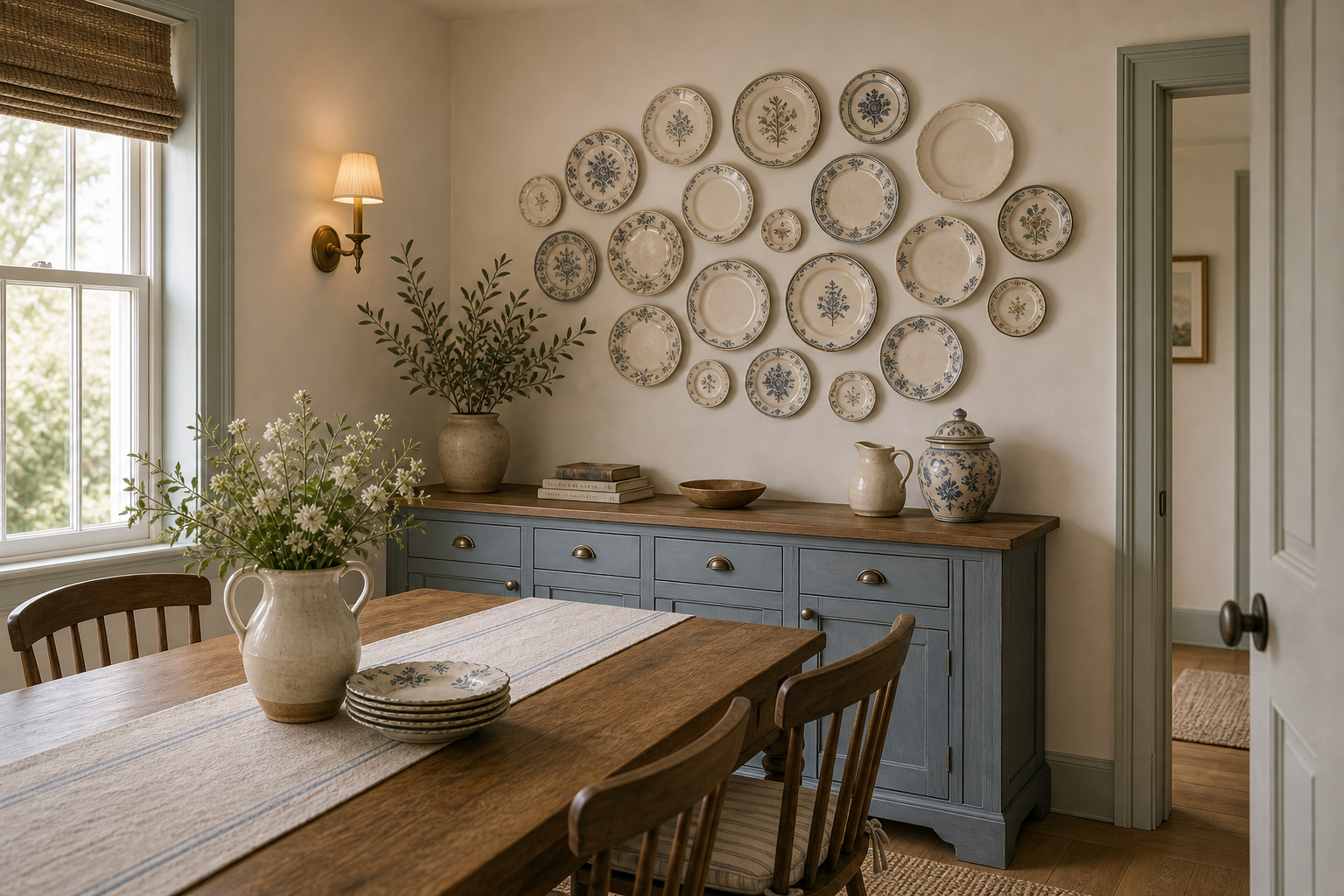

The plate wall turns a broad pale surface into a collection with movement. Blue-and-white dishes vary in diameter, border, and motif, gathering into an irregular oval above the sideboard rather than a strict grid. Larger plates hold the center and lower edge, while smaller pieces fill gaps toward the perimeter, giving the display density without making it rectangular.
A muted blue sideboard grounds the arrangement and repeats the plate color at furniture scale. Timber table and spindle chairs occupy the foreground, leaving the wall visible above their backs. Flowers, ceramics, a shaded window, and one sconce soften the composition, but none challenges the plate collection as the room's central decorative architecture.
The Collection Forms an Irregular Oval
The plate grouping is centered above the sideboard and occupies the main wall, so it immediately becomes the room's visual anchor. The collection feels cottage-like because it looks gathered over time, but the spacing keeps it from becoming random.
The outer plates do not align to a border, yet the group remains contained because gaps between pieces are relatively consistent. This visual spacing is more important than perfect symmetry when individual diameters vary.
Plate Scale Creates Movement Across the Wall
Large plates, small saucers and medium pieces are mixed across the wall. That variation creates movement without requiring different object types. The eye travels across the arrangement because the sizes shift gradually. A row of identical plates would feel flatter and less charming.
The largest dishes occupy the visual center and the two lower corners, giving the collection enough weight to hover above the sideboard. Smaller plates bridge the spaces between them and allow the outline to taper near the top. None touches another. This separation lets individual borders remain legible and avoids the appearance of one printed wallpaper patch applied to the wall.
Blue and White Hold Many Patterns Together
Most of the plates share a blue-and-white ceramic language. That tight palette allows many pieces to appear on the wall without overwhelming the room. The blue details also connect to the painted sideboard and table runner. The palette feels repeated, not accidental.
The Sideboard Gives the Display a Stable Base
The painted sideboard gives the plate wall a strong base. Its long shape keeps the ceramic arrangement from feeling like it is floating too high. Brass hardware and the wood top add warmth at a lower level. That balance lets the wall remain decorative while the sideboard stays useful.
The sideboard top carries only a branch vessel, books, and a few ceramics, leaving a quiet strip beneath the busy wall. Its long timber-toned top also connects the painted cabinet to the dining table.
Dining Furniture Stays Below the Collection
The wood dining table sits in the foreground with a simple runner and ceramic pitcher. It repeats the cottage materials without competing with the plates. Stacked plates on the table echo the wall collection in a practical way. That repetition makes the room feel intentionally connected.
Window and Sconce Supply Different Light
Daylight from the window brightens the ceramic surfaces and keeps the dining room soft. The woven shade adds texture without hiding the light completely. The wall sconce creates a warmer glow near the plate wall, helping the arrangement feel special in the evening.
Daylight from the left window reveals the plate relief, while the small shaded sconce on the opposite side creates a warmer localized pool near the collection. The sources are intentionally unequal, which suits the asymmetrical arrangement. Exact lamp temperature cannot be inferred. What is visible is depth at two times of day: side light picks up rims and glazing, and the sconce prevents the far end from disappearing after sunset.
Cottage Details Remain Useful Rather Than Themed
Ceramic pitchers, books, bowls and flowers appear on the sideboard and table, but they are not scattered everywhere. They support the dining function and the ceramic story. This restraint matters because cottage rooms can become overly full. Here, the collection is rich, but the surfaces still have breathing room.
The disciplined tabletop echoes the restraint in this warm neutral dining table analysis, even though the cottage room permits much more pattern on the wall.
The Doorway Frames Wall and Table Together
The open door at the right reveals plate collection, sideboard, and dining-table edge in one view. Furniture remains low enough that the wall is not hidden, while the plate group is contained above the cabinet. That layered doorway composition confirms that decoration, storage, and dining use have been designed as one room.