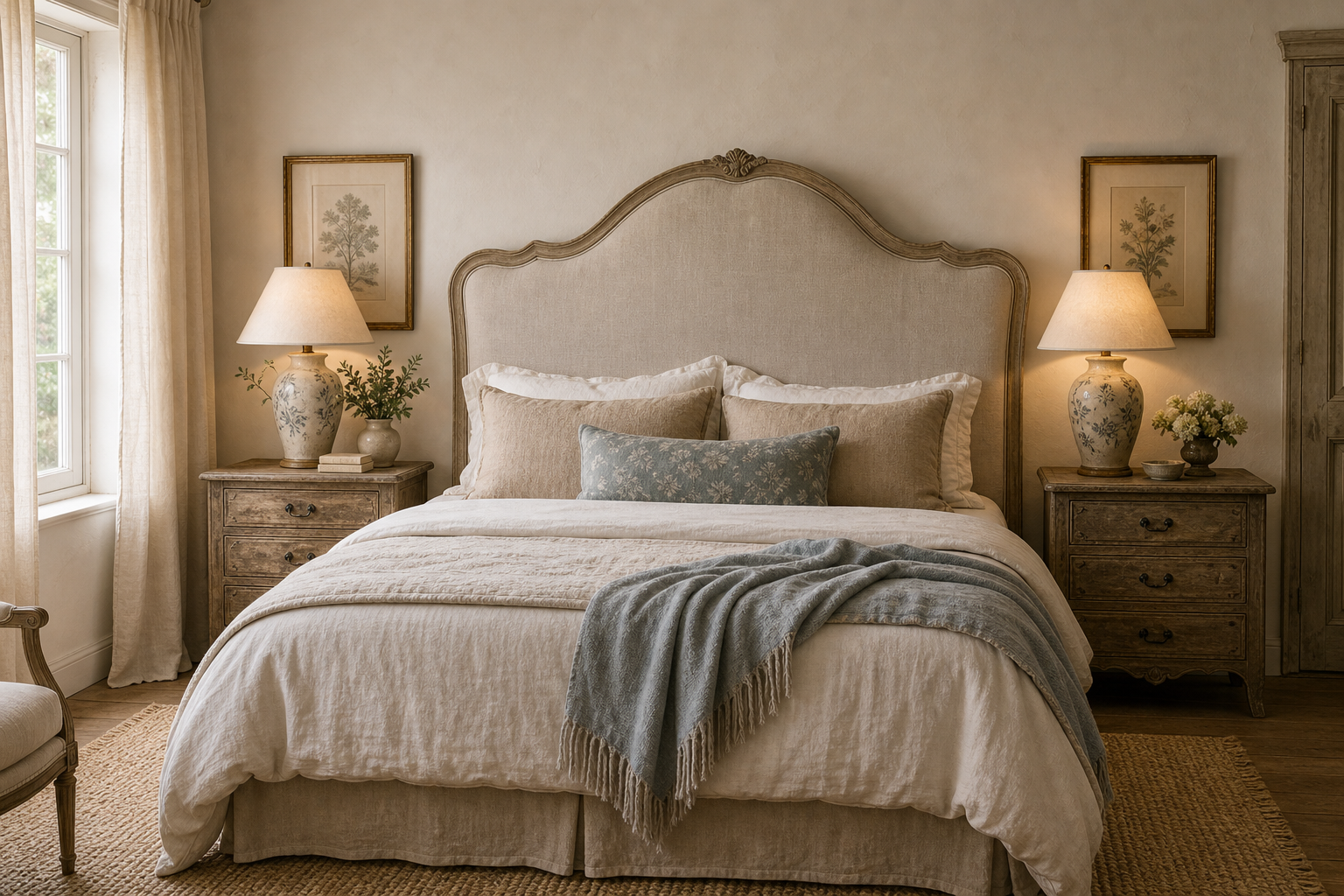

The headboard gives this bedroom its silhouette. A tall upholstered center rises into a broad curve, edged by weathered timber-like trim and a small carved crest. Lower curves sweep outward toward the nightstands, making the bed feel substantial without relying on a canopy or a heavily decorated wall.
Symmetry supports that shape. Similar three-drawer nightstands, ceramic lamps, and botanical prints sit on both sides, while daylight enters from the left. Soft bedding and muted blue accents keep the central furniture from feeling formal. The room balances old-world outline with a restrained, usable arrangement.
The Curved Top Creates a Clear Bed Hierarchy
The headboard rises well above the pillow stack and reaches its highest point at the center. That curve draws the eye inward and gives layered bedding a stable backdrop. Straight nightstand tops and picture frames make the upholstered outline even more apparent by contrast.
Its width extends beyond the mattress but stops before the bedside furniture, maintaining slim wall gaps. An oversized wall-to-wall headboard would erase those separations and reduce the individuality of the nightstands.
Timber Trim Defines the Upholstery Without Heavy Contrast
A narrow weathered frame follows the headboard's full perimeter and thickens at the crest. Its warm gray-brown value is close enough to the fabric to feel integrated. Visible wear or tonal variation gives detail, but the image cannot support a precise wood species or finish process.
The trim relates to nightstands and the tall cabinet at the far right. Repeating a distressed-looking tone across a few substantial pieces creates continuity without matching every object exactly.
Layered Bedding Keeps the Large Headboard Approachable
White and warm beige pillows overlap in front of the upholstery, with one long muted blue floral cushion at the center. A pale coverlet and blue-gray throw move horizontally across the bed, countering the headboard's height. Relaxed folds prevent the arrangement from becoming ceremonial.
The blue appears in limited areas, so it functions as a cool accent rather than a theme. Its placement at pillow and foot connects the full bed depth while leaving the larger neutral textile field calm.
Paired Nightstands Build Balanced Side Zones
Three-drawer nightstands flank the bed at similar height and carry large ceramic lamps. Their broad bases are visually strong enough beside the headboard, while small books, bowls, flowers, and branches create controlled differences between sides.
Botanical prints hang above each nightstand rather than over the headboard. This preserves blank wall around the central curve and distributes detail outward. The prints align closely in height even though daylight makes the left side brighter.
Window Light Reveals Texture Across the Bed
A tall left window with full pale curtains sends soft light across headboard fabric, bedding, timber fronts, and woven rug. Lamps add warm local pools on both sides. The upper wall remains largely unadorned, allowing light and plaster-like texture to register.
For a similar room, establish the headboard as the one expressive outline, leave wall around its curves, and use bedside symmetry as a frame rather than a rigid duplicate. Repeat weathered tones in larger furniture and reserve pattern for small textiles and art. The bed then feels collected, not overloaded.
The Headboard Width Contains the Bedside Composition
The upholstered frame extends beyond the mattress but stops before the paired nightstands, giving bed and side furniture separate outlines. Its curved crest rises above the pillows without reaching the ceiling trim. That controlled width and height make the headboard dominant while preserving pale wall around it, a more convincing hierarchy than simply choosing the tallest possible piece.
Nightstand lamps remain below the headboard's shoulder line, and their pale shades occupy similar zones on both sides. Small framed art and vessels add variation without pushing beyond the bed composition. The furniture group feels complete because every secondary item is scaled against the central upholstered form rather than selected in isolation.
The Bed Sits Within a Soft Rectangular Floor Zone
A pale textured rug projects from beneath the bed and gives the darker timber-toned floor a quiet central field. Bench legs and bed edges remain legible against it. The rug's straight boundary also counters the curved headboard, keeping the room from repeating one silhouette at every level.
The bench at the foot is narrow and open below, so it marks the bed's end without forming a solid barrier. This leaves floor visible through and around it, clarifying movement toward both sides. The overall lesson is proportional: one generous vertical feature can be supported by lighter, lower furniture at the room's circulation edge.