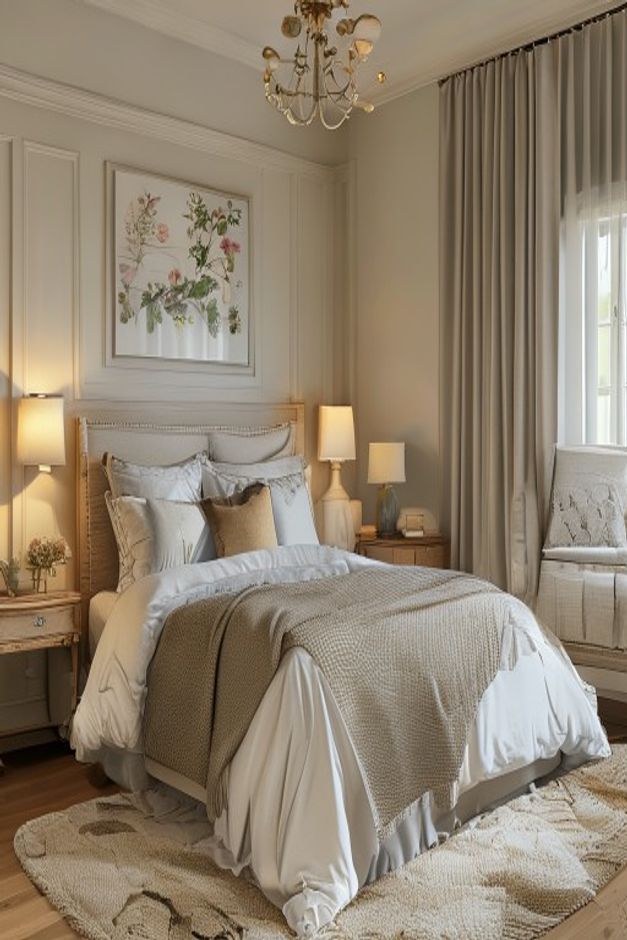

The botanical artwork gives this bedroom a clear identity without asking the bed wall to become theatrical. A large pale print sits inside a paneled field above the upholstered headboard, its greens and faded floral tones introducing just enough color to animate the warm gray and ivory room. The picture belongs to the architecture because its frame aligns with the surrounding molding.
Below it, the bed is layered generously but remains tonal. Bedside tables, three visible lamps, a small chandelier, and full-height curtains establish a formal French country rhythm. The room feels comfortable rather than ceremonial because soft textiles and daylight interrupt the symmetry with folds, shadows, and varied surface texture.
Botanical Art Completes the Central Wall Panel
The print is large enough to hold the space above the headboard, yet a broad margin of painted wall remains around it. Its vertical orientation follows the panel proportions and pulls the eye upward toward the crown molding. A wider landscape would press against the trim and reduce the graceful wall height.
The image itself is delicate, with individual stems and leaves dispersed over a pale ground. That visual openness matters above a bed already filled with pillows. Dense, dark artwork would combine with the headboard and bedding to create a heavy central block.
The botanical forms are broad enough to be read from the foot of the bed, but their pale ground keeps the panel from becoming a dark rectangle. This balance is important above a tall upholstered headboard: the image needs visual reach without adding another heavy mass to the already layered wall.
An Upholstered Bed Softens the Formal Paneling
The headboard has a light fabric face framed by a warmer wood-toned edge and a fine line of trim. It introduces depth without competing with the floral print. The generous white bedding then expands the soft center, while a taupe woven cover adds weight across the lower half.
Pillows vary in scale and texture but stay within cream, gray, and muted brown. The layered arrangement feels abundant because the pieces overlap, not because they introduce many colors. Keeping the tallest pillows below the artwork preserves a visible strip of wall between furniture and frame.
Bedside Lighting Balances Without Exact Matching
Tall shaded lamps flank the bed, and a smaller lamp sits on the right table. Their bases and heights differ, but the warm pools of light are comparable on both sides. This functional balance is more relaxed than perfect matching and suits a room that combines formal molding with everyday furniture.
Full-Height Drapery Gives the Window Equal Presence
Taupe curtains begin just below the crown and fall to the floor beside a sheer inner layer. Their vertical folds occupy much of the right wall, giving the bright opening enough visual weight to balance the paneled bed wall. The upholstered chair near the glass stays pale so it does not become a third large focal point.
The tonal window treatment can be compared with this published warm neutral bedroom curtain study. In the present room, the curtain color also echoes the bed cover, connecting the window and sleeping zone across the corner.
The Chandelier Adds Detail Above a Quiet Ceiling
A small branching chandelier hangs centrally and introduces curved metal-toned lines and glass-like drops. Its scale is modest enough that the crown molding remains visible around it. The fixture supplies a period note without lowering the perceived ceiling or competing with the botanical art below.
Warm Wood Appears Only at Supporting Points
Bedside tables, the headboard edge, and the floor provide restrained wood tones around the pale textiles. These small areas prevent the neutral palette from becoming cool and connect the room to the organic subject of the artwork. Large dark case pieces would undermine that lightness.
The strongest adaptation is to choose the art and wall proportion together. Once the frame occupies the correct panel, bedding, lamps, and drapery can support its muted colors. Here, botanical imagery is not an accessory added at the end; it is the measured center of an otherwise restrained bedroom composition.
Wood-toned bedside pieces and the floor appear at separate levels rather than forming one continuous brown band. Pale bedding interrupts them at the center, and curtains interrupt them at the window. The resulting pauses keep warmth distributed around the room instead of concentrated in a single furniture set.