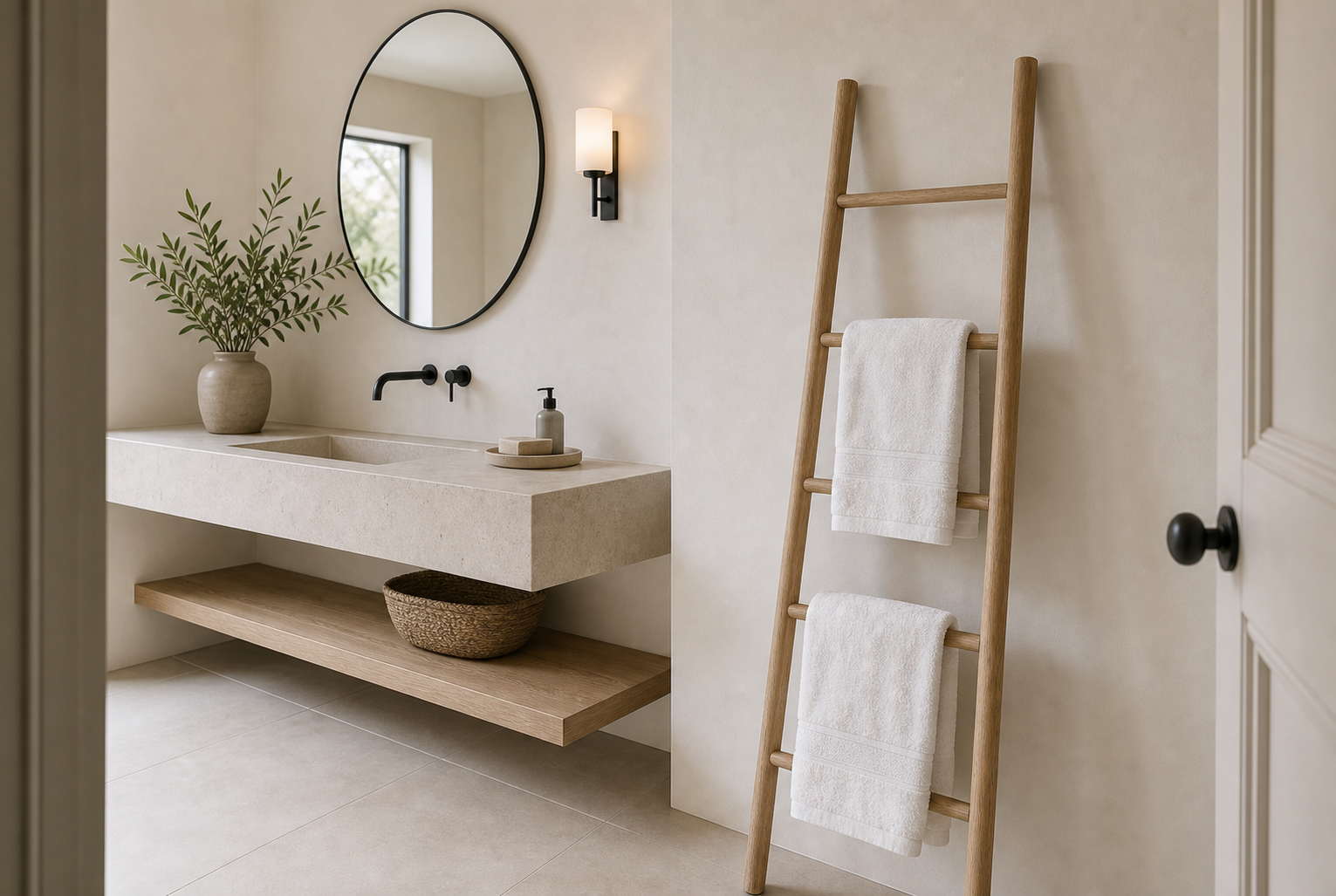

The towel ladder earns attention through placement rather than ornament. It leans against a broad pale wall opposite the floating basin and holds two folded white towels at different heights. With no cabinet, artwork, or wall hooks surrounding it, the slender timber frame has enough negative space to read as a purposeful storage element rather than a temporary object.
Across the room, a light-toned basin block and long open timber shelf form a stronger horizontal composition. The ladder provides the necessary vertical counterpoint. This opposition between one tall movable piece and one low fixed plane brings balance to a small bathroom while keeping the center floor clear from door to vanity.
A Clear Wall Lets the Ladder Read as Furniture
The ladder is positioned beyond the door swing and away from the basin edge, so its feet occupy a quiet corner instead of the active washing zone. Its top stops well below the ceiling and leans at a shallow angle. The photograph cannot confirm fixings or anti-slip details, but the visible setup demonstrates that a ladder needs open wall width and stable floor contact to feel intentional.
Two Towels Preserve the Open Frame
White towels hang across separate rungs, leaving most of the uprights and intermediate rails visible. Their folded widths do not extend beyond the timber frame. Overloading every rung would turn the ladder into a dense textile column and erase the simple geometry that suits the room. The staggered positions also let each towel dry without visually merging into the one below.
The Floating Basin Keeps the Opposite Side Light
A rectangular light-toned counter projects from the left wall and contains a shallow integrated basin. Beneath it, a thick timber shelf runs almost the same length, holding one low woven basket near the center. The open gap between counter and shelf prevents this side from becoming a solid vanity block and leaves the pale floor visible under both levels.
Round and Linear Forms Balance Each Other
A large round mirror is centered over the basin, softening the long counter and ladder rails. The circular outline also echoes the rounded plant vessel below. Black wall-mounted fittings and a compact vertical sconce introduce smaller straight accents. This limited exchange of circles and lines is enough to give the room variety without additional decorative objects.
Texture Replaces a Decorative Color Scheme
The walls, floor, counter, basin, and towels remain within pale neutral tones. Variation comes from the grain of the ladder and shelf, the woven-looking basket, matte-looking black fittings, and leafy branches. The exact surface compositions are not fully distinguishable, so the useful observation is tonal: warm textured elements are concentrated against a quiet, light background.
Open Circulation Is the Practical Payoff
The ladder and vanity hug opposite walls, leaving an uninterrupted path from the doorway into the room. No bath, shower, or additional fixture is visible and should be inferred. This clarity is also central to the minimalist bathroom floating vanity approach, where lifting storage from the floor makes a compact footprint easier to understand.
For a comparable bathroom, choose the wall position before choosing the ladder itself. Confirm that towels can be reached without stepping into the basin area, preserve enough blank wall around the frame, and keep the number of hanging textiles low. The room feels minimalist because every visible object has a defined location and none interrupts movement through the center.
The ladder's timber tone closely matches the lower shelf but the two pieces are not aligned or physically connected. That separation is valuable: one belongs to the dry towel wall and the other to the washing zone. Their repeated warmth carries the eye across the room while the open floor between them remains the dominant spatial feature. Even the basket stays low and centered beneath the basin, avoiding a cluster of warm objects at either end. The palette thus links opposite walls without confusing their practical roles.
Door, ladder, and shelf also occupy different depths. The dark knob projects at the foreground, the ladder rests midway along the wall, and the shelf is fixed across the basin zone. These separate layers keep the small room comprehensible from its entrance and avoid a flat lineup of objects along one plane.