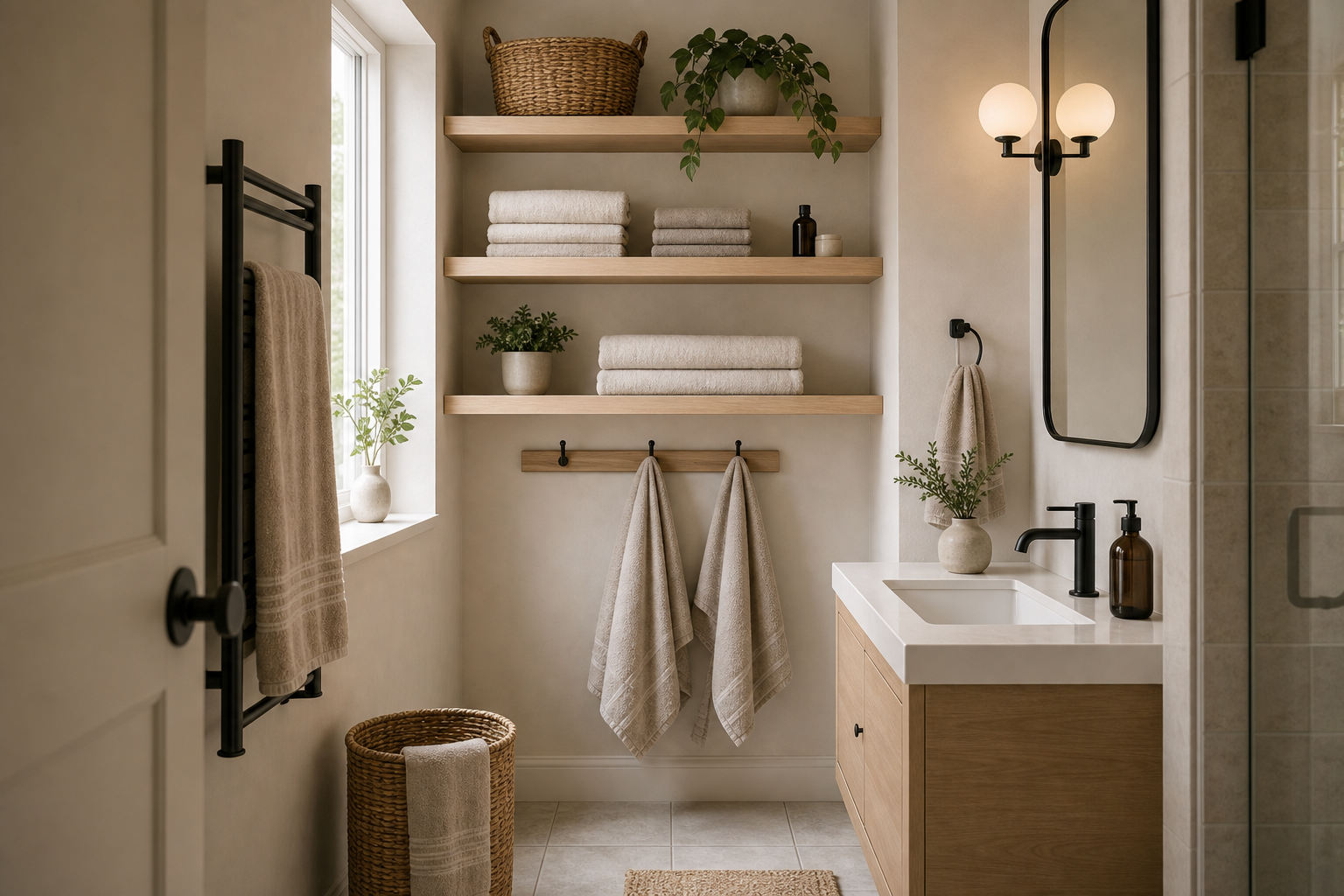

Towel storage is distributed across several shallow vertical layers instead of concentrated in a full cabinet. Three pale timber shelves hold folded towels, a basket, plants, and small containers; a black rail warms or holds one large towel; three hooks carry two smaller towels; and a woven floor basket contains another textile. The narrow bathroom remains open because none of these elements projects deeply into the center.
The system is easy to read from the doorway. Clean folded stacks occupy the middle shelves, hanging towels remain below or beside them, and the tallest basket sits at the top. Warm timber, pale textiles, woven fiber, black metal, and soft daylight create Scandinavian restraint without making every storage piece identical.
Three Shelves Use the Full Wall Height
Open shelves are stacked between the left window and vanity wall, filling a tall narrow field that would be difficult to use with deep furniture. Their aligned front edges establish one vertical storage zone while leaving substantial wall between levels.
The shelves appear pale and timber-toned, but exact species and support method are not visible. Their shallow depth is the important feature: towels and baskets fit without narrowing the route in front of the vanity.
Folded Towels Occupy the Most Reachable Levels
Two neat stacks sit on the middle shelf, and two larger folded towels rest on the shelf below. Their pale tone keeps the open storage visually quiet. Different stack widths make use of the shelf without filling it from edge to edge.
A dark bottle and small container stay beside the upper stacks, while plants occupy separate levels. This spacing prevents towels from becoming background for many unrelated accessories.
The Upper Shelf Holds Larger, Less Frequent Volumes
A broad woven basket sits on the highest shelf beside a trailing plant. Its solid volume creates a visual cap over the lighter folded textiles below. The basket remains inside the shelf width and leaves pale wall visible at both sides.
Contents are unknown and should not be assigned. Position alone communicates the hierarchy: larger contained storage sits high, while towels needed at hand height remain open and visible.
A Black Rail Adds a Separate Hanging Layer
A tall black ladder-like rail stands on the left wall beside the window with one large towel draped across it. Its vertical bars echo the black mirror frame, faucet, door hardware, and shower edge. The dark silhouette remains narrow against the pale wall.
Whether the rail is heated cannot be proven solely from appearance, so its visible role is towel support. It keeps one textile spread vertically and away from folded stacks, using wall height rather than floor area.
Hooks Handle Smaller Towels Below the Shelves
A short timber strip with three black hooks is mounted beneath the lowest shelf. Two hand towels hang separately with space between them, leaving the third hook available. This layer sits above the baseboard and does not interfere with the vanity or floor basket.
The hooks repeat shelf timber and dark fittings in one compact piece. Their placement turns otherwise empty lower wall into immediately accessible storage without adding a projecting bar.
The Floor Basket Contains the Softest Overflow
A round woven basket sits below the rail with one pale towel folded over its rim. Its warm texture connects to the upper basket and small woven rug. Because the basket occupies the corner, the central floor remains clear.
The image does not reveal whether the towel is clean or used, so the basket should not be assigned a laundry function. It simply demonstrates another visible way to contain a bulky textile at floor level.
Compact Fixtures Preserve the Storage Wall
A small timber-toned vanity, white basin, dark faucet, tall mirror, and twin-globe sconce stay on the right, leaving the towel wall uninterrupted. Shower glass forms a slim edge beyond, and a side window brightens shelves and rail.
For a similar bathroom, separate folded, hanging, and contained textiles by height, choose shallow shelves, and keep the floor basket at the perimeter. The plan works because storage is distributed where each towel format naturally fits rather than forced into one large cabinet.
The lowest shelf and hook rail stop before the vanity projection, leaving a clean vertical gap between storage and basin. That separation prevents towels from crowding the hand-washing zone.