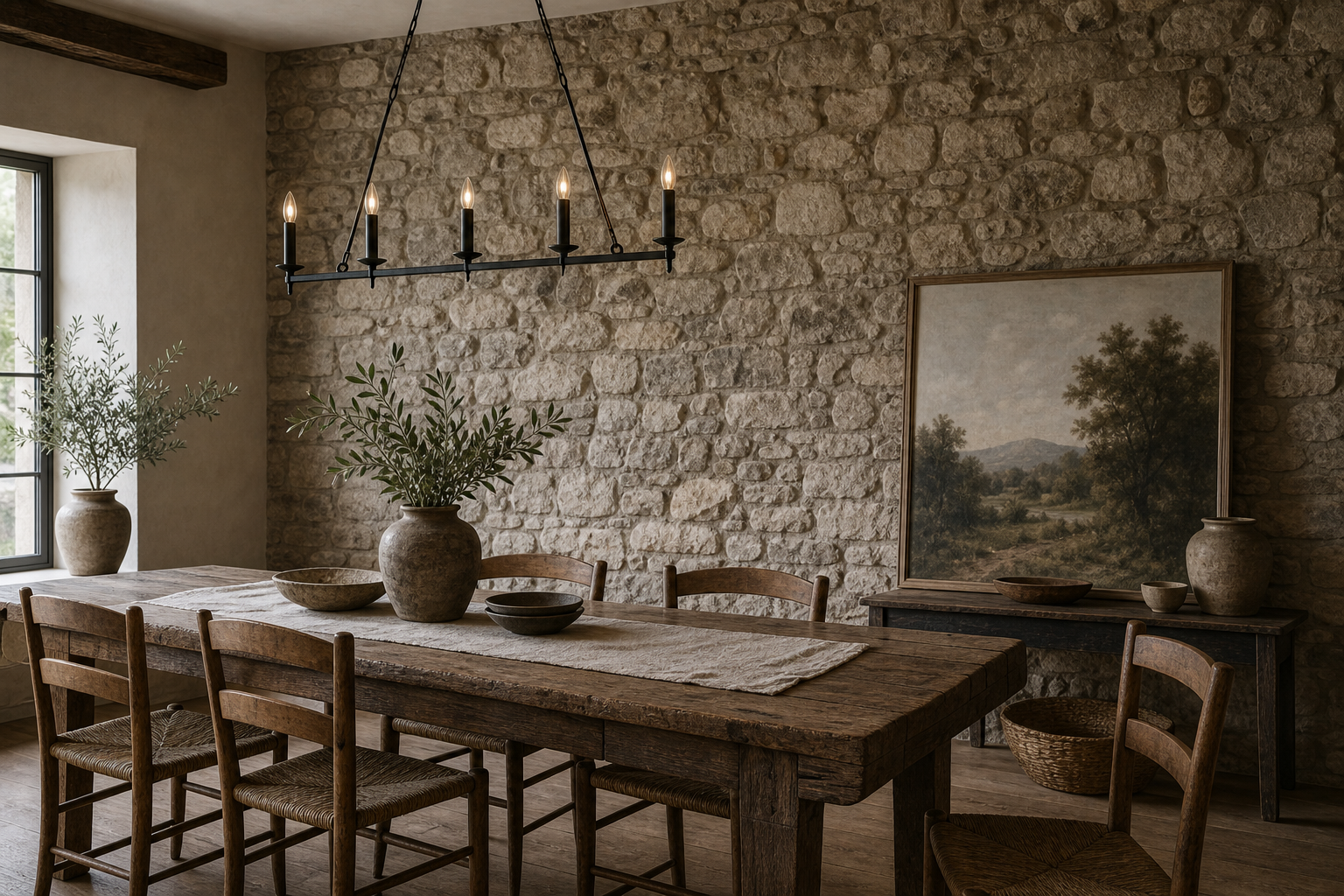

Irregular pale stone occupies the entire dining-room elevation, giving the long table a background with enough weight to match its scale. A dark linear chandelier runs above the center, while woven-seat chairs remain comparatively light at floor level. One large landscape hangs off-center and a branch vessel marks the tabletop. Side daylight grazes the masonry, revealing relief without adding another wall treatment or color block.
The Stone Wall Gives the Dining Room Structural Weight
The irregular stones create depth across the full dining wall. Their varied sizes and rough surfaces give the room a sense of permanence that a painted accent wall could not provide. Because the rest of the palette stays earthy and restrained, the wall can remain visually rich without overwhelming the dining area.
The masonry continues beyond both table ends and reaches the upper boundary of the image, so it reads as architecture rather than a narrow decorative panel. Its pale range keeps the wall substantial without turning it into a dark enclosure.
The long wood table has a thick, weathered top that feels appropriate against the masonry. A delicate table would look temporary in front of this much stone. Its horizontal grain also calms the busy texture of the wall, giving the eye a steadier surface at dining height.
Stones vary in size and project at different depths, while pale mortar forms an uneven network between them. This pattern is already visually rich; keeping the adjacent wall and floor quiet allows natural relief to supply the decoration.
The Heavy Table Matches the Wall's Scale
The woven rush seats bring texture at a smaller scale than the wall or table. They add tactility without introducing upholstery that would feel too refined for the setting. Their simple wood frames also keep the chair silhouettes light enough that the table and stone wall remain the stronger design elements.
The table uses a thick top and broad supports, establishing a horizontal mass that can hold its own against the wall. Its warm timber tone separates it from the cooler masonry but stays close enough to maintain an earthy palette.
Woven-Seat Chairs Keep the Lower Edge Permeable
The black dark linear chandelier runs parallel to the table, clarifying the dining zone under the ceiling. Its slim linear frame gives structure without blocking the stone wall behind it. The candle-like bulbs suit the rustic setting because they add warmth while keeping the fixture visually simple.
The framed landscape leaning against the stone wall introduces another aged surface, but it stays quiet in color. That keeps the artwork from fighting the masonry. Its placement low against the wall makes the corner feel collected rather than formally decorated.
One Landscape Interrupts the Masonry Carefully
The linen runner softens the heavy wood top while preserving the length of the table. Ceramic bowls and a large vase add handmade forms that suit the rustic material palette. Nothing on the table is glossy or oversized, which is important. The styling needs to feel useful and tactile, not staged against the stone.
If the dining room has a stone wall, choose furniture with enough mass to stand beside it. A thick wood table, woven-seat chairs and iron lighting will usually feel more convincing than thin modern pieces. Keep the palette close to the wall: weathered brown wood, natural linen, black iron, clay ceramics and muted greenery.
Furnishing a Dining Room Around Full-Width Stone
I would avoid glossy dining chairs in this room. Their finish would feel disconnected from the matte stone and aged wood. I would also avoid a brightly colored painting on the stone wall. The masonry already carries enough variation, so artwork should stay muted and atmospheric.
The earlier scheduled rustic stone dining-wall study offers a closely related material lesson. This photograph distinguishes itself through a longer uninterrupted wall, lighter seating silhouettes, and an off-center landscape composition.
Chair backs repeat in a fine line along both table sides and remain transparent enough for the wall to show between them. The chandelier follows the table length but hangs below the upper masonry field. Heavy architecture, substantial table, and lighter seating are therefore separated into distinct scales.
A low side surface stays near the wall end and does not interrupt chair pull-back space. The central aisle remains readable between the foreground chairs, preserving daily use despite the visual weight of stone and timber.