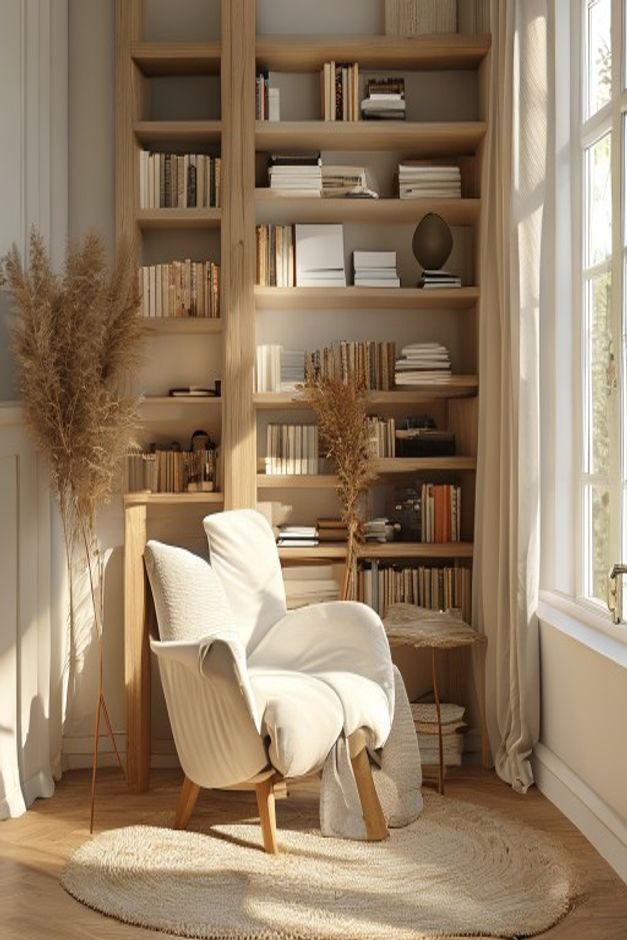

This reading nook is defined less by its chair than by the tall shelving behind it. Light wood-toned uprights frame a broad grid of books and open compartments, giving the narrow window corner a strong vertical structure. The armchair sits forward of that wall as a deliberately loose object, its soft cover contrasting with the precision of the joinery.
Direct sunlight enters from the right and crosses the chair, rug, and shelf faces. That changing light keeps the pale neutral scheme lively. Rather than adding color through many accessories, the room relies on books, dried stems, and natural-looking textures to create variation within a restrained Scandinavian palette.
The Shelving Makes Use of the Full Wall Height
The bookcase reaches from floor to ceiling and is divided by a few substantial vertical members. Shelf spacing varies, with taller openings near the top and denser book storage below. This irregular grid feels composed but not mechanical, and it provides enough blank backing for sunlight to register between objects.
Books Are Arranged to Preserve Negative Space
Some volumes stand upright, others form low horizontal stacks, and several compartments remain partly empty. The arrangement keeps the shelving functional while avoiding a continuous band of visual noise. Neutral book jackets dominate, but darker spines punctuate the wall and stop it from dissolving into one beige field.
Decorative objects are limited to a dark sculptural vessel and a few small pieces. Their placement works because they occupy gaps rather than displacing the books. The result looks like a personal library that has been edited, not a shelf styled only for display.
The Armchair Sits Clear of the Window Line
A pale, loose-covered chair is angled toward the daylight with its front legs well inside the circular rug. Its high back and layered cushions support a relaxed posture, yet the chair remains low enough that much of the shelving stays visible. The slim wood legs lift the upholstered mass above the floor and maintain a sense of lightness.
A Small Side Piece Fits the Remaining Gap
Between the chair and window is a narrow round piece with a textured top and fine legs. It occupies the only practical service position without projecting into the foreground. Its modest scale is crucial: a wider table would crowd the curtain and reduce access to the seat.
The piece is also low enough to stay beneath the window sill, protecting the clean vertical line of the curtain. Its fine legs make it visually permeable in direct sunlight. This is a useful reminder that the service surface beside a reading chair need not match the chair's bulk to be effective.
The Circular Rug Defines a Soft Island
The pale round rug gathers the chair, foot area, and side piece into one zone. Its curved outline counters the rectangular shelves and window, while its thick texture softens the sunlit floor. Because wood flooring remains visible around it, the nook feels inserted into the corner rather than walled off from the adjoining room.
This light-touch zoning differs from the more enclosed cottage reading nook with built-in wood shelving. Both use books as architecture, but the circular rug here allows the seating arrangement to feel movable and informal.
Dried Stems Introduce Vertical Irregularity
Tall dried grasses stand at the left and a smaller branch rises in front of the shelves. Their fine, uneven outlines interrupt the bookcase grid and cast delicate shadows. They also extend the warm tan palette without introducing another hard object at eye level.
Window Light Is the Primary Atmosphere
The full-height window and pale curtain form a bright right edge. Sunlight reaches deep across the shelving, revealing the depth of each compartment and the chair's folds. No visible floor lamp dominates the scene, so the nook's daytime identity depends on its relationship to the glazing.
Comfort Comes from Contrast, Not Excess
Straight shelves, stacked books, and a rigid window frame provide order; the chair cover, rug, and dried plants provide softness. Neither side overwhelms the other. Adding more cushions or shelf ornaments would reduce that productive tension and make a small corner feel busier without improving how it is used.
The practical sequence is simple: establish full-height storage, protect the best daylight for the seat, and use one small surface within reach. This photograph shows that a reading nook can feel generous even when its footprint is limited, provided the large elements are vertically organized and the floor remains visually open.