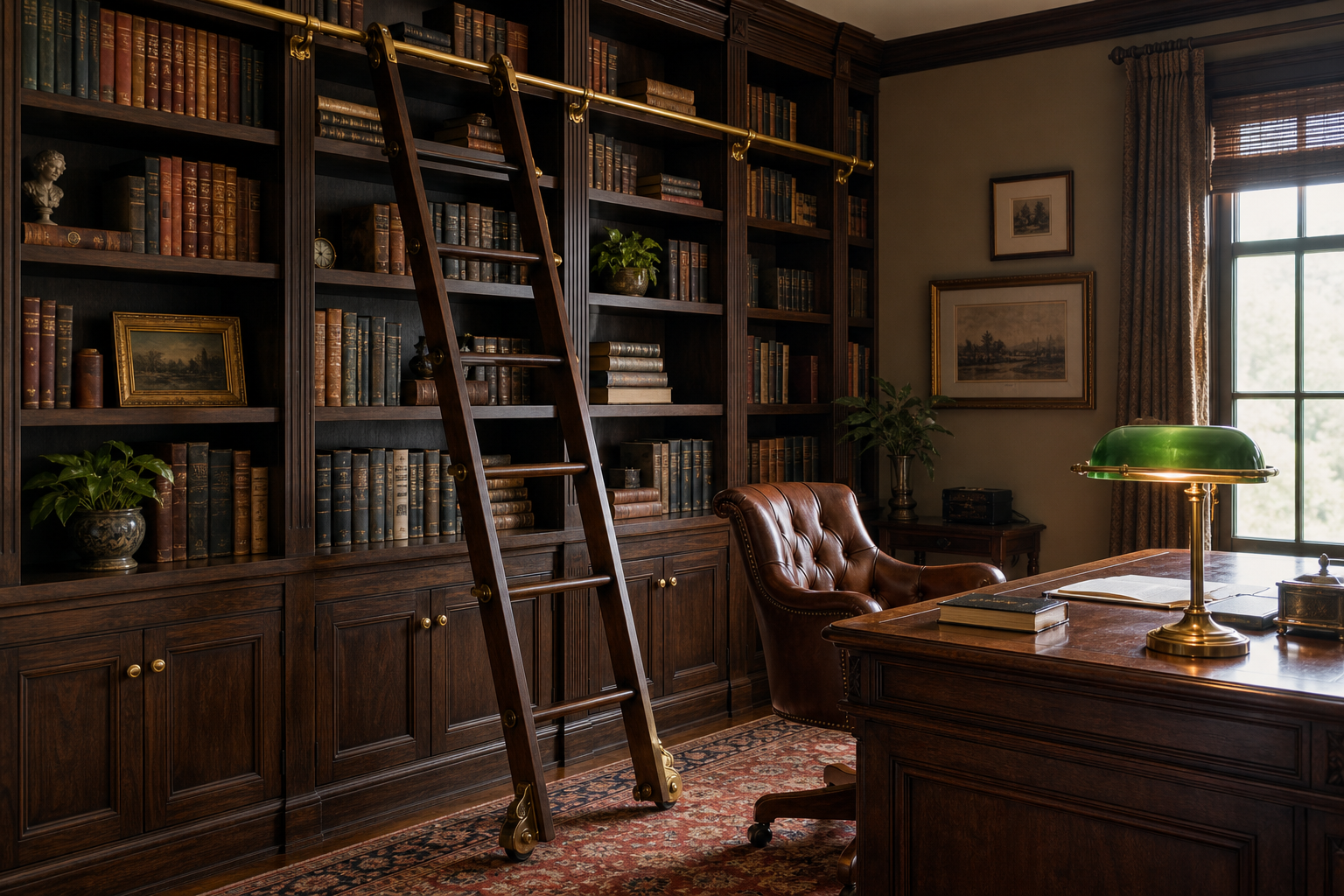

A rolling ladder turns this bookcase wall from decorative backdrop into working library architecture. Its timber-toned rails lean diagonally across full-height dark shelving, interrupting a strict grid of books, open bays, and closed lower cabinets. A warm-metal track establishes a second horizontal datum, while a substantial desk, dark upholstered chair, green-shaded lamp, patterned rug, and side window give the study a convincing occupied center.
The Ladder Breaks the Bookcase Grid With One Diagonal
The ladder crosses the bookshelf wall as a bold diagonal, so it immediately interrupts the grid of shelves and cabinet doors. That contrast is what makes the office feel designed rather than simply filled with books. Its warm-metal rail also catches light across the upper shelves, giving the room a clear horizontal line above the desk height.
The ladder angle is shallow enough to read as usable and steep enough to remain close to the shelves. Its vertical rungs introduce a finer rhythm against the larger rectangular book bays.
The shelves reach high enough that a rolling ladder makes visual and functional sense. If the bookcases were shorter, the ladder would feel theatrical rather than useful. Here, the tall shelving gives the ladder a reason to exist, and that is why the detail feels credible.
Books occupy shelves from cabinet top to ceiling, so upper access is a genuine functional requirement. The rustic office wall-shelving guide studies a lighter open arrangement; this office relies on dense, room-height joinery.
A Warm-Metal Track Unifies the Upper Elevation
The warm-metal rail is more than hardware. It draws one bright line across the dark wood and connects the ladder brackets into a continuous architectural detail. The aged brass also relates to the desk lamp base and small cabinet pulls, so the metal finish feels repeated but not overused.
The rail runs across multiple bays and remains visible between ladder and upper shelves. Its warmer line catches light against dark cabinetry without requiring bright hardware on every door.
The large desk occupies the right side of the image, yet it does not overpower the ladder wall. Its dark wood tone belongs to the same family as the shelves, so the work surface supports the room instead of competing with it. That is the correct hierarchy for this office. The wall provides identity; the desk provides function.
The Desk Holds the Center Without Blocking the Shelves
The cognac dark upholstered chair introduces a softer, warmer material in front of all the dark wood. Its rounded arms and tufted back keep the office from feeling too rigid. Because the chair sits lower than the ladder rail, it adds comfort without disrupting the book wall.
The desk sits forward from the bookcases and leaves a route behind its chair. From this angle, the ladder remains reachable without moving the main work surface, although exact clearance cannot be measured from the photograph.
A Dark Chair Adds Comfort Without Losing Formality
The green shaded lamp creates a classic task-light moment on the desk. Its color gives the room a small but memorable accent against walnut, brass and leather. The glow also balances the daylight from the window, making the office feel useful beyond a single time of day.
The patterned rug sits below the ladder, chair and desk, tying the work area back to the bookshelf wall. Its muted red and dark tones suit the traditional palette. A plain floor would make the ladder feel more isolated. The rug gives the lower half of the room enough visual weight.
Designing a Library Wall for Use Rather Than Display
Start with the shelving height and rail placement. The ladder should be needed for upper access, not added as decoration after the room is finished. Choose hardware that relates to other metal details in the office, then keep the desk and chair visually quieter than the ladder wall.
Begin with shelf reach, track height, and a protected ladder path. Decorative ladders that cannot align with upper bays, or desks pushed against the shelving, would undermine the room's strongest promise of real use.
Lower cabinet doors align with the shelf bays above, giving the dense wall a stable base. The ladder rests against this full-height order rather than crossing an arbitrary collection of freestanding bookcases.