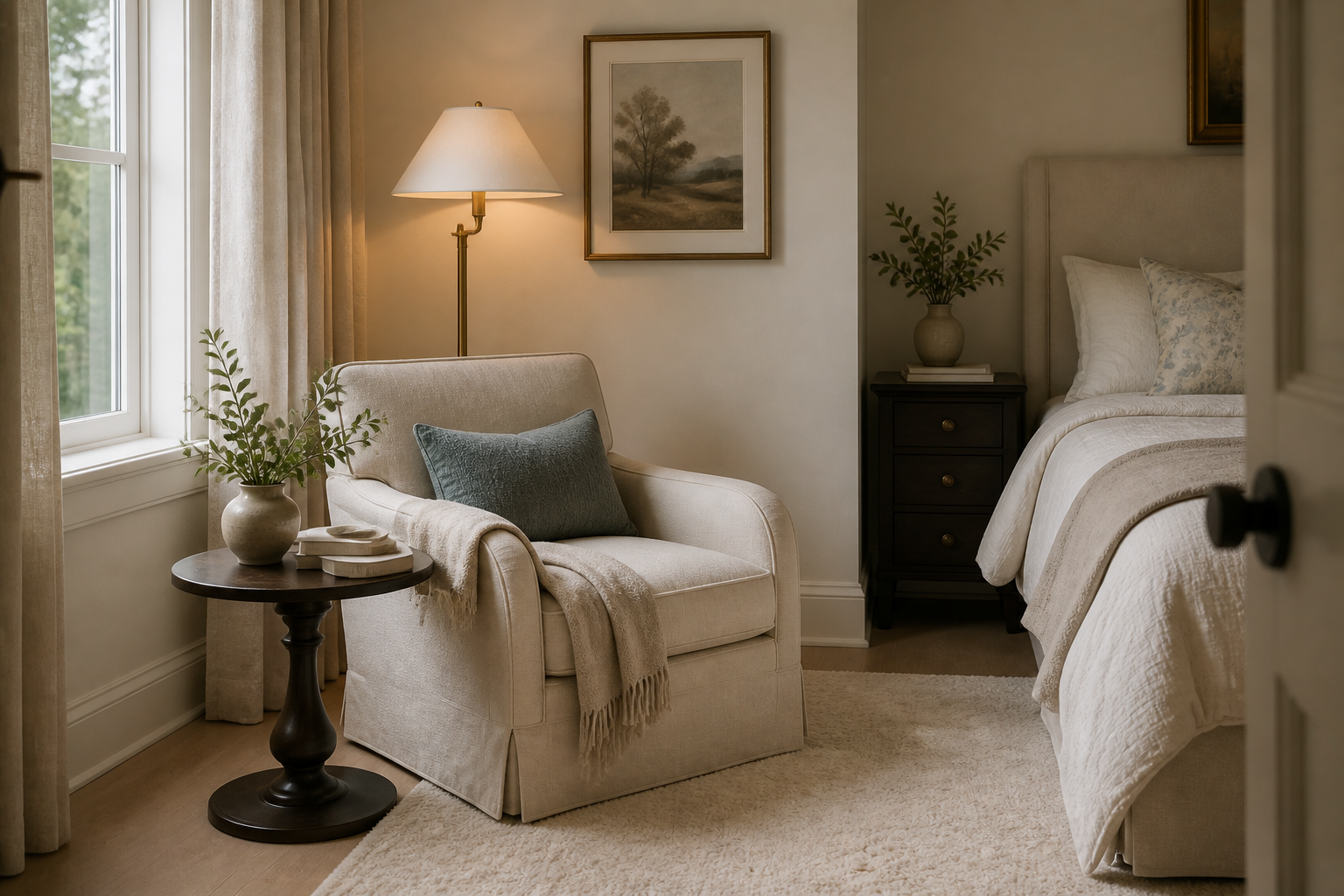

This reading corner works because it occupies the light between window and bed without becoming an extension of either one. A generous upholstered armchair turns slightly toward the room, a tall shaded floor lamp rises behind it, and a small round table sits within easy reach. Together they form a complete activity zone in a footprint that might otherwise have remained an empty bedroom corner.
The chair is deliberately larger than the table but lower than the lamp, creating a clear three-part hierarchy. Pale upholstery and a draped throw connect it to the bedding, while the dark table base and nearby nightstand add enough contrast to separate sitting from sleeping. Nothing has to be labeled; scale and placement make the two uses immediately legible.
The Chair Claims the Corner Without Blocking Light
The armchair sits just inside the window line, leaving the glazed area and pale curtain fully visible behind its left shoulder. Its high back gives support and enclosure, yet the rounded arms keep the silhouette soft. A muted blue cushion and warm throw provide comfort without extending onto the floor path. Angling the seat slightly inward also avoids presenting a rigid side profile from the doorway.
A Floor Lamp Establishes the Reading Function
The slim lamp rises behind the chair and places a pale shade above shoulder height. Its base stays close to the wall, outside the open area in front of the seat. Warm light is visible on the shade and wall, though an exact temperature cannot be inferred. The fixture tells the eye that this is a place for evening use, not merely a decorative chair positioned for daytime photographs.
The Round Table Fits the Remaining Reach Zone
A compact dark pedestal table occupies the gap between window and chair. Its circular top holds a branch vessel, books, and a cup-sized object while remaining smaller than the arm width. The central base minimizes visual clutter at floor level. A square table of similar width would project harder corners into the approach and compete with the rectilinear nightstand beside the bed.
Bed and Reading Area Share a Material Language
Pale linen-looking textiles, timber tones, muted artwork, and leafy branches repeat across both zones. The bed remains visible at the right with a dark nightstand and softly layered pillows, but it does not absorb the chair into its composition. The shared palette gives continuity; the distinct furniture group preserves function. This same principle appears in the quiet luxury reading nook chair study, where one substantial seat organizes a compact retreat.
Window and Rug Define the Available Footprint
The floor covering reaches beneath the chair and toward the bed, visually joining the room while leaving the window-side edge readable. The chair's front feet remain well within the textured field, and a clear strip in front permits approach. Full-height curtains fall behind rather than beside the seat, so their folds do not interfere with the table or chair arms.
Small Art Keeps the Corner Residential
One framed botanical image hangs above the chair at a modest scale, with another work partly visible near the bed. The pieces do not form a gallery or compete with the window. Their subdued fields fill just enough wall to make the corner feel inhabited. The branch vessels repeat that natural reference in three dimensions without introducing a separate, brighter accent color.
Comfort Depends on Separation, Not Excess Space
The arrangement demonstrates that a reading corner does not require a bay window or built-in shelves. It needs a seat with a clear approach, a local light, and a reachable surface that do not obstruct bedroom circulation. Preserve the gap between chair and bed, test the lamp position from the cushion, and keep table styling minimal. Those practical moves allow the corner to function every day rather than reading as staged leftover space.
The bedside chest remains partly visible behind the chair, marking the boundary where the sleeping zone begins. Its dark rectangular mass contrasts with the round table and soft chair, so the overlap does not make the corner ambiguous. The floor lamp rises in the narrow wall strip between both functions and serves as the vertical hinge of the arrangement. This careful layering allows the room to gain an extra use without relocating the bed or filling the window bay with permanent joinery.