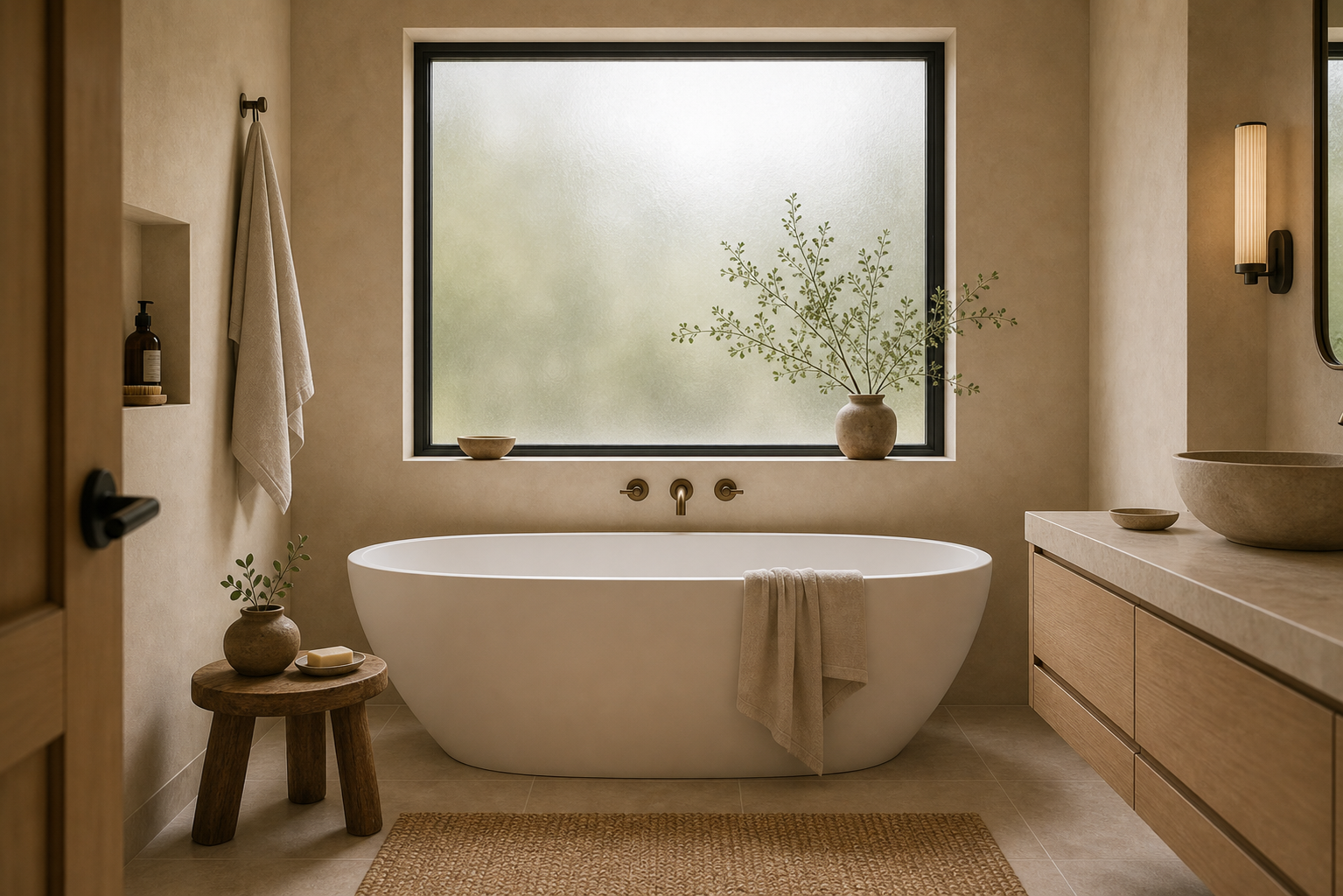

The freestanding tub is positioned as a calm object against a large diffused window rather than surrounded by decorative tile or shelving. Its oval white body sits on a pale floor with generous visible space around the ends, while a wall-mounted filler keeps the foreground clear. Warm plaster, a small timber-toned stool, and narrow vanity edges at both sides provide enough texture to prevent the minimalist composition from feeling clinical.
The Tub Occupies the Window Axis
The oval tub is the first element the eye reads because it sits alone below the window. That separation is important. A freestanding tub needs space around it so its shape can be understood as a sculptural object.
The tub is centered beneath the main glass panel but remains clearly detached from the wall. This visible perimeter allows its curved silhouette to register completely and makes the window feel like an intentional backdrop rather than an accidental opening behind it.
The large frosted window brings daylight into the room without exposing the bathing area. Its soft light wraps the tub and plaster walls, which makes the minimalist palette feel warm instead of stark.
The glazing admits broad light while obscuring a detailed exterior view. That softness suits the limited palette and eliminates the need for a curtain treatment that would add folds or strong vertical edges around the bath.
An Oval Profile Softens the Rectangular Opening
The beige plaster walls add quiet texture around the tub. That surface keeps the room from feeling flat while still preserving the clean, edited look that warm minimalism needs.
Wall-Mounted Plumbing Preserves the Floor
The wall-mounted filler gives the tub a functional point without adding a floor-mounted fixture. That keeps the space around the bathtub cleaner and lets the oval form stay uninterrupted.
Spout and controls emerge from the wall near one tub end, leaving no floor-mounted fitting in the open approach. The arrangement also prevents plumbing from interrupting the central white body when seen from the doorway.
The Stool Adds One Warm Low Accent
The small wood stool adds warmth and a practical landing spot beside the tub. Its scale is important. It is useful, but low enough that the bathtub and window remain the main composition.
Pale Flooring Maintains Visual Continuity
The pale tiled floor gives the room a calm base and reflects daylight softly. Because the floor is quiet, the tub does not have to compete with pattern, color or strong grout lines.
Side Sconces Mark the Wider Room
Start by choosing a tub shape that can stand alone without decorative support. Then place it near diffused light, use one simple filler and keep nearby objects limited to a stool, towel and vessel.
Keeping a Freestanding Tub Visually Uncrowded
I would not add a busy accent wall behind the tub. The plaster and window already create enough atmosphere. I would also avoid oversized bath accessories. The room works because each object has space around it.
The floating joinery in this minimalist bathroom vanity study achieves openness below storage. Here, the same visual priority is applied to bathing: floor, tub perimeter, and window remain largely uninterrupted.
The vanity volumes enter only at the far left and right edges of the image, making the bath feel centered within a wider room rather than isolated in a tight alcove. Their straight fronts contrast with the oval tub but stay below its rim line. The composition is balanced without being perfectly mirrored, because the stool and towel occupy different sides while the window and tub retain the central axis.
A small timber-toned stool sits near one end of the tub and carries only a folded item, giving the otherwise pale composition a warm point at hand height. It does not cover the filler or interrupt the entry side. This is an effective use of contrast in a minimalist bathroom: one compact object can humanize the bath zone without demanding shelving, baskets, or decorative floor layers not shown in the image. A narrow towel bar and folded towel remain at the left wall, while a small branch vessel sits at the opposite vanity edge. These restrained side elements indicate everyday use without entering the central tub silhouette. Their asymmetry also prevents the warm minimalist setting from feeling staged around perfect mirrored accessories.