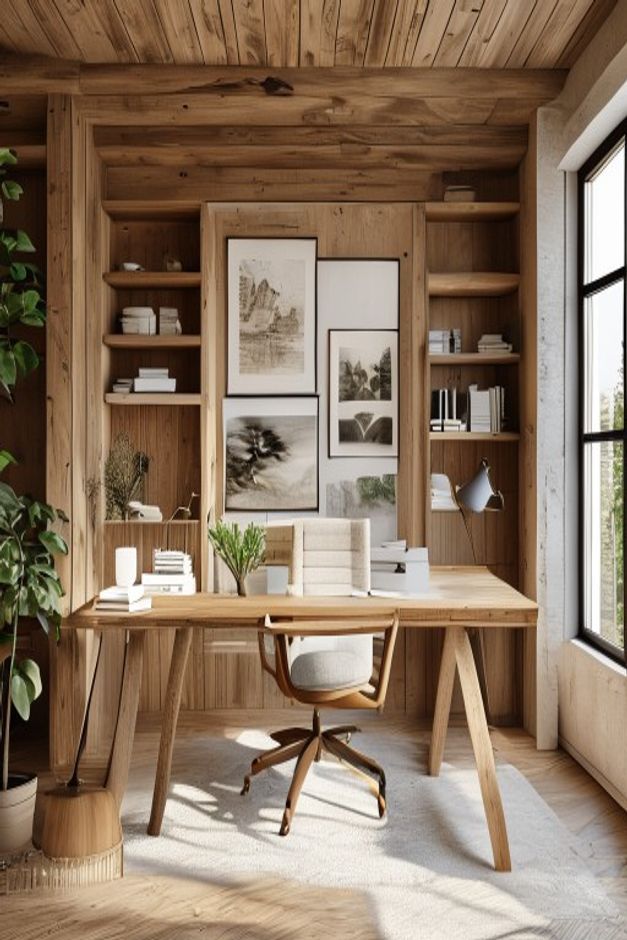
The artwork behind the desk is the detail that prevents this timber-lined office from becoming a study in wood alone. Several framed images overlap within a recessed central panel, creating a vertical gallery wall between two open shelving bays. The long desk then crosses the composition horizontally, giving the art a clear base and the workspace a defined center.
Rustic and modern qualities are held in productive tension. Boards with visible tonal variation cover the wall and ceiling, while the desk, shelving, and large black-framed window use crisp, simple lines. The room feels warm without looking nostalgic because ornament has been replaced by material continuity and disciplined alignment.
The Gallery Wall Is Contained Inside the Joinery
Frames of several sizes are arranged within a broad central recess rather than spread across the entire wall. Their lower edges begin above the desk, and the tallest piece draws attention toward the ceiling. The overlap creates depth, but the surrounding timber border keeps the collage from appearing loose or accidental.
Most images are monochrome or muted, which is important against a richly figured background. Strong color in every frame would fight the wood grain and books. The pale mats also introduce small areas of visual rest, connecting the gallery to the light chair and rug below.
A Long Desk Establishes the Working Horizon
The wood-toned desk stretches between the shelving bays and projects on angled legs toward the foreground. Its generous width supports a screen, task lamp, books, and a plant while retaining clear surface around them. Because the top is relatively thin, the desk remains visually lighter than the wall enclosure behind it.
The chair is centered on the screen and gallery rather than on the room as a whole. That alignment creates a focused work position while leaving more open floor near the window side. A second chair would disrupt this direct relationship and turn the desk into a meeting table, which the image does not suggest.
The trestle-like leg arrangement leaves the underside largely open and gives the chair room to rotate. Sunlight can travel beneath the top, which helps the substantial desk avoid becoming a visual barrier across the room. The clean under-desk zone is particularly important because the surrounding wall already carries abundant shelves and artwork.
Side Shelves Balance Storage Without Perfect Symmetry
Open shelves flank the art, but their contents and widths differ. The left side holds pale objects and books; the right carries books, a small task light, and more open space. Similar timber backing unifies them, while the variation makes the office look used rather than built around a rigid display formula.
The integrated shelving strategies in this published mid-century modern home office with built-ins are more regular. Here, the irregular gallery and rustic boards justify a looser arrangement around the desk.
Window Light Cuts Across the Timber Interior
A tall black-framed window occupies the right wall and directs strong sunlight over the desk, chair, and rug. The dark frame provides a sharp counterpoint to the warm boards, helping the room feel contemporary. Light also reveals the changing grain and knots, so the wall remains tactile rather than uniformly brown.
The desk is perpendicular to the glazing instead of facing it directly. That position allows daylight to arrive from the side and keeps the outdoor view available without placing the screen squarely against the brightest opening. The photograph does not show glare conditions on the display, but the lateral relationship is visibly more controlled than a front-facing placement would be.
A Pale Rug and Chair Clear the Visual Foreground
The upholstered swivel chair and light rug create a soft central patch beneath the desk. Their pale tones separate the working position from the wood floor, walls, and furniture. Slim chair arms and legs preserve sightlines through to the desk supports, preventing the lower half of the room from becoming a dense collection of timber shapes.
A leafy plant at the far left breaks the rectilinear enclosure and balances the bright window. It remains peripheral, allowing the gallery wall to retain its role as the main visual story. The office succeeds by assigning each layer a job: wood forms the envelope, art establishes identity, the desk provides function, and daylight keeps the whole composition visually breathable.