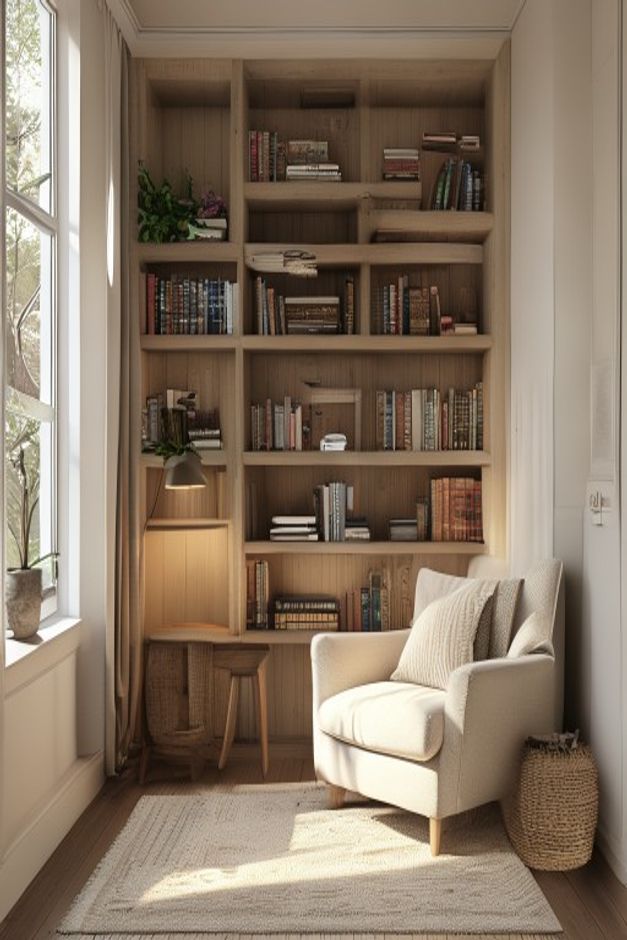
The smallest fixture provides the most instructive idea in this reading nook. A compact wall lamp is mounted within a low bookcase niche, placing light over a tiny wood table without using any floor area. That decision leaves enough room for a generously cushioned armchair while preserving the narrow approach from the foreground.
A full-height bookcase fills the rear wall and gives the corner its cottage-library character. The window on the left supplies strong daylight, pale upholstery keeps the sitting zone bright, and a woven basket occupies the only remaining floor edge. Each element has a clear territory, which is why the nook feels settled rather than crowded.
The Wall Lamp Creates a Task Zone Inside the Shelves
The lamp projects from the left side of the bookcase just above seated hand height. Its downward shade concentrates light on the small table and nearby books instead of washing the entire wall. This location makes the fixture useful after dark and prevents a standing lamp base from competing with the chair legs or basket.
A shallow open niche surrounds the lamp, giving the light a calm patch of wood-toned backing. The niche is deliberately less populated than the shelves above. Books or tall ornaments placed directly around the shade would interrupt its beam and make the low working area look incidental rather than planned.
The Bookcase Establishes a Strong Rear Boundary
Vertical uprights divide the built-in into three principal columns, while shelf heights change to accommodate upright books, horizontal stacks, and a few plants. The variation keeps the wall from becoming a repetitive grid. Its warm tone also forms a middle value between the bright window trim and the darker floorboards.
Books remain the dominant shelf contents, which is appropriate for a working reading corner. Small gaps reveal the backing and allow daylight to cast shadows between groups. Filling every shelf edge would make the wall heavier and reduce the distinction between the chair, lamp niche, and stored collection.
The Armchair Fits the Remaining Width Precisely
The pale armchair sits against the right wall with its front edge angled slightly toward the window. Its high back supports reading, yet the narrow arms and raised wood legs keep the lower half visually open. The chair does not overlap the lamp table, and a slim gap remains beside the woven basket.
The chair's front legs remain on the rug while its back sits close to the plain right wall. That placement gives the sitter support from the enclosed side and a diagonal view toward the window. Pulling the chair farther forward would narrow the approach and separate it from the lamp niche that makes the arrangement useful.
Window Light and Local Light Work in Sequence
Sunlight enters from the tall left window and travels across the rug and seat. The wall lamp does not attempt to compete with that daytime brightness; it takes over the smaller area beside the chair when natural light fades. This division is more credible than relying on one decorative ceiling fixture for every condition.
A broader shelving-and-chair arrangement appears in our published cottage reading nook with wood shelving. Here, the integrated wall lamp is the useful distinction because it makes a much tighter floor plan workable.
A Small Rug Defines the Seat Without Closing the Bay
The pale rectangular rug begins beneath the chair and extends into the foreground, creating a soft landing while leaving dark wood visible around its edges. That exposed border clarifies the nook's width. A larger rug pushed beneath the window and bookcase would blur the boundary between fitted architecture and movable furniture.
The rug also stops before the bookcase base, leaving a slim strip of dark floor as a visual joint. That exposed line distinguishes soft movable furnishings from fitted storage. It is a small detail, yet it prevents the pale textile from appearing wedged beneath every object in the corner.
Low Accessories Keep the Sightline Clear
A woven basket stands beside the chair, and one planter sits on the window ledge. Both remain below arm height, allowing the bookcase and outdoor view to stay open. Their rounded profiles soften the repeated shelf rectangles without becoming separate focal points.
The transferable lesson is to allocate the floor to comfort and move secondary functions onto the wall. One chair, one very small surface, and one low basket are enough because the bookcase carries storage and the lamp carries evening use. That economy gives the narrow nook a convincing daily purpose.